What's inside
- Best affordable MIG welders by situation
- What separates a bargain from a false economy?
- Voltage options and real material capacity
- Hobart Handler 140 versus Lincoln Handy MIG 140
- When a low-cost flux-core welder is enough
- A cost-per-use calculation that changes the decision
- Durability, repairability, and maintenance
- Final buying recommendation
- Best affordable MIG welders by situation
- What separates a bargain from a false economy?
- Voltage options and real material capacity
- Hobart Handler 140 versus Lincoln Handy MIG 140
- When a low-cost flux-core welder is enough
- A cost-per-use calculation that changes the decision
- Durability, repairability, and maintenance
- Final buying recommendation
As an Amazon Associate I earn from qualifying purchases. This post may contain affiliate links at no extra cost to you.
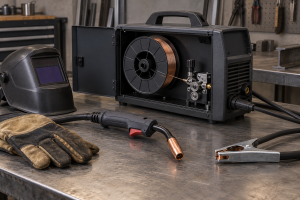
The best affordable MIG welder for most home users is a 140-amp, 120-volt machine with a real spool-gun or gas-shielded MIG option, adjustable wire speed, and support for both solid and flux-cored wire—not simply the cheapest flux-core box.
For occasional repairs, brackets, garden equipment, and light automotive work, a good budget welder should run .030-inch solid wire with C25 gas, accept .035-inch flux-cored wire, and provide roughly 90 to 120 amps at a usable duty cycle. That combination gives better control and cleaner welds than flux core alone while keeping operating costs manageable.
As an Amazon Associate we earn from qualifying purchases at no extra cost to you.


What we cover
- Best affordable MIG welders by situation
- What separates a bargain from a false economy?
- Voltage options and real material capacity
- Hobart Handler 140 versus Lincoln Handy MIG 140
- When a low-cost flux-core welder is enough
- A cost-per-use calculation that changes the decision
- Durability, repairability, and maintenance
- Final buying recommendation
Best affordable MIG welders by situation
| Best for | Recommended type or model | Why it represents good value | Main limitation |
|---|---|---|---|
| First-time home user | Hobart Handler 140 | Simple controls, established support, solid-wire MIG and flux-core capability | 120-volt only; limited thick-steel capacity |
| Lowest-cost occasional repairs | Forney Easy Weld 140 FC-i | Compact, lightweight, and inexpensive to operate for basic flux-core work | Flux-core focused; less versatile than a gas-capable MIG machine |
| Portable farm or outdoor work | Lincoln Electric Handy MIG 140 | 120-volt convenience with a familiar MIG/flux-core format | Not a substitute for a 240-volt machine on heavy material |
| More capability per dollar | Budget dual-voltage inverter MIG | 120/240-volt input, often spool-gun support, and higher peak output | Quality, documentation, and replacement-parts support vary by brand |
| Aluminum and mixed projects | Entry-level multi-process welder with spool-gun provision | Can handle steel, stainless, and aluminum with the correct accessories | Costs more and requires additional setup and consumables |
What separates a bargain from a false economy?
A low purchase price can be misleading if the welder includes only a short torch, a poor-quality ground clamp, no regulator, and no usable wire. Compare the complete starting package rather than the front-panel amperage.
Included accessories
For gas-shielded MIG, you need a regulator and hose, a work clamp, a gun liner, contact tips, and a means of securing the gas cylinder. Some machines include a regulator; others include only a flux-core starter setup. A useful package should include at least one spare .030-inch contact tip and a spool adapter for standard 4- or 8-inch wire.
Budget for a welding helmet, gloves, jacket, wire brush, chipping hammer, and ventilation separately. These are safety equipment, not optional accessories. A machine that costs $100 less but requires another $150 in missing essentials may not be the better affordable MIG welder.
Wire compatibility
For general home fabrication, compatibility matters more than a headline amp number. .030-inch ER70S-6 solid wire is a practical choice for mild steel with C25 shielding gas. .035-inch solid wire can be useful at higher output, while .030- or .035-inch self-shielded flux-core wire is preferable outdoors, where wind can disturb gas shielding.
- Solid MIG wire: cleaner welds, less smoke, and easier visibility indoors.
- Flux-cored wire: better wind tolerance and penetration, but more spatter and slag.
- Stainless wire: requires the appropriate gas blend and liner setup.
- Aluminum wire: normally needs a spool gun or a carefully configured push-pull system; a standard long gun often causes feeding problems.
Check the manual for supported spool diameters. Some compact welders accept only 4-inch spools, while others accommodate 8-inch spools. The latter usually cost less per pound and are more practical for repeated work.
Voltage options and real material capacity
A 120-volt welder is convenient because it can run from a normal household circuit, but it is commonly limited to thin and medium-gauge steel. A 140-amp machine can often weld 1/8-inch steel in a single pass when properly prepared, but 1/4-inch material generally requires beveling, multiple passes, and careful heat management. It is not equivalent to a 200-amp 240-volt machine.
Dual-voltage welders are worth considering if you have a suitable 240-volt circuit. On 120 volts, they retain portability; on 240 volts, they can deliver more stable arc performance and longer duty cycles. However, do not assume that “200 amps” means continuous 200-amp welding. Inexpensive inverter machines may reach their maximum output only briefly.
| Machine class | Typical input | Useful steel range | Typical duty-cycle pattern | Approximate machine weight |
|---|---|---|---|---|
| Compact flux-core unit | 120 V | 20 gauge to 1/8 inch | About 20% at 90–100 A | 15–25 lb |
| 140-amp transformer MIG | 120 V | 20 gauge to 3/16 inch with preparation | About 20% at 90–100 A | 55–65 lb |
| 140-amp inverter MIG | 120 V | 20 gauge to 1/8–3/16 inch | About 20% at maximum output | 20–35 lb |
| 180–210-amp dual-voltage inverter | 120/240 V | 20 gauge to 1/4 inch in multiple passes | About 25–30% at high output | 25–40 lb |
These are realistic working ranges, not guarantees. Joint design, cleanliness, wire type, ambient temperature, extension-cord size, and operator technique all affect penetration. For structural, trailer, lifting, or safety-critical work, use a qualified welding professional and follow the applicable welding procedure rather than relying on a consumer machine’s advertised capacity.
Hobart Handler 140 versus Lincoln Handy MIG 140
The Hobart Handler 140 and Lincoln Electric Handy MIG 140 occupy the familiar 120-volt home-welder category. Both are more suitable for a garage workshop than for continuous production. Their advantages are recognizable brands, conventional controls, replaceable consumables, and easier access to manuals and service information than many anonymous imports.
The Hobart is commonly selected by buyers who want a straightforward machine for mild-steel repairs and occasional fabrication. The Lincoln follows the same basic use case and is attractive when its included gun, clamp, or starter accessories are better matched to the project. Neither should be purchased for frequent 1/4-inch fabrication, high-volume work, or regular aluminum welding.
When comparing them, inspect the package for a regulator, gas hose, spool size, spare tips, and the length of the work lead. The better deal can change depending on whether you plan to use gas immediately or flux core outdoors.
When a low-cost flux-core welder is enough
A flux-core-only machine such as the Forney Easy Weld 140 FC-i can be a sensible choice for simple outdoor repairs, decorative steel, and occasional tack welding. It avoids the cost of a cylinder, regulator, and gas refills, and the self-shielded wire is less vulnerable to light wind.
Its trade-off is ownership mess. Flux-core welding produces smoke, spatter, and slag that must be removed between passes. Thin sheet metal is also easier to overheat, particularly when the machine has coarse voltage settings. Choose this format when portability and low initial cost matter more than clean appearance and maximum versatility.
A cost-per-use calculation that changes the decision
Suppose a gas-capable welder costs $450, while a flux-core-only unit costs $250. Adding a basic helmet, gloves, wire brush, and initial wire might bring the totals to roughly $600 and $350. If you use the machine only three times a year for three years, the purchase cost alone is approximately $67 per use for the gas-capable machine versus $39 per use for the flux-core unit.
But if you make 30 projects over three years, those figures fall to about $20 and $12 per use. The gas-capable machine may then repay its higher cost through cleaner welds, fewer failed joints, and lower-cost solid wire. Frequency of use is therefore as important as the advertised amperage.
Durability, repairability, and maintenance
The parts that usually wear first are contact tips, the gun liner, drive rolls, the ground clamp, and the torch trigger. These are normal consumables. A machine becomes expensive to own when proprietary parts are unavailable or when the liner and drive-roll sizes are difficult to identify.
- Keep wire covered and dry; rusty wire creates feeding resistance and porous welds.
- Clean dust from the ventilation openings with dry, low-pressure air while the machine is unplugged.
- Replace a worn contact tip rather than forcing wire through it.
- Keep the drive-roll tension only tight enough to feed consistently; excessive tension can deform wire.
- Use the shortest practical extension cord, with conductors sized for the welder’s input current.
- Allow the fan to cool the machine when the duty-cycle indicator or thermal light activates.
Transformer machines are heavier but often feel durable and may be easier for a local repair shop to understand. Inverter machines are lighter and more efficient, but their circuit boards can be less economical to repair after a major failure. For either type, a published parts list, clear manual, standard Tweco-style consumables, and responsive manufacturer support are valuable signs of long-term ownership value.
Final buying recommendation
Choose a 120-volt gas-capable 140-amp MIG welder if you want the safest all-around home purchase for mild steel. Choose a compact flux-core unit only when outdoor portability and the lowest entry price dominate. If you weld every month, work on thicker material, or expect to add aluminum projects, spend more on a dual-voltage inverter with a spool-gun option. The strongest budget value is the machine whose wire compatibility, accessories, duty cycle, and replaceable parts match your actual work—not the one with the largest number printed on its case.