What's inside
- Can You TIG Weld Aluminum With DC? Limits and Better Options
- Why aluminum oxide makes DC TIG difficult
- When DC TIG aluminum may be workable
- AC TIG vs. DC TIG for aluminum
- Choose a process by the job
- What to look for when buying an aluminum TIG machine
- Preparation still matters with AC
- Bottom line
- Related Guides
- Can You TIG Weld Aluminum With DC? Limits and Better Options
- Why aluminum oxide makes DC TIG difficult
- When DC TIG aluminum may be workable
- AC TIG vs. DC TIG for aluminum
- Choose a process by the job
- What to look for when buying an aluminum TIG machine
- Preparation still matters with AC
- Bottom line
- Related Guides
As an Amazon Associate I earn from qualifying purchases. This post may contain affiliate links at no extra cost to you.
What we cover
- Can You TIG Weld Aluminum With DC? Limits and Better Options
- Why aluminum oxide makes DC TIG difficult
- When DC TIG aluminum may be workable
- AC TIG vs. DC TIG for aluminum
- Choose a process by the job
- What to look for when buying an aluminum TIG machine
- Preparation still matters with AC
- Bottom line
- Related Guides
Can You TIG Weld Aluminum With DC? Limits and Better Options
Yes, you can TIG weld some aluminum with DC, but it is a narrow-use technique—not the right default for most repairs or fabrication. DC TIG can work on very thin, clean aluminum with suitable equipment and technique. For general-purpose aluminum welding, AC TIG is the better choice because its electrode-positive portion helps break up the oxide layer that otherwise blocks a sound weld.
Why aluminum oxide makes DC TIG difficult
Aluminum quickly forms a thin aluminum-oxide coating in air. The base metal melts at about 660°C (1,220°F), while the oxide melts at roughly 2,050°C (3,720°F). That difference matters: the aluminum can melt underneath an oxide skin that remains solid. The result may look like a puddle is forming while the oxide contaminates or prevents proper fusion.
As an Amazon Associate we earn from qualifying purchases at no extra cost to you.

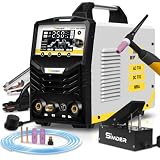

With AC TIG, the current alternates between electrode-negative (EN) and electrode-positive (EP). EN provides most of the heat that melts the workpiece; EP supplies a cleaning action at the surface. DC TIG does not alternate polarity, so it lacks that built-in AC cleaning action. DC electrode-negative can produce a concentrated arc and is useful for some specialized aluminum techniques, but it demands exceptionally clean material and leaves little room for surface contamination.
When DC TIG aluminum may be workable
- Very thin sheet or foil: Some skilled welders use DCEN with helium or an argon-helium mix to limit heat input and obtain a narrow, controllable weld. This is specialized work, not a reliable shortcut for ordinary shop projects.
- Small, clean parts: A controlled setup may work on material with freshly prepared surfaces and no paint, oil, anodizing, or heavy oxide. Cleanliness is essential, but it does not give DC the cleaning action of AC.
- Specialized applications: Certain procedures use DC polarity and specific shielding-gas or torch arrangements. Follow a qualified welding procedure for structural, pressure-containing, or safety-critical parts rather than experimenting.
There is no universal thickness cutoff: alloy, joint fit-up, heat sinking, shielding gas, machine capability, and operator skill all affect the result. If a project needs repeatable, full-fusion aluminum welds, choose AC TIG or another suitable process instead of relying on DC.
AC TIG vs. DC TIG for aluminum
| Consideration | DC TIG, usually DCEN | AC TIG |
|---|---|---|
| Polarity behavior | One polarity throughout the weld | Alternates EN and EP |
| Oxide cleaning action | No alternating-polarity cleaning | EP portion helps clean the surface |
| Typical shielding gas | Helium or an argon-helium mix may be used in specialized procedures | Argon is a common starting gas |
| Best fit | Specialized, thin, very clean work with a qualified setup | General aluminum fabrication and repair |
| Setup difficulty | High; gas, polarity, preparation, and technique are less forgiving | More practical for routine aluminum work |
These are process-level comparisons, not guaranteed settings. Amperage, AC balance, frequency, tungsten choice, and gas flow depend on the machine, material, joint, and torch. Use the machine manufacturer’s guidance and a procedure suited to the job.
Choose a process by the job
| Your situation | Practical choice | Why |
|---|---|---|
| Occasional aluminum repair; beginner or limited experience | AC TIG machine with adjustable balance, or a qualified welding shop | AC provides cleaning action and is the conventional TIG option for aluminum. |
| Frequent aluminum work and control over appearance matters | AC TIG with appropriate capacity and AC controls | Offers precise heat control and access to AC cleaning adjustment. |
| Longer aluminum seams or higher production | MIG equipment configured for aluminum, with suitable wire-feed hardware | Often faster than TIG, though thinner material and setup still require care. |
| Very thin, specialized work and a qualified procedure is available | DC TIG only when the procedure specifies it | Can be viable in narrow conditions, but is not a general replacement for AC. |
| One-off, safety-critical, or difficult-to-access repair | Have a qualified welder assess the joint and process | Process suitability and inspection matter more than forcing a particular machine to work. |
What to look for when buying an aluminum TIG machine
If you are deciding whether to buy a welder for aluminum, prioritize AC TIG capability rather than a high DC amperage rating alone. Check the machine’s rated output and duty cycle at the amperage you expect to use, its input-power requirements, and whether it offers adjustable AC balance. A machine may advertise TIG capability while providing DC TIG only; that does not make it a general-purpose aluminum TIG machine.
There is no single amperage number that determines suitability. A thin sheet and a thick casting have different heat demands, and torch rating, joint design, and available electrical supply also matter. Compare the complete setup—including torch, consumables, gas cylinder, regulator, and any required input-power upgrade—rather than the welder alone.
Preparation still matters with AC
AC helps manage oxide during welding, but it does not remove the need for clean material. Remove oil and coatings using a suitable cleaning method, then use a stainless-steel brush reserved for aluminum. Keep filler and work surfaces clean, and avoid brushing with tools that have been used on steel. For DC TIG, preparation is even less forgiving: surface contamination can quickly undermine the weld.
Also plan for heat buildup. Aluminum conducts heat rapidly, so a joint may need more initial heat than expected and then become easier to overheat as the workpiece warms. Practice on offcuts of the same alloy and thickness, and inspect the result for incomplete fusion, porosity, and cracking before applying the technique to a real part.
Bottom line
If you are asking “can you DC TIG weld aluminum,” the useful answer is: sometimes, under specialized conditions, but usually not for ordinary aluminum work. For most buyers choosing TIG for aluminum, AC TIG is the practical option because its alternating polarity provides cleaning action. DC TIG is best treated as a specialized process with a defined procedure—not a way to make a DC-only welder perform like an AC TIG machine.