What's inside
- Best welding machine covers by storage situation
- What makes a cover suitable for a welder?
- Head-to-head: loose universal cover versus fitted cover
- Controls, vents, and heat clearance
- Water resistance without trapped moisture
- Decision matrix: which cover should you buy?
- Ownership details that affect service life
- Do accessories need their own covers?
- Bottom line
- Best welding machine covers by storage situation
- What makes a cover suitable for a welder?
- Head-to-head: loose universal cover versus fitted cover
- Controls, vents, and heat clearance
- Water resistance without trapped moisture
- Decision matrix: which cover should you buy?
- Ownership details that affect service life
- Do accessories need their own covers?
- Bottom line
As an Amazon Associate I earn from qualifying purchases. This post may contain affiliate links at no extra cost to you.
The best welding machine covers are breathable, heat-resistant enough for a fully cooled welder, and sized to leave room around vents and controls; for most workshops, a 600-denier polyester cover with a 2–4 in clearance around the machine is the most balanced choice.
As an Amazon Associate we earn from qualifying purchases at no extra cost to you.


What we cover
- Best welding machine covers by storage situation
- What makes a cover suitable for a welder?
- Head-to-head: loose universal cover versus fitted cover
- Controls, vents, and heat clearance
- Water resistance without trapped moisture
- Decision matrix: which cover should you buy?
- Ownership details that affect service life
- Do accessories need their own covers?
- Bottom line
Best welding machine covers by storage situation
| Situation | Recommended cover specification | Typical dimensions | Why it fits |
|---|---|---|---|
| Indoor, low-dust workshop | 300–420D polyester, water-resistant coating, drawcord | 24 × 18 × 12 in | Lightweight and easy to remove frequently |
| Busy shop with grinding dust | 600D polyester, taped seams, side vents or loose lower hem | 30 × 22 × 16 in | Better abrasion and dust resistance without sealing in condensation |
| Welding cart with cylinder and leads | 600D or 900D polyester, split-back or extended cart design | 36 × 24 × 18 in | Covers the welder while allowing hoses and cables to remain organized |
| Covered outdoor storage | 600D–900D solution-dyed polyester, UV-resistant coating, vents | 32 × 24 × 18 in | Handles sun and occasional wind-driven rain better than thin fabric |
| Temporary protection after welding | Heat-resistant welding blanket or leather cover, not a standard machine cover | 24 × 24 in or larger | Provides a safer barrier from sparks while the equipment cools |
What makes a cover suitable for a welder?
A welding machine cover has two jobs: keep abrasive dust and moisture away from the equipment, and avoid creating a damp, unventilated enclosure. Those goals can conflict. A cover with a completely waterproof coating may stop rain but trap humidity against steel panels, electrical connectors, and cooling vents.
Look for water resistance rather than an airtight rain shell unless the machine is stored in a genuinely exposed location. A polyurethane- or PVC-coated polyester cover can repel splashes and light rain, but it should still have a loose lower edge, mesh vents, or enough open space for air exchange. If the cover feels like a sealed plastic bag, it is a poor choice for long-term storage.
Fabric thickness and durability
- 300D–420D polyester: Suitable for indoor dust, occasional handling, and frequent removal. It is less bulky but can wear through on sharp cart corners.
- 600D polyester: The best general-purpose grade for most workshops. It resists abrasion from handles, shelves, and cart frames while remaining flexible.
- 900D or heavier polyester: Useful for outdoor or industrial storage, particularly where wind, UV exposure, or repeated dragging is likely. It costs more and may be unnecessarily stiff indoors.
- Canvas: Breathable and durable, but usually less water-resistant unless treated. It can absorb moisture and become heavy when wet.
- Vinyl-coated fabric: Highly water-resistant and easy to wipe clean, but it offers less breathability. Use it with ventilation and avoid covering a damp machine.
Stitching often matters more than a small difference in denier. Reinforced corners, double-stitched seams, and a smooth hem are valuable because the lower edges receive the most abrasion. A drawcord or adjustable buckle also prevents wind from turning the cover into a sail.
Head-to-head: loose universal cover versus fitted cover
Universal cover
A universal cover is usually the better value when the welder may be replaced, moved between carts, or fitted with different cable arrangements. Its generous cut is also safer around cooling vents because it is less likely to press against the case. The disadvantage is that excess fabric can catch on handles, drag through oily floors, or allow dust to enter from underneath.
Fitted cover
A fitted cover looks tidier and generally provides better dust protection. It is a good choice for an inverter welder that stays on one shelf or cart. However, a very tight fit can block fan openings, press against control knobs, or make it difficult to inspect the machine before use. Choose a fitted design with at least 2 inches of clearance at each side and 3–4 inches above the highest handle or cable connection.
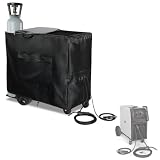
For a welding cart cover, measure the entire loaded footprint rather than the power source alone. Include the rear cylinder, regulator, cable loops, side shelves, and top handle. If a cart measures 30 inches high, 20 inches wide, and 14 inches deep, a practical cover is approximately 34 × 24 × 18 inches. That adds 2 inches to each side and 4 inches to the height, allowing the cover to fall over the cart without pulling at its seams.
Controls, vents, and heat clearance
Protection should not make the welder awkward or unsafe to operate. Covers with zippered front panels or roll-up control flaps provide access to amperage displays, polarity switches, wire-feed controls, and power switches without requiring complete removal. This is useful for short jobs, but do not operate a welder with fabric covering its cooling intake or exhaust.
Allow the machine to cool completely before fitting a fabric cover. As a conservative workshop rule, wait until the case is comfortable to touch and no fan is running; for a heavily used transformer machine, that may take 30–60 minutes. A cover is not a heat shield. Sparks, hot spatter, and recently welded metal can melt polyester or ignite accumulated dust.
Never use a standard polyester welding machine cover while welding. If the machine must be protected during nearby hot work, use a properly rated welding blanket positioned so it cannot block ventilation, and remove it before powering up the welder.
Water resistance without trapped moisture
Outdoor storage creates the hardest choice. A cover can keep direct rain off the machine but cannot make an ordinary welder weatherproof. Store the equipment beneath a roof whenever possible, raise it off concrete, and orient the cover so water sheds away from the control panel and cable connectors.
For a covered outdoor area, choose UV-resistant fabric, sealed or bound seams, and vents located on opposite sides to encourage airflow. Do not cinch the bottom tightly against a damp floor. Leave a small air gap and use a raised platform or cart wheels so condensation can escape.
A simple moisture check prevents many failures: remove the cover every week or two, inspect the underside and the welder’s fan grille, and wipe away any condensation. If the cover or machine is damp, dry both before storage. Silica-gel containers can help inside a cabinet, but they are not a substitute for ventilation.
Decision matrix: which cover should you buy?
| Your priority | Choose | Avoid |
|---|---|---|
| Lowest reasonable cost | 300D–420D universal polyester with drawcord | Ultra-thin plastic that touches the case |
| Frequent daily use | 600D cover with handles, roll-up flap, and reinforced seams | A tight fitted cover that must be removed completely each time |
| Small workshop | Fitted cover with measured vent and control clearance | Oversized fabric that catches on shelves and leads |
| Occasional outdoor storage | 600D–900D UV-resistant polyester with vents | Uncoated cotton or an airtight vinyl shell |
| Welder on a loaded cart | Extended welding cart cover sized around the cylinder and shelves | A power-source cover that leaves the cylinder exposed to weather |
Ownership details that affect service life
The first areas to wear are usually the bottom corners, drawcord channel, and seams around handles. A cover lasts longer when the machine is clean before covering. Grinding dust mixed with condensation forms an abrasive paste, so brush or vacuum the welder and cart regularly. Do not store the cover on a hot surface or fold it while wet.
Wash fabric according to its care label, normally with mild soap and water rather than solvents or bleach. Let it dry fully before reuse. Inspect for pinholes, delamination, and frayed stitching at the start of each season. Small seam damage can sometimes be repaired with outdoor-fabric tape, but extensive peeling of a waterproof coating means replacement is more reliable.
Do accessories need their own covers?
A welding lens cover is worthwhile because helmets collect fine grinding dust and spatter in storage. Use a soft, breathable helmet bag or padded lens case rather than placing the helmet under the machine cover, where sharp tools or cables can scratch the lens. Keep replacement lenses in a clean, rigid sleeve.
Likewise, cable ends should not be left in a puddle beneath a covered cart. Coil leads loosely, keep connectors off the floor, and leave enough space that the cover does not pull against them. The best cover protects the welder as part of a dry storage system—not as a replacement for one.
Bottom line
For most buyers, select a 600D polyester cover with reinforced seams, adjustable fastening, and ventilation; measure the machine or complete cart first, then add at least 2 inches of side clearance and 3–4 inches above the highest point. Choose a lighter 300D–420D cover for clean indoor storage, and move to UV-resistant 900D fabric only when outdoor exposure and abrasion justify the extra bulk. Keep the cover off until the welder is cool and dry, and prioritize airflow over a perfectly sealed fit.