What's inside
- Best Low-Price Plasma Cutters That Still Cut Cleanly
- Quick comparison of affordable plasma cutters
- Best choices by workshop situation
- Head-to-head: inexpensive 50-amp cutters
- Air supply is the hidden buying decision
- What consumables really cost
- How to get a clean cut from a low-price plasma cutter
- Durability and ownership warnings
- Final recommendation
- Related Guides
- Best Low-Price Plasma Cutters That Still Cut Cleanly
- Quick comparison of affordable plasma cutters
- Best choices by workshop situation
- Head-to-head: inexpensive 50-amp cutters
- Air supply is the hidden buying decision
- What consumables really cost
- How to get a clean cut from a low-price plasma cutter
- Durability and ownership warnings
- Final recommendation
- Related Guides
As an Amazon Associate I earn from qualifying purchases. This post may contain affiliate links at no extra cost to you.
What we cover
- Best Low-Price Plasma Cutters That Still Cut Cleanly
- Quick comparison of affordable plasma cutters
- Best choices by workshop situation
- Head-to-head: inexpensive 50-amp cutters
- Air supply is the hidden buying decision
- What consumables really cost
- How to get a clean cut from a low-price plasma cutter
- Durability and ownership warnings
- Final recommendation
- Related Guides
Best Low-Price Plasma Cutters That Still Cut Cleanly
The best low price plasma cutter for most home workshops is a 50-amp, inverter-based machine with a built-in air filter, a 60% duty cycle, and a recommended clean-cut capacity of at least 1/2 inch mild steel—not simply the model with the highest advertised amperage.
Affordable plasma cutters can produce clean, useful cuts, but their real performance depends on four things that product listings often blur: the thickness they can cut without slowing down, the quality and dryness of the compressed air, how long they can run before overheating, and the cost of replacing torches, electrodes, nozzles, and swirl rings.
As an Amazon Associate we earn from qualifying purchases at no extra cost to you.


Quick comparison of affordable plasma cutters
The following figures are practical buying ranges and commonly published specifications for these product families. Exact specifications can vary by revision, voltage, torch package, and seller, so confirm the manual before ordering.
| Product or type | Output | Recommended clean cut | Maximum separation cut | Duty cycle | Weight | Air requirement | Typical market range |
|---|---|---|---|---|---|---|---|
| YESWELDER CUT-55DS | 10–55 A | 3/8–1/2 in | 3/4–1 in | 60% at rated output | About 16 lb | 60–70 PSI, roughly 4.5 CFM | $220–$330 |
| LOTOS CUT50 | 10–50 A | 3/8–1/2 in | About 3/4 in | Commonly listed near 60% | About 27 lb | 65 PSI, roughly 4.5–6 CFM | $300–$450 |
| PrimeWeld CUT50 | 10–50 A | 3/8–1/2 in | About 3/4 in | Commonly listed near 60% | About 23 lb | 55–70 PSI, roughly 4.5 CFM | $300–$450 |
| Hypertherm Powermax30 XP | 15–30 A | 1/4 in | About 5/8 in | 35% at rated output | About 21 lb | About 5.2 CFM at 90 PSI | $1,500–$2,000 |
| Generic CUT-50 inverter | 10–50 A indicated | 1/4–3/8 in in typical use | 1/2–3/4 in | Often unspecified | 15–25 lb | 60–70 PSI, 4–6 CFM | $180–$280 |
“Clean cut” means the machine can cut through the material at a useful travel speed with manageable dross. “Maximum cut” usually means the torch can separate the material slowly, with more bevel and slag. For repeatable fabrication, buy according to the clean-cut figure rather than the maximum number.
Best choices by workshop situation
| Your situation | Best fit | Why | Main compromise |
|---|---|---|---|
| Lowest sensible entry cost | Generic CUT-50 with verified ratings | Low purchase price and enough power for sheet steel and occasional brackets | Inconsistent documentation and uncertain spare-part availability |
| First plasma cutter for occasional home use | YESWELDER CUT-55DS | Light, dual-voltage versions are convenient, and replacement consumables are widely available | Air quality and torch consumable fit matter greatly |
| Heavier garage use | LOTOS CUT50 or PrimeWeld CUT50 | Established product families, conventional 50-amp capacity, and better support than anonymous units | They are less compact than the smallest inverter cutters |
| Frequent fabrication and long ownership | Hypertherm Powermax30 XP | More predictable arc behavior, durable torch design, and strong consumable support | Far more expensive and not a high-output machine |
| Limited storage or mobile repair work | 15–30 lb inverter machine with a 20–30 ft torch | Easy to carry and quick to set up at a vehicle or outside table | Long extension cords and small compressors can reduce performance |
Head-to-head: inexpensive 50-amp cutters
YESWELDER CUT-55DS
This is a practical low cost plasma cutter when portability and price matter more than industrial duty. Its 55-amp rating is suitable for cutting mild-steel sheet, angle iron, exhaust components, and plate around 1/4 to 3/8 inch with a comfortable margin. At the upper end, it may separate thicker plate, but speed and edge quality decline.
Look for the dual-voltage version if your workspace has both 120- and 240-volt circuits. On 120 volts, the machine may have reduced output or a lower duty cycle. The advantage is convenience; the disadvantage is that a household circuit can trip when the cutter is run near its limit.
LOTOS CUT50
The LOTOS CUT50 remains a recognizable choice in the affordable category. It is a reasonable option for a garage that cuts regularly but does not need a production machine. Its practical strength is the familiar 50-amp format: standard torch parts are easier to locate than obscure proprietary parts, and the machine has enough capacity for many 1/4-inch and 3/8-inch jobs.
It is heavier than the smallest generic units, but that extra size is not necessarily a disadvantage. A slightly larger case can be easier to service and less awkward when cables are attached. Check whether the package includes a regulator, water separator, and the torch style you want before comparing prices.
PrimeWeld CUT50
The PrimeWeld CUT50 occupies a similar position. It suits owners who want a budget machine from a brand with a clearer support channel than an unbranded import. As with other 50-amp cutters, its results depend more on air delivery and consumable condition than the final five amps on the label.
Choose it when you expect to use the cutter several times a month and want a conventional machine rather than the absolute cheapest possible purchase. For occasional thin sheet, a smaller 30-amp cutter can be easier on the electrical circuit and less costly to operate.
Air supply is the hidden buying decision
A plasma cutter does not consume air like a pneumatic impact wrench for a few seconds; it needs a steady flow while the arc is operating. A machine calling for about 4.5 CFM at 60–70 PSI should be paired with a compressor that can deliver at least 5–6 CFM at its rated pressure. A compressor advertised at 5 CFM at zero pressure may not meet that requirement.
For regular cutting, a 20–30 gallon compressor is a more comfortable match than a small pancake compressor. The smaller tank may still work for short cuts, but the pressure can fall during a long profile, causing a weak arc, excessive dross, and premature consumable wear.
Use a water separator and drain the tank before cutting. Moisture is one of the fastest ways to damage electrodes and nozzles. Keep the air hose as short as practical, avoid restrictive fittings, and set pressure while air is flowing rather than while the torch is idle.
What consumables really cost
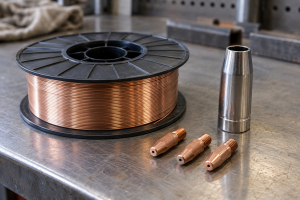
The consumables that wear first are normally the nozzle and electrode. A damaged shield cap, swirl ring, or retaining cap may also need replacement after a tip-up, collision, or prolonged contact with the workpiece. For inexpensive 50-amp cutters, a basic replacement set often costs about $15–$35, while branded systems can cost more but may last longer and produce more consistent cuts.
Consider a simple ownership calculation. Suppose a machine costs $280, a consumable set costs $25, and one set produces approximately 20 hours of clean cutting under ordinary shop conditions. If you cut for two hours per month, consumables add about $2.50 per month, before electricity and compressed-air costs. If poor air or incorrect amperage reduces life to 8 hours, that same cost rises to about $6.25 per month. Cheap consumables can therefore become expensive when moisture or excessive torch drag is involved.
How to get a clean cut from a low-price plasma cutter
- Prepare the metal. Remove heavy rust, paint, scale, and oil where the torch will start. A dirty surface makes arc transfer less reliable.
- Set the air correctly. Use the pressure range in the manual with the torch air flowing. Too little pressure produces a lazy arc; too much can widen the cut and destabilize it.
- Match amperage to thickness. Use only enough current to maintain a stable cut. Excessive amperage enlarges the kerf and can shorten nozzle life.
- Keep the torch square. A tilted torch creates a beveled edge. For a straight cut, rest the shield lightly on the plate or use a guide while maintaining the manufacturer’s recommended standoff.
- Maintain steady travel speed. If sparks spray upward or the arc struggles to stay behind the torch, move more slowly or increase current. If the bottom edge carries heavy dross, check speed, air, and consumables before simply increasing power.
- Inspect after cooling. Replace an electrode with a deep center pit or a nozzle with an enlarged, oval, or damaged opening. Continuing with worn parts makes every cut worse.
Durability and ownership warnings
The weak points in low-price plasma cutters are usually not the inverter electronics alone. Fan and vent blockage, moisture, loose ground clamps, fragile torch leads, and unavailable replacement parts can end a machine’s useful life early. Keep the cutter off the floor, provide ventilation, and blow dust from the intake only according to the manufacturer’s service guidance.
Before buying an unusually cheap unit, confirm three details: the input voltage and plug type, the actual air-flow requirement, and whether a complete torch-consumable kit is available. A machine that saves $80 at purchase but requires an entire replacement torch for a worn nozzle is not a low-cost tool over time.
Final recommendation
For most occasional users, a supported 50- or 55-amp inverter cutter such as the YESWELDER CUT-55DS, LOTOS CUT50, or PrimeWeld CUT50 offers the best balance of price, portability, and 3/8-inch-class cutting. Choose a generic CUT-50 only when the seller provides clear electrical ratings and readily available consumables. If you cut frequently, need predictable edge quality, or cannot tolerate downtime, spending more on the Hypertherm Powermax30 XP is easier to justify than repeatedly replacing bargain machines.