What's inside
As an Amazon Associate I earn from qualifying purchases. This post may contain affiliate links at no extra cost to you.
The best flux-cored welder for most workshop repairs is a 140-amp 120V machine like the Hobart Handler 140 — it runs on household power, handles up to 1/4-inch steel in a single pass, and tolerates rusted material far better than MIG-only units. But the right pick depends on your input power, the thickness you weld most, and whether the machine ever leaves the garage.
As an Amazon Associate we earn from qualifying purchases at no extra cost to you.


What we cover
Why Flux-Cored Beats Solid-Wire MIG for Outdoor Repairs
Flux-cored arc welding (FCAW) generates its own shielding gas from the wire’s flux core, so wind doesn’t blow your shielding away — the reason it’s the standard for fence posts, trailer frames, gates, and farm equipment. It also burns hotter and digs through light rust, mill scale, and paint contamination that would cause solid-wire MIG to spit and fail. The trade-offs are more spatter, slag to chip off, and rougher-looking beads.
For workshop repairs, the practical rule: anything under 1/8 inch, MIG with gas is cleaner. Anything outdoors, rusty, or structural (trailer hitches, mower decks, exhaust brackets), flux-core is the right tool.
Comparison: Five Machines That Cover Every Budget
| Welder | Input | Output Range | Duty Cycle (peak) | Max Wire Size | Weight | Typical Price Range |
|---|---|---|---|---|---|---|
| Hobart Handler 140 | 120V | 25–140A | 20% @ 90A | 0.035 in | 57 lb | $550–$700 |
| Lincoln Electric Power MIG 140MP | 120V | 20–140A | 30% @ 90A | 0.035 in | 50 lb | $650–$800 |
| Miller Multimatic 215 | 120/240V | 20–230A | 20% @ 130A | 0.035 in | 38 lb | $1,500–$1,800 |
| YesWelder Flux-135 | 110V | 30–135A | 35% @ 110A | 0.035 in | 11 lb | $150–$200 |
| Forney Easy Weld 261 | 120V | 20–140A | 30% @ 90A | 0.030 in | 19 lb | $200–$300 |
Note the pattern: transformer-based machines (Hobart, Lincoln) are heavier but famously durable. Inverter units (YesWelder, Forney) sacrifice some longevity for huge weight savings and often a better duty cycle on paper.
How to Read the Specs That Actually Matter
Duty cycle beats max amperage
Duty cycle means minutes of welding per 10-minute period at a given amperage. A “140-amp” machine rated 20% at 90A gives you two minutes of bead per ten minutes at the settings you’ll use on 3/16-inch steel — enough for repairs, but frame fabrication will stall you. The YesWelder’s 35% at 110A is unusually generous for the price.
Wire size determines penetration
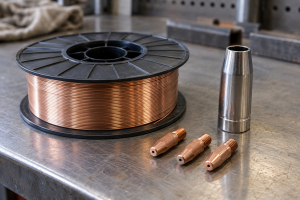
0.030-inch wire suits sheet metal and tubing; 0.035-inch E71T-GS wire is the repair-shop standard for 1/8 to 1/4 inch steel. Machines that only feed 0.030-inch (like the Forney 261 with the supplied spool, though it accepts 0.035) limit you on thick work. Buy E71T-GS gasless wire for single-pass repairs, or E71T-11 for multi-pass strength.
Portability has a real cost
An 11-pound inverter welder hangs off your shoulder on a ladder. A 57-pound Hobart is a bench machine. But transformers have essentially no electronics to kill — a drop onto concrete that finishes an inverter board won’t faze them.
Which One for Your Situation
| Your situation | Best pick | Why |
|---|---|---|
| Weekend repairs, tight budget, trailer/fence work | Forney Easy Weld 261 | Adequate penetration to 1/4 in, cheap consumables, light |
| Same budget but need it portable for field work | YesWelder Flux-135 | 11 lb, higher duty cycle, dual-voltage variants exist |
| Frequent use, want a machine for 15+ years | Hobart Handler 140 | Transformer reliability, easy parts, resale value |
| Mixed shop work — TIG or stick sometimes too | Miller Multimatic 215 | Multiprocess, 240V headroom, best arc control |
| Welding thin sheet metal plus occasional repairs | Lincoln Power MIG 140MP | 20A low end gives better control on 20-gauge |
Performance on Rusty Steel: What Specs Don’t Tell You
Flux-core tolerates contamination, but “tolerates” isn’t “ignores.” On outdoor steel, expect to grind a shiny spot only where the clamp lands and where your arc starts — grinding the whole joint is wasted time. Use a DCEN (electrode negative) setup if your machine allows polarity switching; most gasless-only budget units are fixed polarity and that’s fine for E71T-GS.
On steel heavier than 3/16 inch, a 120V machine needs beveled joints or multiple passes regardless of brand — the claim “welds 1/4 inch” means one pass with good prep, not clamping two rusty plates and pulling the trigger. If your repair work routinely involves quarter-inch or thicker, step up to a 240V-capable machine like the Multimatic 215 rather than fighting a 120V unit’s limits.
Ownership Realities: What Wears and What Costs You
- Contact tips wear fastest. Keep a 10-pack; a worn tip causes erratic feeding that looks like a machine fault. Cost: under a dollar each.
- Drive rolls and liners are the second failure point. Flux-cored wire is soft — over-tightened rolls flatten it and cause bird-nesting at the feeder.
- Wire cost math: a 10-lb spool of E71T-GS runs roughly $35–$55 in 2026. A typical weekend repair (a trailer bracket, a gate hinge) consumes maybe half a pound — under $3 per job. The consumable cost is negligible; your time grinding isn’t.
- Slag cleanup is mandatory. Flux-core leaves a slag coat that traps moisture — paint over it and the joint rusts within a season. Budget a chipping hammer and wire wheel with the purchase.
- Common mistake: dragging the gun like MIG. Flux-core wants a drag angle too (15–20 degrees), but beginners push it and get porous welds with slag inclusions that fail under load.
FAQ
Can a 110V flux-cored welder repair a trailer frame?
Yes, up to roughly 3/16 inch in a single pass with 0.035 wire and proper prep — but for a trailer frame, bevel the joint, weld multiple passes, and have the finished weld inspected if it’s load-bearing.
Is flux-cored welding strong enough for structural work?
E71T-11 wire produces welds exceeding 70,000 psi tensile strength. The limiting factor is usually the operator’s technique and joint prep, not the process.
Gasless vs gas-shielded flux-core — what’s the difference?
Gasless (self-shielded) is what these machines run — windproof, portable, more spatter. Gas-shielded flux-core needs a cylinder and is a different wire (E70T-1) aimed at heavy industrial welding.