What's inside
As an Amazon Associate I earn from qualifying purchases. This post may contain affiliate links at no extra cost to you.
What we cover
Quick Answer: Which Diesel Welding Machine for Remote Work?
The best diesel welding machine for most remote job sites in 2026 is a 400–500 amp diesel engine drive in the Miller Big Blue Pro or Lincoln Vantage class: it delivers enough amperage for 3/16-inch stick rods and flux-cored wire, runs a full shift on one tank, and doubles as a 10–20 kW generator for grinders, lights, and tools. If you mostly run 1/8-inch rods and need portability, a smaller 250–300 amp machine is cheaper to buy and burn. Below, we break down the criteria that actually matter in the field and match machines to situations.
What to Evaluate Before You Buy
Spec sheets list dozens of numbers, but only a handful determine whether a diesel powered welding machine earns its place on a remote site.
As an Amazon Associate we earn from qualifying purchases at no extra cost to you.



- Amperage output and duty cycle: 300+ amps at 100% duty cycle handles 3/16-inch 7018 rod all day. Below that, you’ll hit thermal limits in hot weather.
- Fuel consumption: Diesel sips roughly 0.6–1.0 gallons per hour at welding load versus 1.2–1.8 for comparable gas machines — a real cost gap over a season.
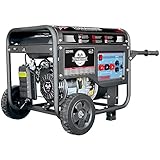
- Generator capacity: 10–12 kW continuous covers most tool loads; 20+ kW lets you run a second welder or an air compressor.
- Runtime: Look for 10+ hours at rated load. Fuel access is the whole reason you’re buying diesel.
- Noise: Quieter machines (under 70 dB at 23 feet) matter on residential-adjacent sites and long shifts.
- Cold starting: Glow plugs or intake heaters plus a block heater option matter below 20°F. Perkins, Kubota, and Deutz engines used in these machines are proven cold starters.
- Field-service durability: Simple analog or minimal-electronics controls survive dust, vibration, and glove-handed abuse better than touchscreens. Check parts availability for the engine brand in your region.
Head-to-Head Comparison
These are the diesel welding machines contractors actually deploy in 2026, with the specs that drive the decision.
| Model | Max Output (Stick) | Generator (Continuous) | Fuel Tank | Runtime @ Load | Noise @ 23 ft | Engine |
|---|---|---|---|---|---|---|
| Miller Big Blue 400 Pro | 400A, 100% duty | 12 kW | ~25 gal | ~14 hrs | ~72 dB | Kubota diesel |
| Lincoln Vantage 400 | 400A, 100% duty | 11.5 kW | ~25 gal | ~12 hrs | ~70 dB | Perkins diesel |
| Miller Big Blue 500 Pro | 500A, 100% duty | 20 kW | ~25 gal | ~10 hrs | ~74 dB | Kubota diesel |
| Lincoln Vantage 580 | 580A, 100% duty | 19 kW | ~25 gal | ~9 hrs | ~73 dB | Perkins diesel |
| Miller Big Blue 600 Duo | 2 × 300A arcs | 27 kW | ~50 gal | ~12 hrs | ~76 dB | Deutz diesel |
Note: figures are approximate published ranges — verify current spec sheets, as sub-trims differ. Market pricing runs roughly $15,000–$25,000 for 400-amp class machines and $25,000–$40,000 for 500+ amp and dual-operator units, new. Well-maintained used units trade at 40–60% of new price.
Miller Big Blue vs. Lincoln Vantage
This is the real head-to-head on most pipelines and fab yards. A Lincoln diesel welding machine like the Vantage 400 uses a Perkins engine with famously simple mechanics and a smooth DC arc that pipeline welders favor for downhill 6010 work. The Lincoln welding machines diesel lineup also offers strong multi-process capability (stick, TIG, MIG, gouging) with chopper-style arc control. The Miller Big Blue counters with Kubota power, slightly better fuel economy, and excellent generator headroom — the 500 Pro’s 20 kW auxiliary output is a genuine advantage when the machine doubles as site power. Both are proven; the choice usually comes down to dealer support in your region and arc preference for your rod mix.
Picks by Situation
| Your Situation | Recommended Class | Example | Why |
|---|---|---|---|
| Solo welder, 1/8–5/32″ rods, tight budget | Used 300–400A diesel | Used Vantage 300/400 | Half the fuel cost of gas units, proven engines, cheap parts |
| Structural/pipeline crew, all-day 3/16″ rods | 400A diesel, 100% duty | Big Blue 400 Pro or Vantage 400 | No duty-cycle pauses, full-shift runtime |
| Welding plus heavy site power needs | 500A+ diesel | Big Blue 500 Pro | 20 kW runs compressors, pumps, a second machine |
| Two welders, one machine | Dual-operator diesel | Big Blue 600 Duo | Two independent arcs, one engine, one fuel bill |
| Truck-mounted service rig, weight-sensitive | Compact 250–300A diesel | Smaller Kubota-powered units | ~1,000 lb less than a 500-amp machine; fits half-ton trucks |
Worked Example: Fuel Cost Per Season
Say you weld 6 loaded hours per day, 200 days per year (1,200 loaded hours). A 400-amp diesel averages about 0.8 gal/hr at welding load — roughly 960 gallons. A comparable gas engine drive averages 1.5 gal/hr — about 1,800 gallons. At $4/gal diesel and $3.70/gal gas, that’s about $3,840 versus $6,660 — roughly $2,800 saved per year. On a machine you’ll keep 8–10 years, diesel’s higher purchase price pays back in under two seasons of heavy use. For under 300 loaded hours a year, the math flips and a gas engine drive is the cheaper ownership path.
Cold-Weather Starting Checklist
- Switch to winter-blend diesel or add anti-gel additive below 10°F — #2 diesel gels around 15–20°F untreated.
- Run a 50W or 30W winter-grade engine oil per the engine manual.
- Test glow plugs every fall; one dead plug makes a Perkins crank forever at 5°F.
- Keep the battery on a maintainer overnight; cold cranking amps drop fast below freezing.
- Order the factory block heater option if you work regularly below 0°F — it’s a cheap install that prevents most no-starts.
Ownership Realities: What Wears First
Diesel engine drives are durable but not maintenance-free. Expect fuel filters every 250–500 hours and oil changes every 250–300 hours — remote dust shortens both intervals. Slip rings and brushes on the generator end wear around 2,000–4,000 hours depending on auxiliary power use; check them annually. Receptacles and weld terminals corrode and loosen — a $5 dielectric grease habit prevents most “generator is dead” service calls. Common mistakes: running at high idle with no load (wet-stacking fouls injectors), letting the tank sit half-full in humid climates (water condenses, algae grows), and ignoring the hour meter for service intervals. Budget roughly $400–$800/year in consumables and fluids for heavy use — far less than one emergency call-out for a dead machine.
FAQ
Is a diesel welding machine worth it over gas?
Yes, if you weld more than ~300 loaded hours per year or need 400+ amps. Diesel wins on fuel cost, engine lifespan (often 10,000+ hours versus 3,000–5,000 for gas), and torque at low RPM. Gas units cost less upfront and suit lighter duty.
Can I run a diesel welder indoors or in enclosed spaces?
No — diesel exhaust is dangerous in enclosed areas. Position the machine outside or upwind with leads run in, and never run it in a confined space.
What size generator output do I actually need?
Add up your simultaneous tool loads: a 9-inch grinder draws ~2,000W starting, lights ~500W each, a small compressor 3,000W+. Most crews are covered by 10–12 kW; go 20 kW if you’ll run a compressor and power tools together.
Lincoln welding machine diesel or Miller — which for pipeline work?
A Lincoln welding machine diesel (Vantage series) is the traditional pick for downhill pipeline welding due to its DC arc characteristics on 6010 rod. Miller Big Blue machines are equally capable for structural and general fabrication, often with better auxiliary power. Match to your dealer network and rod preference.