What's inside
As an Amazon Associate I earn from qualifying purchases. This post may contain affiliate links at no extra cost to you.
The best Miller gas welder for most buyers is the Bobcat 200 for portability and light field work, and the Trailblazer 325 or Big Blue 400 Pro for heavy-duty repairs — the right pick depends almost entirely on how much amperage you need at the electrode and whether you’re hauling the machine on a truck bed or mounting it permanently. Below is a breakdown of Miller’s gas powered welders by engine size, amperage, fuel use, noise, and real-world ownership factors, so you can match the machine to the work rather than overspending on a spec sheet.
As an Amazon Associate we earn from qualifying purchases at no extra cost to you.

What we cover
What a Miller Gas Welder Actually Is
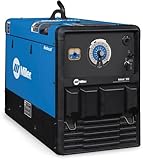
A Miller gas powered welder is an engine-driven welder/generator — typically a gasoline engine (Kohler, Kubota, or Miller’s own badged engines) turning a generator that produces welding current and auxiliary AC power. Miller’s lineup splits into two tiers: the portable “Bobcat” and “Trailblazer” series for pickup trucks and job sites, and the “Big Blue” diesel and gasoline-driven machines for pipeline, structural, and fabrication yards. This article focuses on gasoline models, which dominate field repair work on farms, ranches, and construction sites.
Miller Gas Welder Comparison Table
| Model | Engine | Weld Output (DC) | Duty Cycle at Max | Auxiliary Power | Weight | Fuel Tank |
|---|---|---|---|---|---|---|
| Bobcat 200 | Kohler 23 HP gas | 40–200 A stick / MIG-capable | 100% @ 200 A | 6,500 W peak / 5,500 W continuous | ~245 lb | 12 gal |
| Bobcat 250 | Kohler ~25 HP gas | 40–250 A | 100% @ 250 A | 11,000 W peak / 10,000 W continuous | ~500 lb | 12 gal |
| Trailblazer 325 | Kohler ~26 HP EFI gas | 20–325 A | 100% @ 300 A | 12,000 W peak / 10,500 W continuous | ~600 lb | 12 gal |
| Big Blue 400 Pro (gas) | Kubota gas engine | Up to 400 A | 100% @ 300+ A | 12,000 W | ~1,150 lb | 25 gal |
| Big Blue 500 Pro | Kubota diesel (comparison) | Up to 500 A | 100% @ 450 A | 20,000 W | ~1,500 lb | 25 gal |
Prices for these machines run roughly $3,500–$5,000 for a Bobcat 200, $6,000–$9,000 for the Bobcat 250 and Trailblazer series, and $14,000–$25,000+ for Big Blue models, depending on configuration and dealer.
Picking by Situation: Decision Matrix
| Your Situation | Best Fit | Why |
|---|---|---|
| Farm/ranch gate repairs, occasional 1/8″ rod work, need to move it yourself | Bobcat 200 | 245 lb is truly portable; runs 7018 up to 5/32″; enough generator power for an angle grinder |
| Mobile welding business, truck-mounted, mixed stick and MIG work | Bobcat 250 or Trailblazer 325 | 250+ A covers 3/16″ 7018 all day; Trailblazer’s EFI engine handles cold starts better |
| Structural steel, pipe fencing, carbon arc gouging | Big Blue 400 Pro | Gouging needs 300+ A sustained; 25-gal tank runs a full shift |
| Daily commercial use, lowest fuel cost per hour, fleet work | Big Blue 500 Pro (diesel) | Diesel burns roughly 20–30% less fuel at load and the engine life is 2–3× a gas engine |
| Also powering tools, compressor, or lights on site | Trailblazer 325 | Highest continuous auxiliary wattage in the portable class; can weld and run tools simultaneously |
Amperage: Match Rod Size, Not Machine Marketing
A useful rule for stick welding: multiply rod diameter in thousandths by 1 amp per thousandth. A 1/8″ (0.125″) 7018 rod wants roughly 125 A; a 5/32″ rod wants ~160 A; a 3/16″ rod needs ~190–200 A. That means the Bobcat 200 already handles 90% of field repair work. You only step up to 250–400 A machines if you’re gouging, running large-diameter rods all day, or welding with multiple operators off one machine (Big Blue models support two arcs on some configurations).
Fuel Consumption and Runtime
Miller gas powered welders burn fuel mostly based on load. Realistic consumption figures:
- Bobcat 200: ~0.6–0.9 gal/hr at welding load; a 12-gallon tank gives roughly 12–18 hours of mixed work — often two full days.
- Bobcat 250 / Trailblazer 325: ~1.0–1.4 gal/hr under heavy welding; idle draws drop to ~0.4 gal/hr with auto-idle engaged. Expect 8–12 hours per tank.
- Big Blue 400 Pro: ~1.5–2.0 gal/hr gas (less on diesel); the 25-gal tank still runs a long shift.
Worked example: if you’re bidding mobile work at $2.85/gal and your Trailblazer burns 1.2 gal/hr under load, fuel costs ~$3.40/hour — negligible against a $100+/hr labor rate, but meaningful over 1,000 hours a year (~$3,400). That’s the argument for diesel Big Blue machines on high-hour commercial work.
Noise: A Real Jobsite Factor
The Trailblazer’s EFI engine and better muffling make it noticeably quieter than older Bobcat designs — roughly 65–72 dB at 23 feet under load versus 74–78 dB on carbureted Bobcats, and 80+ dB on older Big Blue machines. If you work in residential areas, near livestock, or communicate with a helper while welding, the Trailblazer’s quieter operation is a legitimate selling point, not a luxury.
Maintenance Access and Ownership Realities
This is where Miller gas welders differ from spec-sheet comparisons:
- Service interval: oil changes every 100 hours on most Kohler engines; air filter checks every 50 hours in dusty conditions — monthly for daily users. The Bobcat and Trailblazer open with a single panel for oil, filter, and spark plug access. Big Blue machines have swing-out panels for radiator and filter service.
- What wears first: brushes and slip rings in the generator (inspect every 500–1,000 hours), battery (expect 3–4 years), fuel filter annually, and carburetor jets on non-EFI engines that sit with ethanol fuel — the single most common no-start complaint on carbureted machines.
- Common mistakes: leaving fuel in a carbureted machine over winter (use stabilizer or drain it), running the engine at idle for hours (glazes cylinder walls — weld or shut it off), and buying 325 A when 200 A covers the work (you pay double the purchase price and ~40% more fuel for capacity you never use).
- Consumables to budget: welding leads, electrode holders, ground clamps, and a cover. Leads are the most replaced item — cheap leads fatigue at the lug within a year of coiling/uncoiling.
FAQ
Can a Miller gas powered welder run MIG, or only stick?
All the models above weld stick and TIG out of the box. MIG requires a wire feeder — Miller’s suitcase-style feeders (like the SuitCase series) connect directly to the weld output. The Bobcat 200 and Trailblazer 325 are popular specifically because they pair cleanly with a suitcase feeder for structural MIG in the field.
How long does a Miller gas welder engine last?
With regular oil changes, Kohler gas engines in Bobcat/Trailblazer machines commonly reach 3,000–5,000 hours before major work. Kubota diesels in Big Blue machines routinely exceed 8,000–10,000 hours. Neglected air filters and stale fuel kill far more engines than hours do.
Is EFI worth paying extra for?
On the Trailblazer, yes for most buyers: fuel injection eliminates carburetor gumming from ethanol fuel, improves cold starts below freezing, and trims fuel consumption roughly 10–20%. If the machine sits unused for weeks between jobs — typical for farm use — EFI pays for itself in avoided carburetor cleanings.
What size generator power do I actually need?
Add the running wattage of everything you’ll run while welding. An angle grinder (~1,500 W), lights (~500 W), and a fan total ~2,500 W, so even the Bobcat 200’s 5,500 W continuous is sufficient. Compressors and large chop saws push you toward the Trailblazer’s 10,500 W.
Bottom line: for occasional portable work the Bobcat 200 is the value pick; for a working truck rig the Trailblazer 325’s EFI, quietness, and generator capacity justify the premium; and for gouging, multi-operator, or high-hour commercial work, step up to a Big Blue and consider diesel.