What's inside
- Best AC/DC TIG Welders of 2026 for Aluminum and Steel
- Quick comparison of the leading choices
- Our picks by situation
- Why AC balance matters more than maximum amperage
- Choosing output for real material thickness
- Duty cycle: convert the specification into shop time
- Setup choices that prevent common aluminum problems
- Ownership realities: what wears out first
- Final buying decision
- Best AC/DC TIG Welders of 2026 for Aluminum and Steel
- Quick comparison of the leading choices
- Our picks by situation
- Why AC balance matters more than maximum amperage
- Choosing output for real material thickness
- Duty cycle: convert the specification into shop time
- Setup choices that prevent common aluminum problems
- Ownership realities: what wears out first
- Final buying decision
As an Amazon Associate I earn from qualifying purchases. This post may contain affiliate links at no extra cost to you.
What we cover
- Best AC/DC TIG Welders of 2026 for Aluminum and Steel
- Quick comparison of the leading choices
- Our picks by situation
- Why AC balance matters more than maximum amperage
- Choosing output for real material thickness
- Duty cycle: convert the specification into shop time
- Setup choices that prevent common aluminum problems
- Ownership realities: what wears out first
- Final buying decision
Best AC/DC TIG Welders of 2026 for Aluminum and Steel
The best AC/DC TIG welder for most serious home and small-shop users is the Everlast PowerTIG 255 EXT, while the Miller Dynasty 210 DX is the better choice when arc control, service support, and portability matter more than purchase price.
An AC/DC TIG machine is useful because it covers both aluminum and steel: AC breaks up aluminum oxide, while DC provides the stable arc normally used for steel, stainless steel, copper, and titanium. The important buying details are not just maximum amperage. AC balance, AC frequency, minimum amperage, cooling capacity, and the duty cycle at a realistic welding current determine whether a machine is pleasant to use or frustrating.
As an Amazon Associate we earn from qualifying purchases at no extra cost to you.


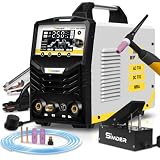
Quick comparison of the leading choices
| Machine | Output range | AC frequency | Manufacturer-rated duty cycle | Approx. weight | Best fit |
|---|---|---|---|---|---|
| Miller Dynasty 210 DX | 5–210 A | 20–400 Hz | 30% at 200 A; 60% at 150 A | About 50 lb | Portable professional work and precise aluminum control |
| Lincoln Electric Aspect 230 AC/DC | 5–230 A | 20–200 Hz | 25% at 230 A; 100% at about 145 A | About 52 lb | Fabrication shops wanting a robust conventional machine |
| Everlast PowerTIG 255 EXT | 5–255 A | 1–250 Hz | Up to 60% at 250 A, depending on input configuration | About 60 lb | High output per dollar and frequent aluminum work |
| PrimeWeld TIG225X | 10–225 A | 10–200 Hz | 60% at 225 A | About 35 lb | Budget-conscious hobbyists and light fabrication |
Duty-cycle figures are manufacturer specifications and can vary with input voltage, ambient temperature, and revision. Treat the amperage and percentage as a comparison guide rather than a promise that every machine will deliver full power indefinitely. A 60% duty cycle means six minutes of arc time in a ten-minute period, followed by four minutes of cooling; it does not mean six minutes of continuous welding without stopping for repositioning, filler, or inspection.
Our picks by situation
- Best overall for a demanding owner: Everlast PowerTIG 255 EXT. Its high output, broad AC-frequency range, pulse controls, and substantial duty-cycle rating make it a capable aluminum and steel machine. It is a strong value where local service access is acceptable and the owner is comfortable learning a dense control panel.
- Best premium portable machine: Miller Dynasty 210 DX. The Dynasty has unusually fine arc-control options, a wide AC-frequency range, and a compact inverter design. Its lower maximum output than a 250-amp class welder is rarely a limitation for sheet, tube, brackets, and most 1/4-inch aluminum work. The price is commonly in the premium professional range.
- Best shop-oriented alternative: Lincoln Electric Aspect 230 AC/DC. This is a sensible choice for a fabrication environment that values Lincoln’s dealer and service network. Its 230-amp output handles a broad range of work, although its top-end duty cycle is less impressive on paper than some competitors.
- Best budget AC/DC TIG welder: PrimeWeld TIG225X. It offers the core controls needed for aluminum, including adjustable AC balance and frequency, without moving into professional-machine pricing. The interface and accessories are less refined than premium alternatives, but it is a practical entry point for occasional welding.
Why AC balance matters more than maximum amperage
Aluminum quickly forms a hard oxide layer that melts at a much higher temperature than the base metal. In AC TIG welding, the electrode-negative portion supplies most of the penetration and electrode-positive portion helps clean the oxide. Increasing electrode-positive time generally increases cleaning action, but it also puts more heat into the tungsten and reduces penetration.
On many modern machines, the balance control is displayed as electrode-negative percentage. A setting around 65–75% EN is a useful starting range for clean aluminum. If the puddle has a dirty gray film, black flecks, or an unstable arc, modestly increase cleaning time. If the tungsten balls excessively, overheats, or the weld lacks penetration, reduce cleaning time. Cleaning cannot compensate for oil, paint, oxidation, or inadequate stainless-steel brushing; preparation still comes first.
AC frequency controls how broad or concentrated the arc feels. Around 80–120 Hz is a versatile starting range. Lower frequency produces a wider, softer arc that can help cover a broad joint. Higher frequency narrows and concentrates the arc, making it useful near edges, on thinner material, or when you need a tighter heat-affected area. Very high settings are not automatically better: they can make the arc feel sharp and increase machine noise.
Choosing output for real material thickness
For aluminum, a practical planning figure is roughly 1 amp per 0.001 inch of thickness, with joint design, preheating, alloy, and heat sinking affecting the result. A 1/8-inch aluminum plate may therefore need approximately 125–160 amps, while a 1/4-inch joint can demand 200–250 amps or more. Steel generally needs less amperage for the same thickness, often near 1 amp per 0.001 inch as a starting estimate but with more flexibility from joint preparation and travel speed.
That makes a 210–225 amp machine sufficient for much home fabrication. Choose a 250-amp class model if you routinely weld thick aluminum, use large heat sinks, need long passes, or want reserve capacity. Maximum output is less useful if the machine has a weak duty cycle at the current you actually use.
Duty cycle: convert the specification into shop time
Suppose a machine is rated at 60% duty cycle at 225 amps. In a ten-minute rating period, that is six minutes of arc-on time. If your actual aluminum project uses 180 amps and the manufacturer lists a longer duty cycle at that load, the machine may run comfortably through a sequence of short beads.
For a realistic example, imagine ten welds that each require 20 seconds of arc time. The total arc-on time is 200 seconds, or 3 minutes 20 seconds. Even a 30% rating at the selected current could cover that ten-minute period, provided the machine is not operating in a hot, poorly ventilated location. However, a continuous six-minute bead at maximum output is a different demand. Use the published duty cycle at the closest amperage—not the headline maximum rating.
Setup choices that prevent common aluminum problems
- Clean the joint mechanically. Degrease first, then use a dedicated stainless-steel brush. Do not use a brush contaminated with steel particles.
- Select AC and start near 100 Hz. Move toward lower frequency for a wider puddle or higher frequency for a tighter arc.
- Begin around 70% electrode negative. Adjust only after observing the puddle and tungsten. More cleaning is not always better.
- Use the correct tungsten and gas flow. A 2% lanthanated tungsten and pure argon are common general-purpose choices. Excessive gas flow can create turbulence and draw air into the shielding envelope.
- Set post-flow long enough to protect the tungsten. A useful starting point is about one second per 10 amps, then adjust for torch size, cup, and electrode diameter.
- Keep the arc short. A long arc broadens heat input and weakens shielding. Hold the torch consistently and add filler at the leading edge of the puddle.
Ownership realities: what wears out first
TIG machines themselves can last for years, but torches and consumables receive the daily abuse. Ceramic cups chip, collets lose tension, gas lenses collect contamination, foot pedals develop cable damage, and torch leads are harmed by sharp bends. Keep spare tungstens, collets, cups, gas lenses, and a compatible torch switch available.
Dust is a larger threat to an inverter than many owners expect. Keep the cooling vents clear, avoid grinding directly beside the machine, and use dry compressed air cautiously only when the manufacturer permits it. Do not seal the vents to reduce dust; restricted airflow can trigger thermal shutdown or shorten component life. A machine with excellent controls is still a poor choice if replacement boards or authorized service are unavailable in your region.
Final buying decision
Choose a premium Miller or Lincoln when uptime, refined arc control, and service support justify the higher general market price. Choose the Everlast PowerTIG 255 EXT when high aluminum output and extensive adjustments are the priority. Choose the PrimeWeld TIG225X when your work is occasional, your budget is limited, and 225 amps is enough.
Before buying any TIG AC/DC welder, confirm the required input circuit, included torch and foot pedal, warranty terms, minimum amperage, AC balance range, AC frequency range, and duty cycle at your intended welding current. Those details predict the ownership experience far better than maximum amperage alone.