What's inside
- Best Welding Jackets for Heat Protection and Comfort
- Choose by the work, not just by the material
- Best jacket choices by situation
- Coverage, closures, and fit: details that change the decision
- Check the fit with a simple coverage test
- Breathability without giving up appropriate protection
- Ownership: what wears first and how to care for it
- Bottom line
- Best Welding Jackets for Heat Protection and Comfort
- Choose by the work, not just by the material
- Best jacket choices by situation
- Coverage, closures, and fit: details that change the decision
- Check the fit with a simple coverage test
- Breathability without giving up appropriate protection
- Ownership: what wears first and how to care for it
- Bottom line
As an Amazon Associate I earn from qualifying purchases. This post may contain affiliate links at no extra cost to you.
What we cover
- Best Welding Jackets for Heat Protection and Comfort
- Choose by the work, not just by the material
- Best jacket choices by situation
- Coverage, closures, and fit: details that change the decision
- Check the fit with a simple coverage test
- Breathability without giving up appropriate protection
- Ownership: what wears first and how to care for it
- Bottom line
Best Welding Jackets for Heat Protection and Comfort
The best welding jacket depends on your process and workspace: choose a heavier leather jacket for frequent overhead or high-spark work, a flame-resistant cotton jacket for lighter welding and better airflow, or a hybrid design if you need leather protection in key areas without full-leather weight.
There is no single jacket that suits every welding task. Compare the material, how far it covers, whether the closures stay shut, and how much heat it traps. A garment labeled flame-resistant is not automatically suitable for every welding hazard; match its specifications to your work and follow your shop’s protective-equipment requirements.
As an Amazon Associate we earn from qualifying purchases at no extra cost to you.


Choose by the work, not just by the material
| Jacket type | Typical material and weight | Best suited to | Main trade-off |
|---|---|---|---|
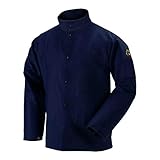
| FR cotton | Flame-resistant cotton; commonly about 7–9 oz/yd² fabric | Light fabrication, short welds, warm shops, and lower-spark work | Cooler to wear, but generally less resistant to sustained sparks and abrasion than leather |
| Leather | Split cowhide or other welding-grade leather; panel thickness and total weight vary by maker | Frequent welding, heavier spatter, and work where sleeves or torso face sparks | Durable protection can mean more heat, weight, and restricted movement |
| Hybrid | FR fabric body with leather sleeves or front panels | Welders who need more protection at exposed areas but want a lighter torso | Protection depends on panel placement; seams and uncovered zones still matter |
| FR cotton with leather sleeves | FR cotton body with leather sleeves, often with a snap or button front | Bench work where arms receive more spatter than the chest | Less suitable if sparks regularly land on the front, shoulders, or back |
These fabric weights are useful comparison points, not a guarantee of protection. Leather thickness, stitching, garment construction, fit, and the welding process all affect performance. Check the manufacturer’s stated materials and intended use rather than treating a weight number as a safety rating.
Best jacket choices by situation
- Hot workshop, light or intermittent welding: Start with a well-fitting FR cotton jacket, especially if it has a collar, long sleeves, and adjustable cuffs. Avoid wearing less coverage simply to stay cool; improve airflow with suitable room ventilation and scheduled breaks instead.
- Regular MIG welding or noticeable spatter: Consider a hybrid jacket with leather sleeves and a leather front, or a full-leather option if sparks reach more than one area. Make sure the garment overlaps your gloves and trousers as you move.
- Overhead work or frequent heavy spatter: Prioritize coverage over lightness. A leather jacket with a high collar and secure cuffs is often more appropriate, but it may need to be paired with additional protective clothing for exposed areas.
- Cool shop or long shifts: A heavier leather jacket may be comfortable over a base layer, provided layering does not make it tight or restrict movement. In a warm shop, that same combination can trap heat; choose a lighter suitable jacket and reassess the task’s protection needs.
- Occasional hobby use: A properly specified FR cotton jacket may be a practical starting point for light work. If your projects change to heavier welding or overhead positions, reassess the garment rather than assuming one jacket covers every task.
Coverage, closures, and fit: details that change the decision
Coverage
Look for a collar that can be raised, sleeves long enough to remain over the glove cuffs, and a body length that stays in place when bending. If sparks commonly land on your chest, a fabric-only front may wear or be damaged sooner than a leather-front design. For overhead work, the shoulders, upper arms, neck, and chest may need more protection than they do at a fixed bench.
Closures
Snaps are convenient to open and close, while hook-and-loop closures are easy to adjust but can collect debris and lose grip as they wear. A zipper may be fast, but check that it is protected by a suitable flap and is not exposed directly to sparks. The key is a closure that stays shut during work and does not leave a gap when you reach, crouch, or turn.
Fit and movement
Try the jacket on with the clothing you expect to wear underneath. Reach forward, raise both arms, and bend as if you were positioning a workpiece. The sleeves should not pull above your gloves, and the shoulders should not bind. A jacket that is too loose can catch on equipment; one that is too tight can restrict movement and make layering impractical. Use the maker’s size chart and measure over your usual work layer, not directly against your body.
Check the fit with a simple coverage test
Before buying, measure your sleeve reach in a working position: wear your intended base layer, bend one arm forward as if holding a torch, and measure from the center back of your neck to your wrist. Compare that measurement with the jacket’s sleeve information where available, then confirm the fit by moving in the garment. This is more useful than relying on chest size alone, because sleeve ride-up can expose the wrist-to-glove area.
Also check the overlap at the waist. Sit or crouch in the jacket and make sure the hem still covers the top of your trousers. If it does not, a longer cut or compatible protective garment may be a better choice.
Breathability without giving up appropriate protection
FR cotton generally allows more airflow than a fully leather jacket, while leather sleeves or panels add protection where exposure is greater. Vent panels can help, but their placement and construction matter: openings should not create a direct path for sparks to reach skin or ordinary clothing. Do not modify a welding jacket by cutting vents or removing panels unless the manufacturer specifically permits it.
For a hot shop, consider the whole clothing system. A breathable base layer that is suitable for the task may help, while bulky layers can increase heat and restrict motion. Keep the work area ventilated and take breaks according to workplace procedures. If the welding position or process changes, reassess the jacket’s coverage rather than relying on a garment chosen for a cooler, lower-spark task.
Ownership: what wears first and how to care for it
Common wear points include cuffs, elbows, shoulders, seams, snaps, and the edges of leather panels. Repeated flexing can split or fray material; spatter can leave hard, damaged spots; and clogged hook-and-loop closures may stop securing the front. Inspect the jacket before use, especially after a snag, burn, or heavy exposure. Replace it if damage creates a hole, weakens a seam, prevents a closure from working, or exposes an area that should be covered.
Follow the care label. FR cotton can lose useful properties if washed with incompatible products or treated with fabric softener, so use the manufacturer’s cleaning instructions rather than assuming ordinary laundry methods are suitable. Leather should be kept dry when possible and cleaned as directed; harsh cleaners or unapproved oils may affect its condition. Let a damp jacket dry fully before storage, away from heat sources that could damage the material.
Store the jacket where it will not collect metal dust, oily residue, or other flammable contamination. Do not keep using clothing that is contaminated with combustible liquids, and do not treat a repaired garment as safe unless the repair method is permitted by its maker.
Bottom line
For warm-shop comfort during lighter work, a correctly specified FR cotton welding jacket is often the practical choice. For frequent spatter, overhead positions, or wider spark exposure, look toward leather or a hybrid with protection over the areas most exposed. Before choosing, verify the garment’s stated use, check coverage and closures, and test the fit with your gloves and work movements. Comfort matters, but it should come from a suitable design and fit—not from leaving exposed gaps.