What's inside
- Siegmund Systems Explained: 16 vs 22 vs 28
- Size and Weight Comparison: What Fits Your Shop
- Plate Thickness and Surface Treatment: What You Are Paying For
- Accessory Reality: What You Actually Need to Use the Grid
- Decision Matrix: Which Siegmund Table to Choose
- Durability and Ownership: What Wears First
- Buying Strategy for 2026
- Siegmund Systems Explained: 16 vs 22 vs 28
- Size and Weight Comparison: What Fits Your Shop
- Plate Thickness and Surface Treatment: What You Are Paying For
- Accessory Reality: What You Actually Need to Use the Grid
- Decision Matrix: Which Siegmund Table to Choose
- Durability and Ownership: What Wears First
- Buying Strategy for 2026
As an Amazon Associate I earn from qualifying purchases. This post may contain affiliate links at no extra cost to you.
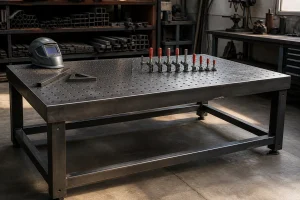
The right siegmund welding table comes down to three interlocked choices: System diameter (16, 22, or 28), table size and plate thickness, and how many accessories you need to make the grid work for your fixtures.
Choose System 16 if you build light to medium fabrication and want the widest accessory range in a compact footprint; choose System 28 if you weld heavy frames, need maximum rigidity, and plan to use large bore clamps and stops; System 22 sits between them and is less common in North America. For table size, match your largest typical weldment plus 300-400mm of clamping border, not your shop wall length. For plate thickness, Professional Extreme 8.7mm plasma-nitrided steel handles daily production abuse, while Professional 12-15mm tool steel is the buy-once option for heavy hammering and straightening.
As an Amazon Associate we earn from qualifying purchases at no extra cost to you.


What we cover
- Siegmund Systems Explained: 16 vs 22 vs 28
- Size and Weight Comparison: What Fits Your Shop
- Plate Thickness and Surface Treatment: What You Are Paying For
- Accessory Reality: What You Actually Need to Use the Grid
- Decision Matrix: Which Siegmund Table to Choose
- Durability and Ownership: What Wears First
- Buying Strategy for 2026
Siegmund Systems Explained: 16 vs 22 vs 28
Siegmund’s “System” number is the bore diameter of the holes in the table plate and side walls. The bore determines which clamps, bolts, stops and accessories fit. They are not cross-compatible without adapters, so your system choice locks you into an ecosystem.
| Feature | System 16 | System 22 | System 28 |
|---|---|---|---|
| Bore Diameter | 16 mm | 22 mm | 28 mm |
| Hole Grid | 50 x 50 mm | 50 x 50 mm | 100 x 100 mm |
| Typical Plate Thickness | 8.7 mm (Professional Extreme) / 12 mm | 12 mm | 15 mm (Professional) / 25 mm (3D ribbed) |
| Side Wall Hole Pattern | Yes, 50mm grid on 4 sides | Yes, 50mm grid on 4 sides | Yes, 100mm grid on 4 sides |
| Clamping Force Profile | Light to medium, fast setup | Medium to heavy | Heavy, highest load capacity |
| Best For | Sheet metal, TIG, chassis, small fabrication | General fabrication shops bridging both | Structural steel, heavy fixtures, production jigs |
| Accessory Ecosystem | Largest, most third-party options | Smallest, mostly Siegmund original | Extensive, focused on heavy-duty components |
Diagonal bores (elongated holes at 45 degrees) are present on all systems and allow clamping at angles without moving the table. On System 16 and System 22 the 50mm grid gives you twice the positioning resolution of System 28, which matters when you fixture small parts. On System 28 the larger bolt shank and tighter tolerances give higher resistance to deflection when you torque a clamp to 30-50 Nm.
Size and Weight Comparison: What Fits Your Shop
Siegmund tables are sold as flat-plate welding tables and as 3D tables with five-sided machining. The model name encodes the size: a 1200×800 is 1,200mm long x 800mm wide, a 2400×1200 is 2,400mm x 1,200mm. Weight and load capacity scale sharply with plate thickness and substructure.
| Model Example (System 16 / 28) | Top Size (mm) | Plate Thickness | Approx. Weight | Recommended Max Distributed Load | Height (with legs) |
|---|---|---|---|---|---|
| Professional Extreme 1200×800 | 1200 x 800 | 8.7 mm plasma-nitrided | ~310 kg | ~1,000 kg | 850 mm |
| Professional Extreme 1500×900 | 1500 x 900 | 8.7 mm plasma-nitrided | ~420 kg | ~1,500 kg | 850 mm |
| Professional Extreme 2000×1000 | 2000 x 1000 | 8.7 mm plasma-nitrided | ~610 kg | ~2,000 kg | 850 mm |
| Professional 2400×1200 (System 28) | 2400 x 1200 | 15 mm through-hardened | ~1,050 kg | ~3,000 kg | 850 mm |
| Professional 3000×1500 (System 28) | 3000 x 1500 | 25 mm ribbed 3D plate | ~1,650 kg | ~4,500 kg | 850 mm |
Note that Siegmund specifies load capacity as distributed load across the ribbed substructure, not a point load in the center. A 2000×1000 Professional Extreme can hold a 400 kg weldment easily, but dropping a 200 kg block on one bore edge will dent any 8.7mm plate. If you regularly straighten with a sledge or press against the table, move to the 12mm or 15mm Professional line.
How to size for your weldments
Measure your 80th-percentile job, not your biggest one-off. Add at least 200mm per side for stops and clamps. A 900mm long gate frame needs a 1200-1500mm table to allow two stops on one end and a clamp on the other without hanging over the edge. If you build 2-meter trailer frames, a 2000×1000 is the true minimum; a 2400×1200 gives you room to fixture a full rectangle and still have a staging zone.
For small shops, the 1200×800 on casters is the most versatile compromise. It rolls against a wall when not in use, yet it still provides 4-sided clamping. The trade-off is you will spend more time repositioning large jobs in sections. For a two-person shop doing 5-10 hours of welding per week, stepping up to 1500×900 saves more setup time than any accessory upgrade.
Plate Thickness and Surface Treatment: What You Are Paying For
Siegmund offers three plate philosophies in 2026:
- Professional Extreme (8.7mm, plasma-nitrided): Lower weight, high surface hardness (~700 Vickers), excellent spatter resistance and corrosion resistance. The nitrided layer prevents rust better than raw steel but can show burnishing if you grind directly on the table. Ideal for TIG, MIG, and light fabrication where you prioritize flatness and mobility.
- Professional (12mm and 15mm, through-hardened tool steel): Solid plate, CNC-milled ribs underneath, hardened to ~180-280 Brinell through the thickness. More mass dampens vibration, resists peening, and stays flatter after years of heavy clamping. Better if you hammer, bend, or fixture heavy distortion-prone welds.
- Professional 25mm Ribbed 3D Plate: Interlocked rib structure under a 25mm top. The stiffest option, designed for jigs that stay bolted for months and for tolerances under 0.05mm across the surface.
Flatness matters more than thickness for precision. Siegmund machines all Professional plates after nitriding or hardening. Published tolerances are typically 0.1mm flatness per 1,000mm length on Extreme and 0.05mm on Professional 15mm and 25mm plates. After delivery, that flatness depends on leveling. Always level the table with a precision level along both diagonals after moving it, especially on System 28 tables over 1,000 kg where a 1mm floor shim creates a twist.
Accessory Reality: What You Actually Need to Use the Grid
A bare Siegmund table is just a ground plate. To hold work you need at least a starter kit of system-matched components. Siegmund accessories are system-specific, so System 16 bolts will not seat in System 28 bores.
For a functional baseline, plan on:
- 4x stops / angle squares (e.g., 175mm or 280mm) to establish a 90-degree corner
- 2-4x fast clamps or screw clamps with system bolts (40mm-75mm throat)
- 2x bolts with ball or eccentric to secure stops quickly
- 1x set of shims / spacer blocks for height and offset
System 16 users typically need more shimming because small parts sit between holes on the 50mm grid. System 28 users need fewer but heavier clamps; a single System 28 professional screw clamp can exceed the holding force of two System 16 fast clamps. If you buy a System 16 table and try to use System 28 accessories with reducing bushings, you lose the precision of the larger bore’s conical seating and add stack-up error.
Budget guideline as of 2026 market ranges: expect to allocate 30-45% of the table cost for a starter accessory set that makes the table usable, and 60-80% if you want to fixture complex 3D assemblies on all five sides. Tables sold as “sets” or “Starter Sets” from Siegmund often value-package the four most common stops and clamps at a lower cost per piece than buying individually.
Decision Matrix: Which Siegmund Table to Choose
Use your primary work type, shop space, and handling capacity to narrow the field before comparing price.
| Your Situation | Recommended System | Recommended Size | Why |
|---|---|---|---|
| One-car garage, single phase, move table to park car | System 16 | 1200×800 or 1500×900 Extreme | Lightest weight, casters available, 50mm grid best for small parts |
| Small fabrication business, mixed MIG/TIG, jobs up to 6 feet | System 16 | 2000×1000 Extreme | Best setup speed and accessory choice, sufficient load capacity |
| Farm / equipment repair, heavy tack and hammering | System 28 | 1500×900 or 2000×1000 Professional 15mm | Thicker plate resists dents, larger bolts handle impact loads |
| Production jig building, repeat fixtures stay mounted | System 28 | 2400×1200 or 3000×1500 Professional 25mm | Maximum rigidity, flattest long-term datum, 100mm grid faster for large jigs |
| Tight budget, want Siegmund precision without full table cost | System 16 | 1200×800 Extreme + accessory set | Lower table investment, add extensions later; Siegmund extension wings are fully grid-compatible |
Worked example: Does a 2000×1000 give enough clamping area?
Take a 1800mm x 600mm rectangular frame made of 50x50mm tube. To fixture it flat you need stops along two adjacent sides and clamps opposite them. On a System 16 50mm grid with 175mm squares, you need roughly 175mm clearance beyond the frame on each clamped side plus 50mm for bolt head swing. Calculation: 1800 + 175 + 50 = 2025mm required length. That frame will not fixture in one go on a 2000mm table without overhanging. You would either reposition mid-weld, use low-profile stops, or step up to a 2400mm table. Running this check against your largest common frame avoids buying a table that is 25mm too short for a true single-setup weld.
Durability and Ownership: What Wears First
Siegmund tables do not wear like woodworking tools; the failure modes are abuse and contamination. What actually shortens service life:
- Spatter in bores: System 16 bores clog faster due to smaller diameter. Always use anti-spatter spray on bores and use bore brushes weekly in production shops. A clogged bore prevents the conical bolt from seating and introduces a 0.1-0.3mm lift under the stop.
- Grinding on the plate: Grinding dust embeds in the nitrided layer and creates high spots. Place a sacrificial sheet or weld on a separate cutting area. If you must grind on the table, cover unused bores with plastic plugs.
- Hammering directly on the surface: The Extreme 8.7mm plate will ring and can dimple under a 3 lb hammer. Use an anvil block clamped in the table instead of striking the plate itself.
- Improper leveling after moving: A table twisted by uneven legs will appear to have welding distortion when the table itself is the cause. Re-level after every move and check diagonals with a straight edge.
Consumables to stock: bore cleaning brushes, spare bore plugs, anti-spatter fluid, and a bottle of Siegmund cleaning oil for nitrided surfaces. Raw steel Professional plates need light oiling if your shop has humidity swings; plasma-nitrided Extreme plates can go longer without oil but still benefit from a wipe-down before long idle periods.
Common mistake is mixing System 16 and System 28 tooling with adapters for critical jigs. Adapters add height and tolerance stack that defeats the purpose of a machined table. If you need both light and heavy work, dedicate one system and build height adapters from system-native components rather than cross-system bushings.
Buying Strategy for 2026
If you can only buy once, prioritize System over size. A correctly chosen System 16 1500×900 will outperform an oversized System 28 table with the wrong bore for your fixtures. If floor space is limited, consider a 1500×900 with a Siegmund extension wing that bolts to the side wall grid; wings maintain the same hole pattern and add 500-800mm of length without a second table footprint.
For new buyers, the lowest total cost path is often a Professional Extreme System 16 Starter Set in 1500×900 or 2000×1000. It includes the table, legs, and the core stops and clamps sized to the grid, so you can start fixturing on day one. Adding heavy-duty System 28 components later is possible but requires a second table; there is no upgrade path that converts a System 16 plate to System 28.
Finally, verify leg options before ordering. Standard height is 850mm, but Siegmund offers height-adjustable legs and heavy-duty casters rated for the table weight plus load. For any table over 600 kg, plan delivery with a forklift or pallet jack rated for at least 1.5x the table weight, and confirm doorway and floor capacity. A 2400×1200 Professional table does not fit through a standard 36-inch personnel door.