What's inside
- Lincoln 1740 welding helmet: the buying decision
- Key specifications and what they mean in practice
- Lens shade and viewing performance
- Headgear comfort and fit
- Battery setup and a simple runtime check
- Replacement lenses: what fits and what does not
- Which option makes sense for your situation?
- Ownership cost and final verdict
- Lincoln 1740 welding helmet: the buying decision
- Key specifications and what they mean in practice
- Lens shade and viewing performance
- Headgear comfort and fit
- Battery setup and a simple runtime check
- Replacement lenses: what fits and what does not
- Which option makes sense for your situation?
- Ownership cost and final verdict
As an Amazon Associate I earn from qualifying purchases. This post may contain affiliate links at no extra cost to you.
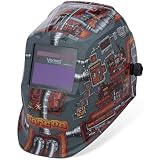
The Lincoln 1740 welding helmet remains a practical daily-use hood when its auto-darkening cartridge is healthy, but its modest viewing area and older battery arrangement make condition and replacement-lens availability more important than the name on the shell. It is best suited to MIG, stick, flux-cored, and ordinary TIG work where a compact, variable-shade helmet is preferable to a large premium viewing window.
As an Amazon Associate we earn from qualifying purchases at no extra cost to you.



What we cover
- Lincoln 1740 welding helmet: the buying decision
- Key specifications and what they mean in practice
- Lens shade and viewing performance
- Headgear comfort and fit
- Battery setup and a simple runtime check
- Replacement lenses: what fits and what does not
- Which option makes sense for your situation?
- Ownership cost and final verdict
Lincoln 1740 welding helmet: the buying decision
The 1740 series is an older Lincoln Electric Viking helmet family, so buyers should distinguish between a complete helmet, a used shell with an aging cartridge, and a replacement lens assembly. A clean helmet with a reliable auto-darkening filter can be worthwhile at a low market price. However, a heavily used example is not automatically a bargain: the lens cartridge, headgear, batteries, and clear cover plates can cost enough to narrow the gap to a current helmet.
For daily welding, prioritize these points in order:
- Lens response and shade control: the variable dark range is typically shade 9–13, suitable for common welding currents when adjusted correctly.
- Viewing area: approximately 3.82 × 1.73 inches, or about 6.6 square inches.
- Headgear: the adjustment mechanism should hold the helmet securely without forcing the operator to overtighten it.
- Battery condition: an intermittent or slow-changing filter is a safety-related reason to stop using the helmet until the power source and lens are checked.
- Replacement parts: confirm the exact cartridge and cover-lens dimensions before ordering.
Key specifications and what they mean in practice
| Feature | Lincoln 1740 series specification or typical configuration | Daily-welding implication |
|---|---|---|
| Viewing area | Approximately 3.82 × 1.73 in; about 6.6 sq in | Compact and usable, but less peripheral coverage than many newer wide-view helmets |
| Dark shade range | Variable shade 9–13 | Works for many MIG, stick, flux-cored, and TIG applications; select shade for amperage and process |
| Light-state shade | Typically shade 3 | Allows setup and electrode positioning without lifting the hood |
| Switching speed | Approximately 1/25,000 second on commonly listed configurations | Fast enough for normal arc starts when the cartridge and batteries are in good condition |
| Power system | Solar-assisted auto-darkening with replaceable lithium coin-cell batteries on many examples | Battery condition matters even if the helmet has been stored in light |
| Cover protection | Replaceable clear outer and inner plates | Worn or spattered plates reduce clarity and can make a good cartridge appear defective |
Specifications can vary by exact 1740 model, production run, or regional listing. Before buying a replacement cartridge, read the model marking inside the shell and compare the old lens dimensions, mounting tabs, connector layout, and control locations.
Lens shade and viewing performance
The 1740’s shade 9–13 adjustment covers the range used for much routine shop welding. Lower settings are commonly used for lower-amperage work, while higher-amperage stick, flux-cored, and heavy MIG work generally call for a darker setting. The correct shade depends on the process, current, and applicable workplace guidance; do not choose a shade merely because the arc looks more comfortable at first glance.
The approximately 3.82 × 1.73-inch window is the main limitation compared with newer wide-screen helmets. It gives a clear central view of the puddle, but the operator may need to move their head more often when following a long joint or working in an awkward position. That is not a defect for bench welding, tack work, repair jobs, or occasional fabrication. It is less attractive for production welding where a wider view reduces repositioning.
Before blaming the auto-darkening filter, replace both the outer and inner clear cover plates if they are scratched, clouded, heat-discolored, or coated with spatter. These inexpensive consumables often cause more visible deterioration than the filter itself.
Headgear comfort and fit
Comfort depends more on the condition and adjustment of the headgear than on the helmet shell. The 1740’s ratchet-style adjustment should provide a snug fit without pressure points. Set the circumference first, then adjust the top straps so the shell sits at a stable height. Finally, set the pivot tension so the helmet stays raised when required but drops smoothly when nodded.
A loose pivot is an ownership problem rather than a lens problem. The hood can creep downward during positioning, while excessive tension can make the helmet uncomfortable and encourage the operator to wear it incorrectly. Check the adjustment knob, pivot hardware, sweatband, and plastic strap anchors. Cracked anchors or missing hardware are reasons to look for a complete replacement headgear assembly rather than improvising with tape or hardware that interferes with the shell.
Battery setup and a simple runtime check
Many Lincoln Viking 1740 helmets use solar assistance together with replaceable lithium coin cells, although the exact battery arrangement should be confirmed from the label and manual for the particular helmet. Replace batteries with the specified type and observe polarity. Do not assume that a helmet stored under shop lighting has fully maintained its batteries.
A useful pre-weld check takes less than a minute:
- Inspect the outer and inner cover plates for cracks, heavy scratches, and spatter.
- Turn the shade control through its range and confirm that the controls are not loose or damaged.
- With the helmet facing a safe bright source, cover and uncover the arc sensors to check for consistent darkening. Never test by staring at a welding arc.
- Fit the helmet and move it through the raised and lowered positions to check that the headgear holds its setting.
- If the filter flickers, stays dark, darkens slowly, or behaves differently on repeated checks, stop using it and replace the batteries or cartridge as appropriate.
Do not open, modify, or attempt to repair the sealed auto-darkening cartridge. If new batteries and clean cover plates do not resolve unreliable operation, replacement is the safer ownership decision.
Replacement lenses: what fits and what does not
Compatible replacement parts usually fall into three categories: the outer clear cover lens, the inner clear cover lens, and the auto-darkening cartridge. Outer and inner plates are not interchangeable merely because they look similar. Their thickness, edge profile, and locating tabs must match the helmet.
When shopping for a replacement lens for a Viking 1740 welding helmet, use the model number printed inside the shell and compare:
- the visible window dimensions;
- the overall cartridge dimensions;
- mounting tabs, clips, or retaining frame;
- the position of shade, sensitivity, and delay controls;
- the battery compartment and electrical contacts.
A lens advertised for a “Viking welding helmet 1740” or “1740 series welding helmet” is not sufficiently identified if it does not state the exact model compatibility. Parts for visually similar Lincoln helmets, including other Viking families, may have different housings or controls. If the original cartridge label is unreadable, measure the opening and photograph the retaining arrangement before ordering; when uncertainty remains, contact Lincoln Electric or a welding-supply parts department with the helmet’s model and serial information.
Which option makes sense for your situation?
| Your situation | Most sensible choice | Reason |
|---|---|---|
| Occasional repair work and a complete, clean 1740 | Keep it and replace cover plates or batteries as needed | The compact window is usually adequate and ownership cost stays low |
| Daily welding with a scratched lens but reliable cartridge | Replace the correctly matched outer and inner plates first | Clear covers restore visibility without replacing the filter |
| Flickering or unreliable darkening | Replace batteries, then the cartridge or helmet if the fault remains | Unreliable protection outweighs the value of a low purchase price |
| Long welds, cramped joints, or frequent overhead work | Consider a current wide-view helmet | A larger window and newer headgear may reduce head movement and fatigue |
| Very limited budget and a damaged 1740 | Compare total repair cost with an entry-level new auto-darkening helmet | Old cartridge and headgear repairs can exceed the value of the shell |
Ownership cost and final verdict
Use a simple total-cost calculation before committing: purchase price + two batteries + outer and inner cover plates + any headgear parts. For example, if a used helmet costs $35, consumables total $15–$30, and headgear repair adds $20, the effective cost is roughly $70–$85 before shipping or labor. At that point, a new entry-level helmet may offer better certainty, while a clean 1740 with a functioning cartridge can still be the economical choice.
The Lincoln 1740 welding helmet is a sensible keeper for budget-conscious welders who value a proven compact design and can verify that the filter darkens consistently. Its drawbacks are the smaller viewing area, aging electronics on used examples, and the need to identify replacement lenses precisely. Buy it for condition and parts support—not simply because it carries the Viking 1740 name—and it can remain useful for daily shop welding.