What's inside
As an Amazon Associate I earn from qualifying purchases. This post may contain affiliate links at no extra cost to you.
Cast iron is durable, but it is not indestructible. A skillet left soaking in the sink, a grill grate forgotten through a wet winter, or a tool stored in a damp garage will all develop rust — and the longer that oxidation sits, the deeper it bites into the metal. Knowing how to remove rust from cast iron without destroying the seasoning you have spent months or years building is a problem every cook and workshop owner eventually faces.
What separates an effective rust-removal product from a disappointing one comes down to mechanism and surface safety. Abrasive blocks can strip oxidation in minutes but risk gouging seasoned surfaces if you press too hard. Chemical dissolvers work without elbow grease but may require rinsing, dwell time, or repeated applications. This roundup compares eight options across both categories, weighing published specifications, price per use, and what owners consistently report about ease, speed, and finish quality.
As an Amazon Associate we earn from qualifying purchases at no extra cost to you.




What we cover
Our Top Picks
 Lodge Rust Eraser Cast Iron Restoration Cleaning BlockOne Size0.5 x 1 x 3.6 Inches0.1 poundsCheck on Amazon


Quick Picks
| Product | Best for | Price |
|---|---|---|
| Lodge Rust Eraser | Skillet restoration without chemicals | $9.88 |
| FilmFix Rust Remover | Chrome and steel spray convenience | $9.99 |
| STAR BRITE Rust Stain Remover | Corrosion stains on multiple surfaces | $15.19 |
| Azitamo Rust Eraser 2-Pack | Knife and small-tool rust removal | $9.9 |
| Iron OUT Outdoor | Large-area concrete and vinyl rust stains | $21.36 |
| Culina Cast Iron Scrub | Natural seasoning-safe cleaning | $14.99 |
| Impresa XL Erasers 2-Pack | Heavy-duty cast iron cookware | $14.99 |
| Rust Remover Dissolver Spray | Bolts, joints, and lubrication | $12.99 |
How We Picked
We filtered these eight products against four criteria that matter most when you want to remove rust from cast iron and similar metals. First, mechanism of action: whether the product works through abrasion, chemical dissolution, or both, because that determines dwell time and effort. Second, surface safety: whether it preserves seasoning on cast iron or is formulated for raw metal only. Third, form factor and coverage: a spray bottle behaves very differently from a rubber eraser block when facing a flared skillet wall versus a flat grill grate. Fourth, value per application, measured by unit price relative to the quantity or volume you receive. We cross-referenced published specs, ingredient disclosures, and aggregate owner feedback to rank these.
The 8 Best How to Remove Rust From Cast Iron in 2026
Lodge Rust Eraser Cast Iron Restoration Cleaning Block for Cookware
This is the entry-level default for anyone whose cast iron has gone from lightly spotted to fully orange. The rubbery block uses fine abrasive grit that bites into oxidation without shredding polymerized seasoning the way steel wool does.
- Pro: No chemicals, no soaking, no fumes — just water and friction.
- Pro: Priced under ten dollars, it costs less per use than almost any liquid alternative.
- Con: Deep pitting can take extended scrubbing; it is not a one-minute fix for neglected pans.
Skip it if your rust has penetrated through the metal wall or if you need to treat surfaces beyond cookware, since the block size suits pan bases and flat cooking surfaces more than curved or textured pieces.
FilmFix Rust Remover for Metal 10.14 fl.oz, Chrome & Steel Spray
FilmFix targets oxidation on chrome and steel through a spray-on chemical formula that dissolves rust into a wipeable residue. Owners with older chrome-plated tools and grill components report visible results within a few minutes of dwell time.
- Pro: Spray applicator makes it easy to reach crevices and threaded joints without disassembly.
- Pro: Works on finished and plated surfaces where abrasives would mar the appearance.
- Con: The ten-ounce bottle runs out quickly if you are restoring multiple large items in one session.
Not ideal if you primarily need to restore seasoned cast iron cookware, since the chemical action can soften and strip the seasoning layer along with the rust.
STAR BRITE Rust Stain Remover, Corrosion Stain Cleaner
STAR BRITE markets a multi-surface corrosion stain cleaner that owners use on boat hardware, outdoor furniture frames, and patio tools alongside cast iron surfaces. Its formula targets oxidized stains that have already leached into surrounding material.
- Pro: Handles rust stains on adjacent surfaces (concrete, vinyl, fiberglass) that cookware-focused products ignore.
- Pro: Larger container volume than the small sprays, giving more applications per purchase.
- Con: Requires rinsing and ventilation; it is not a wipe-and-go solution for a quick stovetop skillet cleanup.
Pass on this if your sole need is restoring a single skillet to cooking condition — the multi-surface chemistry adds steps you will not need.
Azitamo Rust Eraser, Cast Iron Rust Remover, Knife Rust Removal & Sharpening Tool – 2 Pack
Azitamo bundles two eraser blocks at a sub-ten-dollar price, positioning itself for knife collectors and cooks who maintain carbon-steel blades alongside cast iron pans. The blocks combine mild abrasion with a sharpening side edge.
- Pro: Two-pack pricing makes the per-block cost the lowest in this group.
- Pro: Dual-sided design lets you rust-scrape and lightly hone a blade edge with one tool.
- Con: The blocks are smaller than Lodge’s or Impresa’s, so wide skillet faces require more passes.
Skip if you only have large-diameter cookware to restore; the compact block size makes broad-surface work slow.
Iron OUT Outdoor Rust Stain Remover, Concrete & Vinyl Cleaner, 1 Gallon
Iron OUT’s gallon jug targets heavy outdoor rust staining on driveways, vinyl siding, and patio concrete. Cast iron owners buy it when rust runoff from furniture legs has left orange trails that scrubbing cannot lift from the substrate.
- Pro: One-gallon volume covers dozens of applications, dropping the per-use cost well below smaller bottles.
- Pro: Formulated for porous and semi-porous surfaces where eraser blocks and small sprays cannot reach.
- Con: Not designed for direct application to food-contact cookware surfaces; the chemistry targets mineral stains, not seasoning restoration.
Do not choose this as your primary skillet-restoration product. Reserve it for the aftermath — the stains rust has left on your patio or concrete.
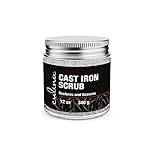
Culina Cast Iron Cleaning & Restoring Scrub
Culina positions a natural-fiber scrub pad as a seasoning-friendly bridge between daily maintenance and full restoration. Owners appreciate that it removes light surface oxidation without the chemical or aggressive-grit concerns of other options.
- Pro: 100% natural materials mean no residue risk on cooking surfaces and no fumes.
- Pro: Gentle enough to use after every cook, doubling as a routine cleaning tool rather than a one-time emergency fix.
- Con: Cannot tackle heavy or pitted rust; it is a maintenance aid, not a deep restoration solution.
If your pan is fully orange and pitted, skip this and reach for a dedicated abrasive block or chemical dissolver first.
Impresa Cast Iron Rust Remover Erasers, 2-Pack XL
Impresa’s XL blocks measure 4.75 by 2 by 1 inches, giving the largest scrubbing footprint in this roundup. The black abrasive rubber is dense enough to bite into moderate rust while flexing to follow a skillet’s curved walls.
- Pro: XL surface area cuts restoration time noticeably on large-diameter pans and griddle tops.
- Pro: Two-pack pricing means you get more total abrasive material per dollar than most competitors.
- Con: The aggressive grit can leave faint scratches on glass-smooth seasoned surfaces if you apply heavy pressure.
Choose a softer pad like Culina’s instead if your cast iron is only lightly spotted and you want to preserve a mirror finish.
Rust Remover & Removal Spray for Metal – Dissolver & Lubricant, 3.38 fl.oz
This compact spray combines a rust dissolver with a lubricant, so it works on seized bolts and threaded joints in addition to flat oxidized surfaces. Workshop owners keep it for cast iron stove hardware and tool fasteners that have rusted in place.
- Pro: Dual dissolver-and-lubricant action means you can free a rusted joint in a single application step.
- Pro: Small bottle slips onto a tool wall or into a go-bag without weight concerns.
- Con: The 3.38-ounce volume is the smallest here; it disappears after a handful of large-area treatments.
Not a good fit for restoring an entire skillet cooking surface. Buy this for the mechanical hardware attached to your cast iron, not the iron itself.
Buying Guide
Abrasive Blocks vs. Chemical Dissolvers
Abrasive rubber blocks remove rust through controlled friction. They work immediately, require no dwell time, and leave no chemical residue — making them the safer choice for any surface that will contact food. The tradeoff is physical effort and a risk of uneven seasoning loss if you scrub one spot harder than another. Chemical dissolvers convert iron oxide into a soluble compound you wipe away. They handle complex geometries, threads, and pitting that blocks cannot reach, but most require rinsing, ventilation, or both. For a skillet, a block is usually sufficient; for a seized bolt on a cast iron stove, chemistry wins.
Surface Size and Form Factor
A ten-inch skillet cooking face presents roughly seventy-seven square inches of surface. A two-inch eraser block covers that area in about thirty to forty strokes; a four-and-three-quarter-inch XL block cuts it in half. If you restore multiple pans or a large griddle, prioritize block size or gallon-volume liquid over compact sprays. Conversely, a single knife or a grill grate hinge needs the precision of a small applicator. Match the tool geometry to the job geometry and you eliminate wasted effort and product.
Preserving Seasoning While Removing Oxidation
Seasoning is polymerized oil bonded to the iron at a molecular level. Abrasives that are too aggressive strip it along with the rust, forcing a full re-seasoning cycle. Natural-fiber scrubs and fine-grit rubber blocks minimize this damage. Chemical dissolvers generally attack only iron oxide and leave polymerized carbon layers intact, but some solvents can soften older, thinner seasoning. If preserving your existing patina matters, look for products explicitly rated seasoning-safe and avoid anything that lists strong acids or solvents without a seasoning-compatibility claim.
Our Verdict
The Lodge Rust Eraser wins as the top pick for the most common scenario: a cookware owner facing moderate rust on a seasoned skillet. It is inexpensive, requires no chemicals, and works within the constraints of a kitchen sink. For the absolute lowest per-unit cost, the Azitamo 2-Pack at nine dollars and change delivers two eraser blocks and a sharpening edge, making it the budget pick. If your rust problem is mechanical rather than cosmetic — seized hardware, corroded fasteners, oxidized joints on a wood stove or outdoor grill — the Rust Remover Dissolver and Lubricant Spray wins because it frees stuck metal in a single step where no block can reach.
FAQ
Can I remove rust from cast iron without stripping the seasoning?
Fine-grit abrasive blocks and mild chemical dissolvers can lift surface oxidation while leaving polymerized seasoning layers largely intact. Deep or pitted rust almost always damages some seasoning, meaning you will need to re-oil and heat-treat the affected area afterward regardless of method.
Is vinegar effective for cast iron rust removal?
Diluted white vinegar dissolves light rust through its acetic acid content, but it also attacks seasoning and can etch bare metal if left too long. Purpose-built products from this list offer more controlled results without the timing guesswork that makes vinegar risky for inexperienced users.
How often should I use a rust eraser on my cast iron?
Only when you see active oxidation, typically after improper storage or prolonged moisture exposure. Between those events, a hot-water rinse and thin oil film prevent rust from forming in the first place, so a dedicated eraser should see use only a few times per year under normal care.
What is the difference between a rust eraser and steel wool?
Rust erasers use bonded abrasive rubber or polymer that wears away slowly and provides consistent grit without shedding loose metal fibers. Steel wool is much coarser, sheds filaments that embed in seasoning, and aggressively strips protective layers. The eraser approach gives you finer control over how much material you remove from the pan surface.