
What's inside
As an Amazon Associate I earn from qualifying purchases. This post may contain affiliate links at no extra cost to you.
What we cover
Our Top Picks
 Bestarc 50A Plasma Cutter Machine50A Pilot Arc V813.98 x 5.12 x 8.46 inches10.2 poundsCheck on Amazon
 SILATU 55A Plasma Cutter55A Pilot Arc Plasma Cutter13.98 x 6.1 x 8.86 inches12.57 PoundsCheck on Amazon

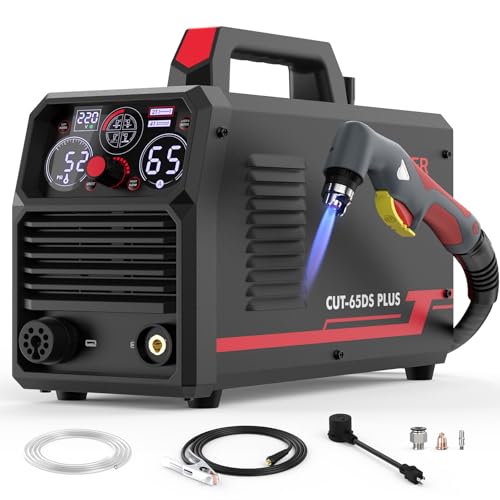

What makes a clean cut on square tubing
A plasma cutter can make a clean, square-tube cut quickly, but the machine alone won’t guarantee a square, burr-free end. Results depend on matching the cutter to the tube wall, keeping a steady torch angle and speed, and supporting the work so it doesn’t shift. Thin tubing is especially easy to distort or pierce through if you move too slowly.
For typical mild-steel square tubing with walls from about 1/16 to 1/8 inch, a 30- to 40-amp cutter is usually a sensible range. Thicker material or frequent production work calls for more amperage and a higher duty cycle. A cutter’s advertised maximum cut is not the same as its clean-cut capacity: check the rated clean-cut thickness, not just the maximum severance figure.
As an Amazon Associate we earn from qualifying purchases at no extra cost to you.


Choose a cutter for the wall thickness and workload
For occasional repairs and light fabrication, a 30-amp plasma cutter can be enough for thin-wall tubing. It costs less and is easier to power, but may struggle to maintain speed on thicker steel. If you’re regularly cutting 1/8-inch walls or want more room to work, consider a 40-amp plasma cutter. It offers more headroom, though it still needs adequate air and electrical supply.
Before buying, check the input voltage and duty cycle. A machine that requires 240 volts is a poor fit if you only have a 120-volt outlet available. Duty cycle describes how long it can cut in a 10-minute period at a stated output; for example, 40% means four minutes of cutting followed by six minutes to cool at that rating. Short cuts in tubing rarely demand a high duty cycle, but repeated cuts in a production run can.
Quick comparison by job
| Use case | Practical range | Main trade-off |
|---|---|---|
| Occasional cuts in thin tubing | 30 amps; clean-cut rating suited to the wall thickness | Lower cost, less reserve on thicker sections |
| Regular fabrication, roughly 1/8-inch walls | 40 amps; check input power and duty cycle | Faster work and more headroom, but higher power needs |
| Thicker sections or long cutting runs | Higher output with a suitable clean-cut rating and duty cycle | Greater capacity, cost, and air demand |
These are starting points, not guarantees. Material type, consumable condition, air quality, and the cutter’s cut rating all affect the result. For square tubing, the wall thickness matters more than the outside dimension: a 2-inch tube with a 1/16-inch wall is a different job from 2-inch tubing with a 1/4-inch wall.
Don’t overlook air and consumables
Most air plasma cutters need a compressor that can deliver the required pressure and airflow continuously, not just reach a high pressure on its tank gauge. Follow the cutter manufacturer’s stated pressure and CFM requirements. A small compressor that runs out of air mid-cut can cause a rough edge, incomplete separation, or excess dross. Use a moisture separator or the specified air-drying setup; water and oil in the air can shorten consumable life and make the arc unstable.
Consumables also affect cut quality. A worn electrode or nozzle may produce a wandering arc, a wider kerf, or a cut that bevels more than expected. Keep spare consumables on hand and inspect them if the torch begins sputtering or the cut edge deteriorates. A machine with a hand torch is generally enough for occasional tube work; a machine that supports a mechanized torch or guide may be worth considering for repetitive, uniform cuts.
Set up the tube and make the cut
Mark the cut with a square or wraparound guide, then clamp the tube so it cannot roll. Support both sides of the cut, but leave clearance beneath the line for the arc and molten metal. If you’re cutting a tube across all four faces, plan how it will sit between cuts so the fresh edge doesn’t shift or catch the torch. Wear a welding helmet with the shade recommended for plasma cutting, gloves, nonflammable clothing, and eye protection for anyone nearby. Plasma arcs throw hot metal and ultraviolet light.
Set the cutter’s air pressure and amperage according to its manual and the material thickness. Keep the torch close to perpendicular to the face and move at a consistent pace. Too slow can leave a wide kerf and heavy dross; too fast can leave an uncut strip or a ragged edge. On thin tubing, practice on a cutoff of the same material first. Starting the cut at an edge can reduce the chance of blowing a hole through the wall. If the cut stalls or the arc goes out, check travel speed, air supply, ground connection, and consumables before raising amperage.
For repeatable square ends, a guide is often more valuable than extra power. A plasma-cutter straight-edge guide can help keep a hand torch on the line, though it must fit the torch and leave room for the correct standoff. Don’t drag a consumable across the work unless the torch is designed for drag cutting.
What to buy for your shop
For a few cuts a month in thin-wall steel, start with an affordable cutter whose clean-cut rating covers your tubing, and put the savings toward good air preparation, spare consumables, clamps, and a guide. Paying more for a higher-amperage machine won’t fix wet air, poor support, or an unsteady hand. If you cut often, work with thicker walls, or need short cycle times, prioritize a higher clean-cut capacity, a duty cycle suited to your workload, and the electrical service and compressor to run it.
Related guides
More from Amazon
Programs that pair well with the guide above. Offers and eligibility are set by Amazon and may change.
A free business account with business pricing and bulk-buying tools for work, shop or home office.
Create a business accountFree shipping on eligible items, Prime Video and more. Eligible new members can start with a free trial.
Start a Prime free trialAudiobooks and podcasts to listen to on the go. Eligible new members can start with a free trial.
Try Audible freeAd-free music streaming. Eligible new subscribers can start with a free trial.
Try Music Unlimited freeAs an Amazon Associate we earn from qualifying purchases.










Write Your Review
No reviews yet. Be the first to share your experience!