
Our Short List of 3
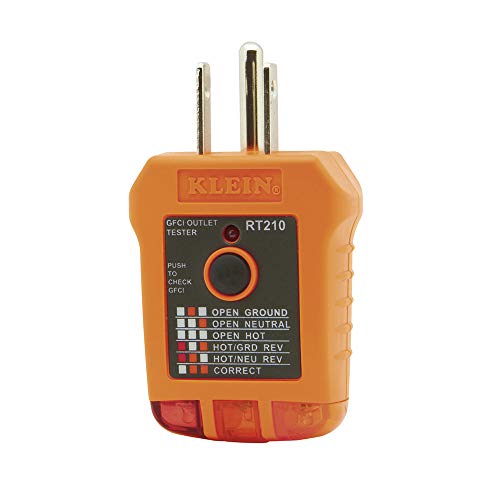
- Model: Klein Tools RT210
- Voltage range: 110 to 125V AC, 50/60Hz, three-wire outlets
- Faults detected: Open ground, reverse polarity, open hot, open neutral, hot/ground reversed
- GFCI test: Yes, push-button test

- Model: Klein Tools RT250
- Voltage range: Standard three-wire 120V receptacles
- Display: Large backlit LCD with voltage readout and wiring condition
- Faults detected: Open ground, open neutral, open hot, hot/neutral reversed, hot/ground reversed, dual open neutral and ground

- Model: Gardner Bender GFI-3501
- Voltage range: 110 to 125V AC, standard three-wire outlets
- Indications: 7 visual LED tests with printed legend
- Faults detected: Open ground, open neutral, open hot, hot/ground reversed, hot/neutral reversed, correct wiring
All 4 Picks at a Glance
| Product | Specs | Action |
|---|---|---|
| 1. Klein Tools RT210 Outlet Tester |
| Check price on Amazon |
| 2. Klein Tools RT250 GFCI Outlet Tester with LCD |
| Check price on Amazon |
| 4. Gardner Bender GFI-3501 Ground Fault Tester and Circuit Analyzer |
| Check price on Amazon |
 5. Southwire 40022S Receptacle Tester |
| Check price on Amazon |
Key takeaways
- Find the best outlet tester for your shop with five proven receptacle and GFCI testers, clear fault lights, LCD options, and checks for safer wiring.
As an Amazon Associate I earn from qualifying purchases. This post may contain affiliate links at no extra cost to you.
As an Amazon Associate we earn from qualifying purchases.
A welding shop runs on receptacles you trust. Plug in a grinder, a charger, or a work light, and you assume the outlet is wired correctly. That assumption fails often in older garages and rented bays where outlets were added over many years. An open ground, a reversed hot and neutral, or a dead GFCI can leave a metal tool body unprotected.
That is why the best outlet tester belongs in every toolbox, next to the multimeter. Push one into a three-wire receptacle, read the lights or screen against the legend on the body, and in seconds you know if the wiring matches a common fault. Models with a GFCI button also trip a ground-fault device on purpose, confirming that protection works around coolant, wash water, and damp concrete.
This guide covers five proven options, from a simple three-light plug to an LCD model showing voltage and trip time, based on manufacturer specifications and practical notes.
Disclosure: This post contains affiliate links. If you buy through links on this page, we may earn a commission at no extra cost to you.
Quick picks
- Best all-around lamp tester: Klein Tools RT210 — clear light legend, GFCI button, tough housing.
- Best with a display: Klein Tools RT250 — large backlit LCD, voltage readout, GFCI trip time on screen.
- Best long-running classic: Sperry Instruments GFI6302 — seven visual indications, simple operation.
- Best circuit analyzer style: Gardner Bender GFI-3501 — seven LED tests for outlets, GFCI devices, and extension cords.
- Best compact spare: Southwire 40022S — small plug-in tester with push-button GFCI check and neon legend.
1. Klein Tools RT210 Outlet Tester
- Model: Klein Tools RT210
- Voltage range: 110 to 125V AC, 50/60Hz, three-wire outlets
- Faults detected: Open ground, reverse polarity, open hot, open neutral, hot/ground reversed
- GFCI test: Yes, push-button test
The RT210 is the tester many electricians hand to an apprentice first. Plug it into a standard or GFCI receptacle and three indicators show the wiring condition at a glance. A chart on the body translates the light pattern into the fault, with no manual to hunt for mid-job.
Our take: it hits the sweet spot for a fabrication shop. No batteries, bench-height drop toughness, and a GFCI button to confirm the outlet by the wash area actually trips. Keep one in the main box and one in the truck.
Pros:
– Printed legend makes fault reading fast
– No batteries to replace
– Tough housing for bench and jobsite use
Cons:
– Lamp pattern only, no numeric voltage readout
– Cannot show GFCI trip time
– Limited to North American receptacles
2. Klein Tools RT250 GFCI Outlet Tester with LCD
- Model: Klein Tools RT250
- Voltage range: Standard three-wire 120V receptacles
- Display: Large backlit LCD with voltage readout and wiring condition
- Faults detected: Open ground, open neutral, open hot, hot/neutral reversed, hot/ground reversed, dual open neutral and ground
The RT250 is the step up when a lamp pattern is not enough. Its large backlit LCD shows voltage as a number and names the wiring condition in plain terms, removing chart-matching in dim corners. It also detects open ground and open neutral together, a combination simpler tools can report confusingly.
Practical notes: the display holds the reading briefly, so you can pull it from a low outlet behind a cabinet and still read it, and the GFCI test shows trip time on screen — a clue to an aging device that trips slowly. It runs on two AAA batteries, included.
Pros:
– Numeric voltage removes guesswork
– Trip time display adds diagnostic value
– Backlit screen works under benches
Cons:
– Needs batteries, unlike lamp testers
– Larger body than a simple plug tester
– Screen can wash out in bright direct sun
3. Sperry Instruments GFI6302 GFCI Outlet Tester
The GFI6302 has been in inspection bags for years, and its appeal is pure simplicity. Plug the yellow and black body into a standard 120V outlet, read the neon lamp pattern against the legend for seven indications, and press the test button to check a GFCI device.
Our take: this is the pick a helper or new hire can use correctly with thirty seconds of instruction. Nothing to configure, no screen to protect, no battery door to lose. For a small garage where outlets rarely change, it answers the key question quickly and repeatably.
Specs
- Model: Sperry Instruments GFI6302
- Voltage range: 120V AC, 60Hz, standard three-wire outlets
- Indications: 7 visual neon light patterns with printed legend
- Faults detected: Open ground, open neutral, open hot, hot/ground reversed, hot/neutral reversed, correct wiring
- GFCI test: Yes, push-button test
- Safety listing: CAT III 300V
- Power: Draws power from the receptacle, no batteries needed
- Color: Yellow and black housing
- ASIN: B000RUL2UU
Pros:
– Very easy to teach and read
– Neon lamps stay visible in shop lighting
– Proven design with a clear legend
Cons:
– No voltage number or trip time
– Pattern requires the legend until memorized
– Basic feature set compared with LCD models
4. Gardner Bender GFI-3501 Ground Fault Tester and Circuit Analyzer
- Model: Gardner Bender GFI-3501
- Voltage range: 110 to 125V AC, standard three-wire outlets
- Indications: 7 visual LED tests with printed legend
- Faults detected: Open ground, open neutral, open hot, hot/ground reversed, hot/neutral reversed, correct wiring
The GFI-3501 frames the familiar lamp idea as a small circuit analyzer. It works on standard outlets, GFCI-protected outlets, and through extension cords — handy when a saw runs at the end of a cord and you want to confirm the ground path survived the extra length. Seven LED tests cover the standard fault set.
Practical notes favor it for walk-throughs. Checking a new shop lease or a row of rental bays, it moves fast from outlet to outlet and the indicators are easy to log. No voltage number or trip time, but for screening dozens of receptacles, simplicity is the point.
Pros:
– Fast checks across many outlets
– Useful through extension cords
– Comfortable shape for repeated use
Cons:
– LED legend only, no numeric readout
– No trip time information
– Legend takes a moment to learn
5. Southwire 40022S Receptacle Tester
- Model: Southwire 40022S
- Voltage range: 110 to 125V AC, for use on 120V receptacles
- Indications: Neon lights with printed diagnostic chart
- Faults detected: Open ground, open neutral, open hot, hot/ground reversed, hot/neutral reversed, correct wiring
The 40022S is the compact spare you toss in a pouch and forget until you need it. Its small black body plugs into a standard three-prong outlet, neon lights show the wiring condition against the printed chart, and a red button performs the GFCI trip check, covering six common conditions plus correct wiring.
Our take: own one alongside a primary tool. Put it in the truck, the welding cart drawer, or the inspection kit, and an unfamiliar outlet can always be verified before a charger goes on it. A tester that is present beats a better one left at the bench.
Pros:
– Small and light for a pouch or cart drawer
– Simple legend and clear GFCI button
– Good choice as a second tester
Cons:
– No display, voltage number, or trip time
– Compact body can be tight in deep recesses
– Fewer extra features than analyzer models
How to choose the right outlet tester
Begin with the job. Checking a handful of outlets after moving into a shop? Any lamp model here will do. Maintaining a building or documenting inspections? Choose a display model — the RT250, with voltage and trip time, gives you something concrete to write down.
Next, GFCI coverage. A tester without a test button shows wiring order but cannot prove ground-fault protection works. Every pick here includes that test, deliberately. In wet, metal-heavy environments, test GFCI outlets near sinks and exterior doors a few times a year, and replace devices that fail to trip or reset.
Consider power and durability too. Lamp testers draw power from the outlet and are always ready; display testers need batteries but read clearly in dark spots. Look for stated drop protection and a legend that stays readable — a worn-off chart turns a good tester into a guessing game.
Finally, know the limits. A plug-in tester is a screening tool, not a wiring certification. It cannot reliably detect a bootleg ground or measure load performance. Find obvious faults fast, then use a multimeter and, when safety is in doubt, a qualified electrician. Simple routine: verify the tester on a known good outlet first, then check, note the result, and confirm the GFCI trips and resets cleanly.
Frequently asked questions
Can an outlet tester detect a bootleg ground?
Not reliably. Most plug-in testers, including the lamp and basic LCD models here, read a jumpered neutral-to-ground connection as if it were a proper ground. If you suspect that shortcut in an older building, have the receptacle opened and inspected before trusting it for sensitive or high-draw equipment.
How often should GFCI outlets in a shop be tested?
Use the test button on each shop GFCI every few months, and always after a trip event, a wash-down nearby, or any wiring change on the circuit. Plug in the tester, confirm correct wiring, press the test button, and confirm the device trips and then resets with power restored.
What is the difference between a lamp tester and an LCD tester?
A lamp tester shows a light pattern you match to a printed legend. An LCD tester such as the RT250 shows words and numbers, including voltage and GFCI trip time. Both find common faults; the LCD version is faster for beginners and gives extra troubleshooting data.
Do I still need a multimeter if I own a receptacle tester?
Yes. A receptacle tester is a fast screening tool for wiring order and GFCI function. A multimeter measures voltage precisely, checks continuity, and helps diagnose problems beyond the outlet itself. The two tools complement each other, and a safe shop keeps both within reach.
Conclusion
For most shops, the Klein Tools RT210 is the best outlet tester to own first: simple, tough, and battery-free. Step up to the RT250 for voltage as a number and GFCI trip time on a backlit screen. The Sperry GFI6302 and Gardner Bender GFI-3501 are excellent lamp-based choices for fast checks across many outlets, and the Southwire 40022S makes a perfect compact spare. Verify your pick on a known good receptacle first, and make a quick check part of setting up anywhere unfamiliar.
Related guides
More from Amazon
Programs that pair well with the guide above. Offers and eligibility are set by Amazon and may change.
A free business account with business pricing and bulk-buying tools for work, shop or home office.
Create a business accountFree shipping on eligible items, Prime Video and more. Eligible new members can start with a free trial.
Start a Prime free trialAudiobooks and podcasts to listen to on the go. Eligible new members can start with a free trial.
Try Audible freeAd-free music streaming. Eligible new subscribers can start with a free trial.
Try Music Unlimited freeAs an Amazon Associate we earn from qualifying purchases.





Write Your Review
No reviews yet. Be the first to share your experience!