
Key takeaways
- Find the best mechanic stethoscope for pinpointing ticks, knocks and bearing whine. Compare five proven picks for engines, pulleys and transmissions.
What's inside
As an Amazon Associate I earn from qualifying purchases. This post may contain affiliate links at no extra cost to you.
As an Amazon Associate we earn from qualifying purchases.
A mystery tick, knock, or whine can eat an entire afternoon if you chase it by ear alone. A scan tool will not hear a failing idler pulley, a dry alternator bearing, or a lifter that only complains at idle, and tearing parts off on a hunch wastes time in any shop. That is why the humble mechanic’s stethoscope still earns a drawer in so many toolboxes. Touch the probe to a housing, listen, move a few inches, and listen again. The sound that gets louder and sharper as you close in tells you exactly which component deserves the wrench.
Finding the best mechanic’s stethoscope comes down to a few practical things: how clearly the diaphragm chamber passes sound, how long and sturdy the probe is, and how well the earpieces seal out shop noise. Below we compare five proven options, from a classic single-purpose listener to an electronic model with adjustable sensitivity.
Disclosure: This post contains affiliate links. If you buy through links on this page, we may earn a commission at no extra cost to you.
What we cover
Quick picks
- Best overall: Lisle 52500 Mechanic’s Stethoscope — clear, sensitive, and built for daily shop use
- Best for leak hunting too: GEARWRENCH Mechanic’s Stethoscope 835D — shock-resistant handle and a design that breaks down for storage
- Best electronic option: Steelman EngineEAR II — adjustable sound levels and a non-conductive probe for work near electronics
- Best two-pack for the home garage: Lamoutor 2Pcs Automotive Mechanic Stethoscope — one for the toolbox, one for the truck
- Best compact listener: Sixzoo Mechanic Stethoscope — short, handy probe that suits tight engine bays
Lisle 52500 Mechanic’s Stethoscope

Lisle has made diagnostic listeners for decades, and the 52500 is the model many technicians reach for first. Its unique sound chamber pairs with a super-thin diaphragm that greatly amplifies sound, so faint bearing roughness and light valvetrain ticks come through cleanly instead of getting lost under general engine noise. In our take, that sensitivity is why this tool has stayed popular: it separates the noise you are hunting from everything else running at the same time.
The build is simple in the right ways. The probe and chamber are stainless steel, the tool needs no batteries, and there is nothing electronic to fail in a hot, greasy engine bay. Touch the probe to a valve cover, then a timing cover, then each accessory in turn, and the faulty part announces itself by getting noticeably louder. It works just as well on transmissions, differentials, and water pumps.
Specs
- Brand: Lisle
- Model: 52500
- Type: Acoustic, diaphragm chamber
- Material: Stainless steel
- Weight: 1.76 ounces
- Power: None required
- ASIN: B0002SQYSM
Pros:
– Very clear amplification from the thin diaphragm design
– Feather-light and easy to handle for long diagnostic sessions
– No batteries, no electronics, nothing to maintain
Cons:
– Single-purpose design does not include a funnel for air leaks
– Earpieces are basic and can loosen with heavy daily use
GEARWRENCH Mechanic’s Stethoscope 835D
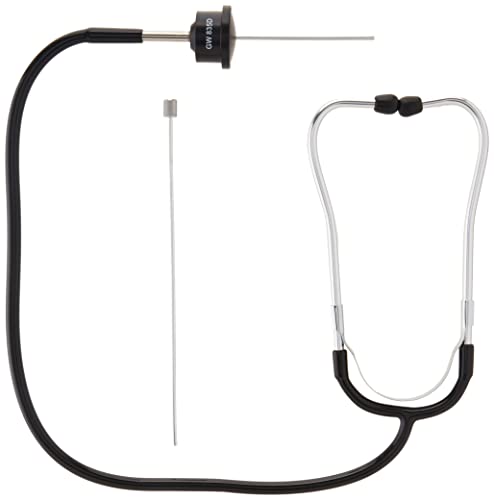
The GEARWRENCH 835D, originally sold under the KD Tools name, takes a tougher approach to the same job. It uses a shock-resistant handle that shrugs off knocks in the engine bay, and the whole tool disassembles for compact storage in a crowded drawer or tool cart. That design also makes it easier to clean oil and grime out of the joints.
In practical notes, the 835D feels a touch more substantial than the lightest listeners, which helps when you need steady contact on a vibrating housing. Sound clarity is crisp, especially on pulley squeal, gear whine, and pump groan. GEARWRENCH backs its hand tools with a strong warranty tradition, which matters for a tool that will get dropped and tossed in a box for years.
Specs
- Brand: GEARWRENCH
- Model: 835D
- Type: Acoustic with diaphragm chamber
- Handle: Shock-resistant, disassembles for storage
- UPC: 082171008351
- Power: None required
- ASIN: B000R6TYR2
Pros:
– Rugged handle tolerates rough shop handling
– Breaks down small for drawer or cart storage
– Crisp clarity on pulley, gear, and pump noises
Cons:
– Slightly heavier feel than the lightest acoustic models
– No electronic amplification for very faint sounds
Steelman EngineEAR II Electronic Stethoscope

Steelman built its name on electronic listening tools, and the EngineEAR II is the step up for noises a passive probe struggles to isolate. Instead of a plain diaphragm, it uses a non-conductive microphone on a flexible gooseneck shaft, over-ear headphones that shut out shop noise, and a sound level meter with seven settings spanning 60 to 120 decibels. You dial sensitivity up or down instead of pressing harder or guessing, a real help when a faint injector tick hides under a loud cooling fan.
The non-conductive rubber boot on the solid aluminum probe is a thoughtful touch for modern engine bays packed with wiring and sensors, and the gooseneck reaches into spots a rigid probe cannot. Our take: this is the pick for technicians who diagnose late-model vehicles often. It is bigger and needs power, so it complements rather than replaces a simple acoustic listener in most boxes.
Specs
- Brand: Steelman
- Model: 06800 (EngineEAR II)
- Type: Electronic with non-conductive microphone
- Sound levels: 7 settings, 60 to 120 decibels
- Probe: Solid aluminum with flexible gooseneck shaft
- Headphones: Over-ear, included
- Weight: 2 pounds
- ASIN: B00I3ZPVX0
Pros:
– Adjustable sensitivity finds faint noises in loud bays
– Non-conductive probe is safer around modern electronics
– Over-ear headphones block background shop noise well
Cons:
– Bulkiest option here and needs batteries
– More tool than a quick bearing check usually requires
Lamoutor 2Pcs Automotive Mechanic Stethoscope

Sometimes the smartest move is having a listener everywhere you might need one. The Lamoutor set includes two complete stethoscopes, each with a stainless steel probe and vinyl tubing, so you can keep one in the main toolbox and one in the truck or trailer. For a home garage that also handles small engines and mowers, that redundancy is genuinely useful.
Each unit follows the proven acoustic pattern: a sensitive chamber and diaphragm, a metal probe for contact listening, and earpieces that help isolate outside noise. Sound quality is honest for everyday work — clear enough to separate a bad tensioner from a healthy one, or to confirm which wheel bearing growls when you spin the hub by hand. If one gets damaged or lent out, you still have a working tool.
Specs
- Brand: Lamoutor
- Model: 2Pcs Automotive Mechanic Stethoscope
- Type: Acoustic, diaphragm chamber
- Quantity: 2 stethoscopes per pack
- Material: Stainless steel probe, vinyl tubing
- Package weight: 7.7 ounces
- ASIN: B08H8RHFT7
Pros:
– Two complete tools cover shop and vehicle kits
– Simple, proven design with no upkeep
– Handy for cars, trucks, motorcycles, and small engines
Cons:
– Earpiece comfort is average on long sessions
– Tubing is less supple than premium-brand hoses
Sixzoo Mechanic Stethoscope

The Sixzoo listener is a compact, no-fuss take on the classic design, built around an 8.46-inch metal probe that suits crowded modern engine bays where a longer rod is awkward. The stainless steel and vinyl construction keeps it light, and the sensitive chamber does a solid job of passing along the ticking, whirring, and grinding clues you need to narrow a fault down to one component instead of a whole corner of the engine.
In our take, this is a sensible first stethoscope for a DIYer building a diagnostic kit, and a reasonable spare for dirty jobs like checking a muddy transfer case or a salt-crusted trailer hub. It covers the core tasks — engines, transmissions, pulleys, pumps, and bearings on cars, trucks, SUVs, motorcycles, and RVs — without extra attachments to keep track of.
Specs
- Brand: Sixzoo
- Model: Sixzoo-MS-01
- Type: Acoustic, diaphragm chamber
- Probe length: 8.46 inches
- Material: Stainless steel, vinyl
- Weight: 0.13 kilograms
- ASIN: B0FQCCCZBQ
Pros:
– Short probe maneuvers easily in tight bays
– Lightweight and simple to store in a portable kit
– Clear sound for everyday engine and bearing checks
Cons:
– Shorter reach than long-probe models on deep engines
– Single unit, so no spare if it goes missing
How to choose
Start with how you diagnose. If most of your listening is contact work on bearings, pulleys, pumps, and valvetrains, a quality acoustic model like the Lisle or GEARWRENCH is all you need, and it will never have a dead battery at the wrong moment. If you regularly chase faint or intermittent noises on late-model vehicles, the adjustable sensitivity of an electronic tool like the Steelman earns its keep.
Mind probe length and shape. A longer probe reaches lower pulleys and the transmission, while a shorter probe is easier to control in a packed bay. A flexible gooseneck adds options in awkward spots. Steady, firm contact on a clean, solid surface gives the clearest signal.
Think about leaks as well as knocks. Some kits add a hollow tube and funnel for vacuum leaks, exhaust leaks, and wind noise around seals. If you do a lot of drivability work, that second mode saves buying a separate tool later. Pure contact listeners cannot hear an air leak well, no matter how sensitive the diaphragm is.
Comfort matters more than you expect. Diagnostic listening can mean ten minutes of moving the probe an inch at a time. Earpieces that seal well, tubing that does not fight you, and a tool light enough to hold steady all make the difference between a quick answer and a frustrating session.
Work safely while you listen. Keep tubing, sleeves, and hair clear of belts and fans, touch only stationary housings, and be careful around hot exhaust parts. Let a helper run the throttle or steer on a lift while you listen, rather than reaching across a running engine yourself.
FAQs
What can a mechanic’s stethoscope actually find?
It pinpoints which component is making a noise: worn bearings in alternators, idlers, and water pumps, lifter and valvetrain ticks, gear whine in transmissions and differentials, noisy injectors, and pulley squeal. Move the probe from part to part; the faulty one sounds loudest and clearest at its own housing.
Is an electronic stethoscope better than an acoustic one?
Not automatically. Acoustic models are instant, rugged, and need no power, and they handle most bearing and pulley work well. Electronic models add adjustable sensitivity and better noise blocking, which helps with faint or intermittent sounds and in loud shops. Many technicians own both and grab whichever fits the job.
Can I use one to find vacuum or exhaust leaks?
Only with the right attachment. A funnel or hollow-tube accessory held near hoses, gaskets, and seams can pick up hissing leaks. A contact probe pressed on metal will not. If leak hunting is a regular task, pick a kit that includes the air-listening hardware or plan on a dedicated electronic listener.
How do I get the clearest sound from the probe?
Clean a small spot on the housing, press the probe tip firmly and squarely against solid metal, and hold still for a few seconds at each point. Compare several nearby spots, including a known-good component, so you have a baseline. Louder and sharper as you move means you are getting closer to the source.
Conclusion
A good listening tool turns guesswork into a short, methodical search. For most shops and home garages, the Lisle 52500 is the best mechanic’s stethoscope to own first: sensitive, light, and dependable. The GEARWRENCH 835D adds toughness and tidy storage, the Steelman EngineEAR II brings adjustable electronic sensitivity for stubborn noises, and the Lamoutor two-pack and compact Sixzoo cover spare-tool and tight-bay duties. Pick the one that matches how you work, and the next strange noise will take minutes, not hours, to track down.
Related guides
More from Amazon
Programs that pair well with the guide above. Offers and eligibility are set by Amazon and may change.
A free business account with business pricing and bulk-buying tools for work, shop or home office.
Create a business accountFree shipping on eligible items, Prime Video and more. Eligible new members can start with a free trial.
Start a Prime free trialAudiobooks and podcasts to listen to on the go. Eligible new members can start with a free trial.
Try Audible freeAd-free music streaming. Eligible new subscribers can start with a free trial.
Try Music Unlimited freeAs an Amazon Associate we earn from qualifying purchases.
Write Your Review
No reviews yet. Be the first to share your experience!