
Key takeaways
- Find the best snowmobile GPS for winter trails, from Garmin Tread 2 and Montana 700i to Trail Tech Voyager Pro, with mounts and cold-weather tips.
As an Amazon Associate I earn from qualifying purchases. This post may contain affiliate links at no extra cost to you.
As an Amazon Associate we earn from qualifying purchases.
A groomed trail system can look simple on a sunny morning and completely different after fresh snow, wind, and fading light. Junction signs disappear under drifts, lake crossings offer no landmarks, and a phone often fades fast in the cold or loses signal in the trees. A dedicated best snowmobile GPS earns its place on the bars with a bright screen you can read with goggles on, controls that work with thick gloves, maps stored on the device, and a mount that holds firm over washboard trail and rough ice.
This guide compares five proven units sled riders mount all winter — four from Garmin, which dominates this category, and one from Trail Tech, whose unit doubles as a digital dash. Each pick covers mounting, cold-weather behavior, maps, and shortcomings.
Disclosure: This post contains affiliate links. If you buy through links on this page, we may earn a commission at no extra cost to you.
Quick picks
- Best overall: Garmin Tread 2 — preloaded snowmobile trails for the U.S. and Canada, 6-inch glove-friendly screen, tube mount kit included.
- Best handheld: Garmin Montana 700i — 5-inch touchscreen, versatile mounts, built-in inReach messaging and SOS.
- Best crossover: Garmin zumo XT2 — ultrabright 6-inch display, handlebar mount and power cable included.
- Best battery life: Garmin GPSMAP 67i — button control, multi-band positioning, inReach, multi-day endurance.
- Best dash combo: Trail Tech Voyager Pro — mapping plus speed, temperature, distance, and voltage data, with buddy tracking.
The 5 best snowmobile GPS units compared
1. Garmin Tread 2 — Best overall for sleds

The Tread 2 is the only unit here designed from the start for powersport machines, loaded with snowmobile-accessible trails and locations for the U.S. and Canada alongside unpaved road and trail routing. Our take: plan a loop on the device or in the companion app, follow turn-by-turn guidance where a phone map shows a blank white field, and use the group ride mobile feature in the app to track riding partners when phone connections allow. The 6-inch touchscreen is ultrabright for flat winter light and works with gloves.
The tube mount kit clamps to handlebars or a riser, and the included power cable wires to the sled so it runs off the machine instead of draining its battery in the cold. The housing is sealed to IP67. Practical notes: wire it for power, keep brightness sensible, and it runs all day.
Specs
- Display: 6-inch high-resolution, ultrabright, glove-friendly touchscreen
- Weather sealing: IP67
- Maps: Topographic content, OpenStreetMap and U.S. Forest Service Motor Vehicle Use Maps, Adventure Roads and Trails, snowmobile trails for the U.S. and Canada
- Included: Navigator, tube mount kit, power cable, USB cable, documentation
- Model: 010-02972-00; 3.5 x 1 x 6.15 inches; 12 ounces
- ASIN: B0DKFZTWZW
Pros:
– Snowmobile trail content preloaded
– Large, bright screen readable in flat light
– Mount and power cable included
Cons:
– App group tracking depends on phone coverage
– Wired install takes time to route neatly
– Thick mitts need a deliberate press
2. Garmin Montana 700i — Best handheld on and off the sled

The Montana 700i suits riders who want one device for the sled, the truck, and time on foot at an ice fishing spot or camp. Its 5-inch glove-friendly touchscreen is larger than most handhelds, and the rugged, military-grade build shrugs off drops onto ice and constant vibration. Built-in inReach adds two-way satellite messaging, location sharing, and interactive SOS beyond cell coverage — a real safety layer for solo backcountry days, with an active satellite plan required.
It pairs with Garmin powered mounts and handlebar hardware, clicking in for the ride and popping out at stops. TopoActive maps, multi-GNSS support, and ABC sensors — altimeter, barometer, compass — cover navigation on and off trail, and the pack lasts up to 18 hours in GPS mode.
Specs
- Display: 5-inch color touchscreen, glove-friendly
- Communication: Built-in inReach, two-way messaging, location sharing, interactive SOS (plan required)
- Sensors: Multi-GNSS, altimeter, barometer, 3-axis compass
- Maps: Preloaded TopoActive, routable roads and trails, BirdsEye Satellite Imagery access
- Battery: Lithium-ion pack, up to 18 hours in GPS mode
- Included: Montana 700i, battery pack, USB cable, documentation
- Model: 010-02347-10
- ASIN: B08CS2GB9H
Pros:
– inReach messaging and SOS built in
– Large touchscreen for a handheld
– Moves easily between sled, vehicle, and hand
Cons:
– Heavier than a basic handheld
– Satellite features need an active plan
– Powered sled mount is an added accessory
3. Garmin zumo XT2 — Best big-screen crossover

The zumo XT2 comes from Garmin’s motorcycle line, and that heritage suits a sled well: a rugged navigator built for weather and handlebar vibration, with a brighter 6-inch sunlight-readable display and a mount and power cable in the box. Riders who trailer long distances will appreciate the visual route planner and ride summaries, and Garmin Adventurous Routing builds more interesting routes to and between trailheads.
Mount the cradle on the bars or riser, wire the power cable to the machine, and treat the internal battery — around 6 hours — as backup in deep cold. It pairs with the Tread app and carries 32 GB of storage. Our take: if you split your year between motorcycle and sled, this is the easiest navigator to justify across both seasons.
Specs
- Display: 6-inch ultrabright touchscreen, 1280 x 720
- Weather sealing: IPX7, built for weather and vibration
- Storage: 32 GB internal memory
- Included: zumo XT2, motorcycle mount and hardware, power cable, USB cable, documentation
- Battery: Up to 6 hours internal; designed for wired vehicle power
- Mounting: Handlebar mount; Model: 010-02781-00
- ASIN: B0BW4Y84R8
Pros:
– Biggest, brightest screen here
– Mount and power cable included
– Strong route planning and ride summaries
Cons:
– No dedicated snowmobile trail preload
– Short internal battery life in cold weather
– Motorcycle menus take some adapting
4. Garmin GPSMAP 67i — Best for battery life and gloves

The GPSMAP 67i takes the opposite approach: physical buttons you can work with heavy gloves, mittens, or numb fingers, without peeling a glove off at a windy junction. The 3-inch sunlight-readable display is smaller, but the trade brings outstanding endurance — up to 165 hours in GPS mode and far longer in expedition mode — plus multi-band GNSS that holds position in deep tree cover and steep terrain.
Like the Montana, it carries inReach, with an active plan required, plus TopoActive mapping and satellite imagery. Mount it in a GPSMAP cradle, keep it tethered, or carry it in a chest pocket as a backup communicator for remote ice crossings.
Specs
- Display: 3-inch sunlight-readable color display, button operation
- Positioning: Multi-band GNSS (GPS, Galileo, QZSS and more)
- Communication: Built-in inReach, two-way messaging, interactive SOS (plan required)
- Battery: Up to 165 hours in GPS mode, up to 425 hours in expedition mode on bundle listings
- Weather sealing: IPX7; Memory: 16 GB with microSD on the standard model
- Listing used here: GPSMAP 67i with Wearable4U Power Pack Bundle
- ASIN: B0BX6JWJ3D
Pros:
– Buttons work with thick gloves and mitts
– Exceptional multi-day battery endurance
– Accurate multi-band positioning in trees and valleys
Cons:
– Small screen means more zooming
– Button menus are slower to learn
– Bundle contents vary by listing
5. Trail Tech Voyager Pro — Best dash-plus-navigation combo
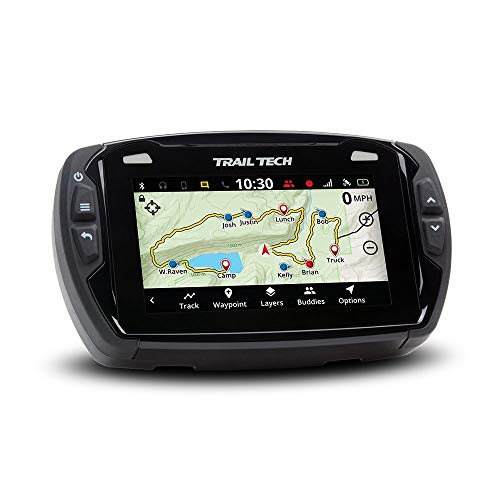
Trail Tech builds for powersport riders first, and the Voyager Pro is part navigator, part digital dash. Alongside mapping with topography and hill shading, it displays speed from GPS or a wheel sensor, plus engine temperature, distance, elevation, and voltage when wired with its sensors — useful on a sled, where temperature and voltage warnings can prevent a trailside repair. The 4-inch touchscreen has an anti-glare finish, the housing is sealed to IP67, and buddy tracking helps a group stay together.
Installation is the most workshop-heavy here: it hardwires in with dock and sensor leads, so plan time to route cables and set up sensors. Once fitted, it feels like part of the sled, and group riders who like data get something none of the Garmins offer.
Specs
- Display: 4-inch color touchscreen, anti-glare finish
- Weather sealing: IP67 sealed housing
- Data: Mapping with topography and hill shading, speed, temperature, distance, elevation, voltage (with sensors)
- Group feature: Buddy tracking
- Model: Voyager Pro 922-123, universal fit kit; Part: 922-123
- ASIN: B07P7WY4FC
Pros:
– Navigation and sled data on one dash display
– Buddy tracking for group rides
– Built for powersport vibration, dust, and water
Cons:
– Hardwired install takes the most time
– 4-inch screen shows less map at once
– Smaller map and app ecosystem than Garmin
How to choose
Start with how you ride. Groomed-trail tourers get the most from the Tread 2, whose preloaded snowmobile content and turn-by-turn trail guidance match that riding directly. Backcountry riders should weigh the Montana 700i or GPSMAP 67i, where inReach communication and off-trail mapping matter more than screen size.
Screen versus buttons. Big touchscreens are fastest to read and plan on, and both 6-inch units work with regular winter gloves. If you ride in mitts or extreme cold, the button-driven GPSMAP 67i removes touchscreen frustration entirely, at the expense of map area.
Mount and power. Use a rigid mount that keeps the screen in your glance line without blocking the sled’s gauges, plus a tether. Wire for machine power whenever the kit allows: cold drains batteries quickly. Route cables clear of steering movement and heat, and test full bar swing in the workshop.
Safety and backup. inReach messaging only works with an active plan, so set it up before the season. Update maps at home, carry a paper trail map, and tell someone your route — a GPS is an aid, not a guarantee.
FAQs
Will a motorcycle GPS work on a snowmobile?
Yes, with the right mount and wired power. The zumo XT2’s vibration tolerance, weather sealing, and handlebar mount adapt well to a sled. You give up dedicated snowmobile trail content, so check your trail maps can be loaded through its app.
How do I stop a GPS battery dying in the cold?
Wire the unit to sled power, mount it with some shelter from wind blast, and avoid leaving it on the sled overnight in extreme cold. Handheld users should keep the unit in an inside pocket at stops and carry a spare power source on multi-day trips.
Do I need a subscription for satellite SOS?
For the inReach Garmin models here, yes — messaging, tracking, and SOS run on an active satellite plan, separate from the device. Navigation and mapping work without it, but emergency communication does not, so activate and test it before remote rides.
What is the best mount position on a sled?
Centered on the bars or riser, tilted into your natural glance line, clear of the windshield and instrument cluster. Use the kit made for your device, add a tether, and check clearance at full steering lock with your usual gloves on.
Conclusion
For most riders, the Garmin Tread 2 is the best snowmobile GPS to buy: built for powersport use, loaded with snowmobile trails, and clean to mount and power. Choose the Montana 700i for one rugged handheld across sled, vehicle, and foot travel, or the GPSMAP 67i for endurance and glove-proof buttons. The zumo XT2 is the smart crossover for riders who also tour on two wheels, and the Voyager Pro stands alone for navigation plus live sled data in one dash. Mount it solidly, wire it for power, and you will spend less time guessing at junctions and more time riding.
Related guides
More from Amazon
Programs that pair well with the guide above. Offers and eligibility are set by Amazon and may change.
A free business account with business pricing and bulk-buying tools for work, shop or home office.
Create a business accountFree shipping on eligible items, Prime Video and more. Eligible new members can start with a free trial.
Start a Prime free trialAudiobooks and podcasts to listen to on the go. Eligible new members can start with a free trial.
Try Audible freeAd-free music streaming. Eligible new subscribers can start with a free trial.
Try Music Unlimited freeAs an Amazon Associate we earn from qualifying purchases.


Write Your Review
No reviews yet. Be the first to share your experience!