
Key takeaways
- Find the best motorcycle helmet for commuting, touring, and weekend rides, with full-face picks from Shoei, Arai, and Bell plus fit and safety advice.
What's inside
As an Amazon Associate I earn from qualifying purchases. This post may contain affiliate links at no extra cost to you.
As an Amazon Associate we earn from qualifying purchases.
What we cover
Introduction
A helmet is the one piece of riding gear you never leave behind, and it is also the piece where fit matters more than any feature list. The best motorcycle helmet for you matches your head shape, seals out wind without squeezing, and carries a current safety certification you trust. Get those basics right and everything else becomes a matter of how and where you ride.
This guide covers five full-face and dual-sport helmets from makers with long track records: Shoei, Arai, Bell, and GLX. Our take below looks at shell construction, liner design, shield systems, and ventilation, plus the comfort details that decide whether a helmet still feels good three hours into a ride. Whether you commute daily, tour on weekends, or split your miles between pavement and gravel, one of these picks should fit your riding and your head.
Disclosure: This post contains affiliate links. If you buy through links on this page, we may earn a commission at no extra cost to you.
Quick picks
- Best overall for highway miles: Shoei RF-1400 — quiet, stable, Snell-certified composite shell.
- Best for fit and finish: Arai Regent-X — Intermediate Oval shape with plush cheek pads.
- Best everyday full-face: Bell Qualifier — light polycarbonate shell, anti-fog shield, speaker pockets.
- Best for mixed pavement and dirt: Bell MX-9 Adventure MIPS — shield and peak in one helmet.
- Best compact shape: GLX GX11 — light full-face with quick-change shield and washable interior.
1. Shoei RF-1400 Full-Face Helmet

The RF-1400 is Shoei’s flagship sport-touring helmet, refined in the maker’s own wind tunnel for less lift, drag, and noise than the model it replaced. The Multi-Ply Matrix AIM+ shell layers fiberglass with high-performance fibers over a dual-layer, multi-density EPS liner. Six intake vents and four exhaust vents move steady air, while airtight shield beading keeps wind and rain out at highway speed.
In our practical notes, the interior is the standout. The 3D Max-Dry Interior System II wicks sweat faster than standard nylon, comes fully out for washing, and adjusts with optional pad thicknesses. The CWR-F2 shield swaps without tools and includes a Pinlock EVO insert in the box, and the Emergency Quick Release System lets responders pull the cheek pads clear after a crash.
Specs
- Shell: Multi-Ply Matrix AIM+ composite, hand-laid fiberglass layers
- Liner: Dual-layer, multi-density EPS
- Shield: CWR-F2 with Pinlock EVO insert included, breath guard and chin curtain in the box
- Ventilation: 6 intake vents, 4 exhaust vents
- Interior: 3D Max-Dry Interior System II, removable and washable
- Certification: Snell M2020 and DOT, FMVSS 218
- Weight: About 3.64 lb
- ASIN: B08QRLJ36N
Pros:
– Very quiet and stable at highway speed
– Snell and DOT certification in a compact shell
– Pinlock insert, breath guard, and chin curtain included
Cons:
– No internal drop-down sun shield
– Fit runs snug at first and needs a break-in period
2. Arai Regent-X Helmet
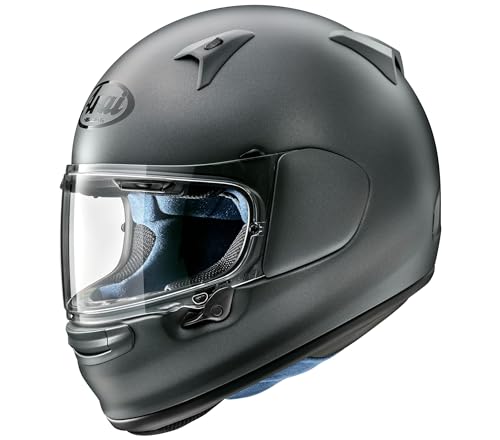
Arai builds every shell by hand around one idea: a smooth, round shape that glances off surfaces instead of catching on them. The Regent-X uses Peripherally Belted Complex Laminate Construction, adding a reinforcing belt around the shell to keep it strong without bulk. The Variable Axis System moves the shield pivot lower, smoothing the temple area, and the shell base flares outward by 5 mm so the helmet pulls on without folding your ears.
Our take: the Regent-X is the comfort pick for riders whose heads sit between shapes. Its Intermediate Oval fit and Facial Contour System cheek pads use a foam spring to cradle the jaw, spreading pressure evenly on long rides. Dual intakes, brow vents, and a three-position chin vent feed five exhausts, and the VAS-V MAX Vision shield is Pinlock ready with a latch position that cracks it open for de-misting.
Specs
- Shell: PB-cLc laminate with Peripheral Belt reinforcement
- Liner: One-piece, multi-density EPS
- Shield: VAS-V MAX Vision, Pinlock ready, de-mist latch position
- Fit: Intermediate Oval, Facial Contour System cheek pads
- Ventilation: Dual intakes, brow vents, 3-position chin vent, 5 exhausts
- Interior: Semi-removable liner
- Certification: Snell M2020 and DOT
- ASIN: B0F9XWFF2Y
Pros:
– Plush, even pressure with no single hotspot for many riders
– Smooth round shell philosophy with Snell certification
– Shield latch cracks open for airflow and de-misting
Cons:
– Shield changes take more practice than rival systems
– No internal sun shield, so plan on a tinted shield or sunglasses
3. Bell Qualifier Full-Face Helmet

The Qualifier borrows styling and features from Bell’s flagship line and puts them in a lightweight polycarbonate shell suited to daily riding. The ClickRelease shield swaps in seconds without tools and carries a NutraFog II coating that resists fogging, scratching, and UV damage. A padded wind collar cuts road noise around the neck roll, and contoured cheek pads include integrated speaker pockets.
In our practical notes, ventilation is simple and effective. The Velocity Flow system with FlowAdjust opens or closes vents to match the weather, and the removable, washable liner keeps the interior fresh through a commuting season. The padded chin strap uses a classic D-ring closure many riders prefer.
Specs
- Shell: Lightweight polycarbonate and ABS construction
- Liner: EPS with removable, washable interior
- Shield: ClickRelease NutraFog II, anti-fog, anti-scratch, UV protective
- Ventilation: Velocity Flow system with FlowAdjust
- Closure: Padded chin strap with D-ring
- Extras: Speaker pockets, padded wind collar
- Certification: DOT and ECE, FMVSS 218
- Weight: About 3.5 lb
- ASIN: B00HLUWN34
Pros:
– Fast, tool-free shield changes
– Speaker pockets ready for a comms unit
– Light shell that is easy on the neck in traffic
Cons:
– Shield ships clear only, tinted shield is separate
– Vent sliders feel basic next to premium rivals
4. Bell MX-9 Adventure MIPS Helmet

The MX-9 Adventure answers a common problem for dual-sport riders: you want a shield for the road and an open eyeport for goggles when the pavement ends. Its flip-up shield is anti-fog and anti-scratch treated and removes entirely for goggle use, while the adjustable peak stays on for sun or comes off for a cleaner profile. Under the polycarbonate shell, a MIPS low-friction layer is designed to reduce rotational forces in an angled impact.
Our take: this is the most versatile helmet here. Three shell sizes keep the profile proportional, quick-drying Ionic+ padding handles sweat on slow trails, and speaker pockets help on group rides. It carries DOT and ECE 22.06 certification per the listing, unusual for a helmet this capable off pavement.
Specs
- Shell: Polycarbonate, 3 shell sizes
- Liner: EPS with MIPS rotational protection, Ionic+ quick-drying padding
- Shield: Removable anti-fog, anti-scratch shield, goggle compatible
- Peak: Adjustable and removable
- Certification: DOT, FMVSS 218, and ECE 22.06 per listing
- ASIN: B094XJRTM3
Pros:
– Shield for the road, open eyeport for goggles off-road
– MIPS protection with DOT and ECE coverage
– Three shell sizes for a better proportional fit
Cons:
– Heavier than a pure off-road helmet
– Peak can catch wind at sustained highway speed
5. GLX GX11 Compact Full-Face Helmet

The GX11 takes a simpler route: a compact ABS full-face shell, a multi-density EPS liner, and a quick-change shield system for swapping between the included tinted shield and a clear shield. Three adjustable intake vents and four exhaust outlets follow a wind-tunnel-tested layout, and at a listed 3.1 pounds the shell feels light on the neck in stop-and-go riding.
In our practical notes, the GX11 fits snugly, so riders between sizes will usually be happier sizing up. The interior removes for washing, and the compact profile stores easily in a top case or workshop cabinet. It is listed for motorcycle, ATV, UTV, and go-kart use and meets DOT requirements under FMVSS 218. The tinted shield is for daylight only; swap to clear after dark.
Specs
- Shell: ABS, compact profile, hard shell
- Liner: Multi-density EPS
- Ventilation: 3 adjustable intakes, 4 exhaust outlets, 7 vents total
- Shield: Quick-change system, tinted shield included
- Interior: Removable and washable
- Weight: About 3.1 lb listed
- Certification: DOT, FMVSS 218 tested by SGS
- ASIN: B078893N66
Pros:
– Compact, light shell that stores easily
– Quick shield swaps between tinted and clear
– Washable interior for daily warm-weather use
Cons:
– Snug fit, many riders should size up
– Tinted shield must not be used at night
– Fewer premium comfort features than the Shoei or Arai
How to choose
Start with head shape, because it decides comfort more than any vent or shield. Most riders fall into an Intermediate Oval shape, which the Arai Regent-X and Shoei RF-1400 both target, but rounder and narrower shapes exist across brands. Measure around your head just above your eyebrows and ears, match the number to the maker’s chart, then wear the helmet indoors for fifteen minutes. It should feel evenly snug, with no forehead hotspot and no roll when you shake your head.
Next, weigh certification. DOT under FMVSS 218 is the legal baseline in the United States. Snell certification, carried by the Shoei and Arai here, adds a voluntary standard with its own test protocol, and ECE approval, found on the Bell picks, reflects the European standard. A helmet carrying two certifications has passed two test regimes, which many riders find reassuring.
Then match the helmet to your riding. Highway commuters and tourers benefit from a quiet, aerodynamic full-face like the RF-1400, plus a Pinlock insert for cold mornings. Dual-sport riders should look at the MX-9 Adventure, where the shield handles the road and the eyeport takes goggles for dirt. Around-town riders may prefer the compact, light GX11. Check that the liner removes for washing and that the closure feels secure with gloves on. Replace any helmet after a crash impact, and retire a hard-used helmet after several seasons.
FAQs
How tight should a new motorcycle helmet feel?
Snug everywhere, painful nowhere. Cheek pads press firmly at first and break in over the first few rides, but the crown should never create a single pressure point. If you get a headache within fifteen minutes indoors, try a different size or head shape rather than hoping it loosens up.
What is the difference between DOT, Snell, and ECE helmets?
DOT is the United States federal standard, self-certified by the maker under FMVSS 218. Snell is a voluntary, independent standard with laboratory testing of samples. ECE is the European standard used in many countries. Each tests impact management differently, so a helmet carrying two has been checked against two protocols.
Can I wear one helmet for street riding and trail riding?
Yes, if it is built for both. A dual-sport design like the Bell MX-9 Adventure pairs a road shield with a goggle-friendly eyeport and a peak, so it handles pavement and dirt in one shell. A pure street helmet works on a trail in a pinch, but its vents and shield are not made for dust and low-speed heat.
When should I replace my helmet?
Replace it after any crash where it struck the ground or another object, if the EPS liner looks compressed or crumbling, if the shell shows cracks or deep dents, or if the fit has gone loose even with fresh pads. Sweat, sun, and time degrade materials, so retire a daily-use helmet after several seasons regardless.
Conclusion
For most riders, the Shoei RF-1400 is the best motorcycle helmet to live with daily, thanks to its quiet shell, strong certification, and washable, adjustable interior. The Arai Regent-X answers with hand-built finish and a forgiving fit, the Bell Qualifier keeps daily riding simple and light, the MX-9 Adventure MIPS covers riders who split time between road and trail, and the GLX GX11 offers compact full-face coverage that is easy to store. Measure your head, try your size on properly, and choose the helmet you will happily wear on every ride.
Related guides
More from Amazon
Programs that pair well with the guide above. Offers and eligibility are set by Amazon and may change.
A free business account with business pricing and bulk-buying tools for work, shop or home office.
Create a business accountFree shipping on eligible items, Prime Video and more. Eligible new members can start with a free trial.
Start a Prime free trialAudiobooks and podcasts to listen to on the go. Eligible new members can start with a free trial.
Try Audible freeAd-free music streaming. Eligible new subscribers can start with a free trial.
Try Music Unlimited freeAs an Amazon Associate we earn from qualifying purchases.



Write Your Review
No reviews yet. Be the first to share your experience!