What's inside
- Contents
- What you are actually breathing when you weld
- Respirator types for welding
- Filter ratings and labels
- Fitting a respirator under a welding helmet
- Seal, facial hair, and fit testing
- Special cases: stainless, galvanized, and coated metal
- Ventilation comes first
- Care, storage, and filter replacement
- Common mistakes
- Who should choose what
- Buying checklist
- Frequently asked questions
- Conclusion
As an Amazon Associate I earn from qualifying purchases. This post may contain affiliate links at no extra cost to you.
Short answer: for most home shops, a reusable half-mask respirator with particulate filters rated at the P100 level, or the equivalent rating in your region, is the practical starting point for welding fume. A powered air-purifying respirator (PAPR) built to work with a welding helmet is a more comfortable step up for long sessions or heavy fume. Disposable masks can help with light work but fit poorly under many helmets. No respirator works unless it seals to your face, matches the hazard, and has its filters checked against the official label. Respirators are a last layer after ventilation and fume extraction, not a replacement for them.
What we cover
- Contents
- What you are actually breathing when you weld
- Respirator types for welding
- Filter ratings and labels
- Fitting a respirator under a welding helmet
- Seal, facial hair, and fit testing
- Special cases: stainless, galvanized, and coated metal
- Ventilation comes first
- Care, storage, and filter replacement
- Common mistakes
- Who should choose what
- Buying checklist
- Frequently asked questions
- Conclusion
Our Top Picks
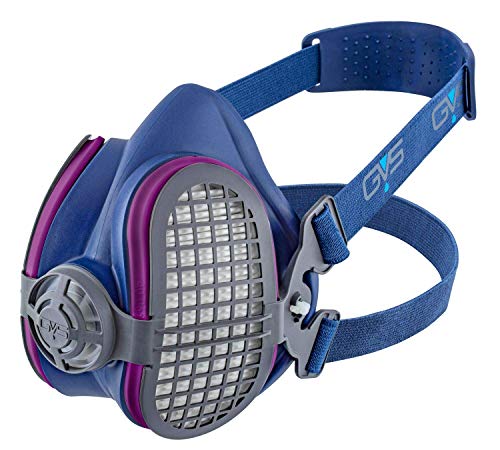 GVS SPR457 Elipse P100 Dust Half Mask Respirator1 Count (Pack of 1)5 x 4 x 4 inches0.4 PoundsCheck on Amazon

Contents
- What you are actually breathing when you weld
- Respirator types for welding
- Filter ratings and labels
- Fitting a respirator under a welding helmet
- Seal, facial hair, and fit testing
- Special cases: stainless, galvanized, and coated metal
- Ventilation comes first
- Care, storage, and filter replacement
- Common mistakes
- Who should choose what
- Buying checklist
- Frequently asked questions
- Conclusion
What you are actually breathing when you weld
The visible smoke over a weld is a cloud of very fine particles formed when metal vaporizes in the arc and condenses in cooler air. These particles are small enough to travel deep into the lungs. What is in them depends on the base metal, the filler, any coating, and the process. Mild steel fume contains iron oxides and typically some manganese. Stainless steel fume can contain chromium compounds, including hexavalent chromium, and nickel. Galvanized steel releases zinc oxide, which is associated with a short-term flu-like illness often called metal fume fever. Paint, oil, plating, and cleaning solvents on the workpiece add their own hazards.
Gases are a separate issue. Shielding gas can displace oxygen in an enclosed space. The arc’s ultraviolet light can form ozone and nitrogen oxides. Degreasers containing certain chlorinated solvents can break down in arc light into harmful compounds, which is one reason you never weld on parts that are still wet with solvent.
Particulate filters do not remove gases. That single fact shapes the whole buying decision: a respirator that is excellent against fume particles may do nothing against a solvent vapor or an oxygen-poor atmosphere. Keep in mind too that exposure limits and health guidance come from regulators and medical professionals. This article is general information, not medical or occupational-health advice.
Respirator types for welding
Disposable filtering facepieces
These are the familiar cup or flat-fold masks where the whole mask is the filter. They are inexpensive and light, and some carry an exhalation valve. Their weakness for welding is shape: many are bulky around the nose and can push a helmet out of position or leave gaps. Spatter can also burn through the fabric. Some models are marketed as suitable for welding; check the manufacturer’s statement and the label rather than assuming.
Reusable half-mask respirators
A half mask covers the nose and mouth with a rubber or silicone body and uses replaceable cartridges or filters. They seal better than most disposables, can be used for years, and low-profile designs sit better under a helmet. Because the filter stage is replaceable, you can match filters to the job.
Powered air-purifying respirators
A PAPR uses a battery-driven blower to push filtered air through a hose into a hood or helmet. Models intended for welding integrate with the welding helmet. They tend to be more comfortable in heat because airflow cools the face, and many types need no tight face seal because they create positive pressure inside the hood. They cost more, require battery and filter upkeep, and are heavier on the belt.
| Type | Strengths | Limits | Typical home-shop fit |
|---|---|---|---|
| Disposable filtering facepiece | Low cost; light; no maintenance | Fit varies; often clashes with helmets; short service life | Occasional light work, grinding, cleanup |
| Half-mask with replaceable filters | Better seal; reusable; filters can be matched to the task | Needs cleaning and proper storage; must be fit checked each use | Regular welding with a low-profile design under the helmet |
| PAPR with welding helmet | Comfortable in heat; less reliance on a tight seal; integrates head and breathing protection | Higher cost; batteries; noise; airflow must be maintained | Long sessions, heavy fume, stainless work |
Filter ratings and labels
Filter markings are standardized, but the system differs between regions. In the United States, NIOSH certifies particulate filters in three series by oil resistance: N for not oil resistant, R for somewhat oil resistant, and P for oil proof. Each comes in efficiency levels of 95, 99, or 100, meaning the minimum percentage of test particles removed. A P100 is the highest particulate efficiency and is oil proof, which is why it is common advice for welding fume. In Europe, filtering facepieces are classed FFP1, FFP2, and FFP3 under EN 149, with FFP3 the highest, and many reusable filters carry P1, P2, or P3 under EN 143. Other countries have their own marks.
What this means in practice:
- Look for the approval number and the manufacturer’s markings printed on the filter or mask, not just a claim on a listing.
- Check that the filter model is approved for use with your specific respirator body. Mixing parts from different makers can void the approval.
- Particulate filters stop particles. If you also face vapors, such as solvent or paint fumes during prep, you need the right gas or vapor cartridge, often combined with a particulate layer. The label states what the cartridge is for.
- A rating describes lab performance. Real-world protection depends on fit, use, and maintenance.
Fitting a respirator under a welding helmet
This is where many home welders run into trouble. A good respirator is useless if you cannot wear it with your helmet. Consider these points before buying:
- Profile. A low-profile half mask with side-mounted filters tends to leave more room for the helmet’s chin area than a mask with a large front cartridge.
- Helmet geometry. Some helmets sit close to the face and press on a mask; others have a deeper shell. Try the combination in the positions you weld in, including looking down at a bench.
- Spatter exposure. Filters and straps near the arc can catch spatter. Position the helmet so it shields the mask, and replace any filter with burn marks.
If you are shopping for something that works well with a helmet, a low-profile half-mask respirator and matching particulate filters is a typical combination to research, and checking the maker’s compatibility statements saves returns.
Seal, facial hair, and fit testing
A tight-fitting respirator only works if air is forced through the filter rather than around the edges. Facial hair across the sealing area breaks the seal, which is why workplaces typically require clean-shaven skin where the mask meets the face. A beard, heavy stubble, or even long sideburns can leak. If you cannot be clean-shaven, a loose-fitting powered hood is often discussed as an alternative, but verify the manufacturer’s claims and any local rules.
In regulated workplaces, respirator users receive a medical evaluation and a formal fit test with a qualitative or quantitative method. A home shop is not a regulated workplace, but the logic still applies. At minimum:
- Choose the size recommended by the maker, trying more than one if the mask is available in multiple sizes.
- Seat the mask and tighten the lower straps first, then the upper straps, following the instructions.
- Perform a user seal check every time you put it on. Typically this means covering the filters and inhaling gently to see if the mask pulls slightly against your face, then covering the exhalation valve and exhaling gently. Use the method in your manual.
- Move your head, talk, and look down to check that the seal holds.
- If you cannot get a seal, try another size or model, or consider another type.
Respirators also add breathing resistance and heat. People with heart, lung, or other medical conditions should check with a physician before using one for extended periods. If you feel dizzy, short of breath, or smell something through the mask, leave the area and check your equipment.
Special cases: stainless, galvanized, and coated metal
The base metal can change your risk profile more than the welding process. Some situations deserve extra caution:
- Stainless steel. Fume may contain hexavalent chromium, a substance of particular health concern. Use good local exhaust and a respirator suited to the task, and consult an occupational health resource for exposure limits that apply to you.
- Galvanized steel. Zinc coating produces fume that can cause metal fume fever. Grinding off the coating in the weld zone first reduces the fume, but grinding itself produces dust that needs protection.
- Painted, plated, or oily metal. Coatings may include lead, cadmium, or other substances. Cadmium in particular is hazardous. If you are unsure of what is on a part, remove the coating where possible or avoid welding it.
- Solvent-wet parts. Never weld on parts wet with degreaser, especially chlorinated types.
| Situation | Main hazard | What to look for |
|---|---|---|
| Short MIG welds on clean mild steel with good ventilation | Particulate fume | Particulate respirator with a high-efficiency rating, plus fume extraction or airflow |
| Long sessions on mild steel in a small garage | Fume buildup and heat | Local exhaust, half mask with high-efficiency filters, or a welding PAPR |
| Stainless or high-alloy work | Fume containing chromium and nickel | Local exhaust and an appropriately approved respirator or PAPR; seek exposure guidance |
| Galvanized or coated parts | Zinc and coating fume | Remove coating first, ventilate strongly, use an approved particulate respirator |
| Grinding and prep | Metal dust, sometimes solvent vapor | Particulate respirator; add vapor cartridges only if the label matches the solvent |
| Confined spaces | Oxygen displacement, concentrated fume | Do not rely on a filter; seek professional guidance and supplied-air equipment |
Ventilation comes first
Safety professionals describe a hierarchy of controls. Eliminating or reducing the hazard at its source beats relying on personal equipment. For welding, that means:
- Local exhaust. A fume extractor or hood placed near the arc captures fume before it reaches your face. This is usually the most effective home upgrade.
- General ventilation. Open doors and use fans that move air across the work and out of the shop, with makeup air entering somewhere sensible. Be careful with fans that blow across the weld, because they can disturb shielding gas and ruin the weld.
- Position yourself. Keep your head out of the plume, work with the fume rising away from your face, and avoid welding in a dead-air corner.
A respirator then covers whatever remains. Do not assume a mask lets you skip extraction.
Care, storage, and filter replacement
A respirator that is dirty, warped, or loaded with dust will not do what the label says. Basic habits keep it working:
- Inspect the mask, straps, valves, and gaskets before each use. Replace cracked, stretched, or stiff parts.
- Clean the face piece as the maker directs, usually with mild soap and warm water, then dry it completely. Do not use solvents that degrade rubber or silicone.
- Store it in a sealed container or bag, away from dust, sunlight, heat, and chemicals.
- Replace filters when breathing becomes noticeably harder, when they are damaged or soiled, or per the maker’s schedule. For gas and vapor cartridges, odor breakthrough means they are exhausted, but many hazards give no warning, so follow the maker’s guidance on service life and date stamps.
Common mistakes
- Using a dust mask or cloth mask. Craft dust masks and cloth coverings are not designed for welding fume and are not certified for that purpose.
- Skipping the seal check. A mask that leaks around the nose or cheeks may feel fine but provides little benefit.
- Relying on the respirator instead of ventilation. The respirator is the last layer.
- Wearing a particulate filter against vapors. A fume filter does not remove solvent vapors or most gases.
- Ignoring facial hair. Stubble can break the seal.
- Using expired or damaged filters. Check dates, condition, and storage.
- Welding unknown coatings. If you do not know what is on the metal, do not guess.
Who should choose what
The weekend hobbyist doing short MIG welds on clean steel. A half mask with high-efficiency particulate filters, plus an open door and a fan positioned to carry fume away, covers most needs. Add a fume extractor if you can.
The home fabricator who welds for hours. Consider a welding PAPR for comfort and consistency. A hot, tight half mask tends to get pushed aside, and a comfortable system is one you actually use.
The stainless or aluminum hobbyist. Raise your guard. Use local exhaust, an approved respirator, and consult authoritative exposure guidance for the alloy you are welding.
The restorer working on old, painted, or plated parts. Identify the coating, strip it where possible, and match the filter to the hazard. Be wary of lead paint and cadmium plating.
If your helmet is already in good shape and you want an integrated option, researching a welding PAPR system that explicitly lists compatibility with your helmet is a sensible next step, along with replacement P100 particulate filters sold for your specific respirator body.
Buying checklist
- Identify the metals, coatings, and processes you actually use.
- Read the official approval markings on the respirator and filters, and compare with the maker’s documentation.
- Confirm that the filters are approved for your respirator body.
- Choose a particulate rating at or above the level recommended for welding fume.
- Check whether you also need gas or vapor cartridges for prep and cleaning work.
- Test fit with your own helmet and eyewear in real welding positions.
- Shave where the mask seals, or choose a type that does not rely on a tight face seal.
- Plan local exhaust and general ventilation before relying on a mask.
Frequently asked questions
Do I really need a respirator for welding at home?
Welding fume is a recognized health hazard, and a home garage is often poorly ventilated. Good extraction and airflow should come first, and a properly fitted respirator adds a layer. Your metals, coatings, and session length determine how much you need.
Is an N95 mask good enough for welding?
An N95 filters at a lower efficiency than a P100 and is not oil proof, and disposable shapes often fit poorly under helmets. For light work it may help, but check the label and consider a higher-rated, better-sealing option for regular welding.
What does P100 mean?
The P means oil proof, and 100 means the filter is certified to remove at least 99.97 percent of test particles under standardized conditions. That describes lab performance, not a guarantee of protection in your shop.
Will a respirator protect me from all welding fumes?
No. Particulate filters do not remove gases or vapors, and a poor seal lets unfiltered air in. A respirator reduces exposure when chosen, fitted, and maintained correctly, but it does not remove all risk.
Can I wear a respirator under my welding helmet?
Often yes, with a low-profile half mask and a helmet that has enough room. Test the combination in working positions. If it does not fit well, consider a PAPR built for use with a welding helmet.
How often should I replace filters?
There is no single schedule. Replace them when breathing resistance rises, when they are damaged or burned, or according to the maker’s guidance. Gas and vapor cartridges also have service-life limits stated by the maker.
Are PAPRs worth the cost for a home shop?
If you weld for long sessions, work in the heat, or have difficulty getting a seal, a PAPR can be worth considering. For occasional short welds, a well-fitted half mask plus good ventilation is usually the practical choice.
Does a respirator replace a fume extractor?
No. Removing fume near the source reduces exposure for the whole space, while a respirator protects only the wearer and depends on fit. Using both is a common approach for regular work.
Conclusion
The best welding respirator for a home shop is the one you can seal against your face, wear with your helmet, and keep supplied with the right filters. For many hobbyists, that means a low-profile half mask with high-efficiency particulate filters. For long or heavy-fume sessions, a welding PAPR deserves a close look. Whatever you choose, verify approval markings against official labels and standards, learn the seal check, keep gear clean, and build your protection from the top down: source control and ventilation first, respirator last. When your work involves stainless steel, coated parts, or confined spaces, ask a qualified safety or medical professional before you strike an arc.
Disclosure: As an Amazon Associate, we earn from qualifying purchases. Links marked as sponsored may earn us a commission at no extra cost to you.
