What's inside
- Top 3 Picks
- Quick Comparison
- How We Chose
- 1. HQUA-TWS-12 UV Water Purifier — Best for Most RVers
- 2. HQUA WF3-03 3-Stage Free-Standing System — Best for Well Water and Heavy-Metal Concerns
- 3. iSpring UVF11A UV Water Filter — Best Budget Pick for Under-Sink RO
- 4. Purewell Portable Electric RO with UV — Best for Boondocking and Travel
- 5. Aquaboon 55W 12 GPM UV System with Smart Flow Sensor — Best for Full-Timers Who Manage Power
- 6. DYLSDFQ 55W 12 GPM Whole House UV — Best Budget High-Flow Option
- Top 3 Picks
- Quick Comparison
- How We Chose
- 1. HQUA-TWS-12 UV Water Purifier — Best for Most RVers
- 2. HQUA WF3-03 3-Stage Free-Standing System — Best for Well Water and Heavy-Metal Concerns
- 3. iSpring UVF11A UV Water Filter — Best Budget Pick for Under-Sink RO
- 4. Purewell Portable Electric RO with UV — Best for Boondocking and Travel
- 5. Aquaboon 55W 12 GPM UV System with Smart Flow Sensor — Best for Full-Timers Who Manage Power
- 6. DYLSDFQ 55W 12 GPM Whole House UV — Best Budget High-Flow Option
As an Amazon Associate I earn from qualifying purchases. This post may contain affiliate links at no extra cost to you.
For most RVers, the best UV water purification system for RVs is the HQUA-TWS-12, a 12 GPM, 120-volt inline unit that ships with a spare UV lamp. It fits the largest group of buyers: anyone with a wet bay or utility closet, 120-volt power from shore, a generator, or an inverter, and a fresh-water system that needs a microbiological safety net without adding a bulky appliance. Twelve gallons per minute is roughly three to four times what a typical RV pump delivers, so the lamp sees slow-moving water and delivers far more UV dose than its rating implies. If you have no 120-volt power or want to treat water at a single faucet, the iSpring UVF11A is the budget pick. If you have a large rig with several simultaneous draws, the Ziwshom 110W 24 GPM unit is the premium pick. UV does one job: it inactivates microorganisms as water passes the lamp. It does not remove sediment, chlorine, lead, PFAS, or dissolved solids — those require filtration or reverse osmosis upstream. Everything below is general product information, not medical advice. If you have a specific health concern about your water supply, have it tested and speak with a professional.
What we cover
- Top 3 Picks
- Quick Comparison
- How We Chose
- 1. HQUA-TWS-12 UV Water Purifier — Best for Most RVers
- 2. HQUA WF3-03 3-Stage Free-Standing System — Best for Well Water and Heavy-Metal Concerns
- 3. iSpring UVF11A UV Water Filter — Best Budget Pick for Under-Sink RO
- 4. Purewell Portable Electric RO with UV — Best for Boondocking and Travel
- 5. Aquaboon 55W 12 GPM UV System with Smart Flow Sensor — Best for Full-Timers Who Manage Power
- 6. DYLSDFQ 55W 12 GPM Whole House UV — Best Budget High-Flow Option
Top 3 Picks
Best Overall: HQUA-TWS-12 UV Water Purifier
A 12 GPM, 120-volt whole-house-class purifier that includes a spare UV lamp, which effectively covers your first replacement. It suits the typical RVer with a wet bay, standard plumbing adapters, and 120-volt power available, because the flow headroom means a slow RV pump gets a generous dose and the simple inline design has almost nothing to fail. It is the safest all-round choice for a permanent installation.
Best Budget: iSpring UVF11A
An 11-watt-class under-sink UV unit designed to sit downstream of a reverse osmosis system or an under-sink filter. It suits small trailers, van conversions, and anyone who already runs an RO faucet and wants a final UV stage at the point of use. It is inexpensive, tiny, and easy to mount, but it cannot treat whole-RV flow — it treats only what passes through a single faucet line.
Best Premium: Ziwshom 110W 24 GPM
A 110-watt, 24 GPM unit with 1-inch MNPT ports, built for large fifth wheels, toy haulers, bus conversions, and park models where the shower, washer, and outdoor kitchen can all be running at once. The higher wattage and bigger chamber give the most dose margin of anything in this roundup, at the cost of a much larger power draw and a much larger physical footprint.
Quick Comparison
| Product | Best for | Key specs from the listing | Price tier |
|---|---|---|---|
| HQUA-TWS-12 UV Water Purifier | Most RVers; permanent inline install with 120V available | 12 GPM, 120V AC, whole-house class, includes 1 extra UV lamp | Mid-range |
| HQUA WF3-03 3-Stage Free-Standing System | Well water, rural hookups, park models, heavy-metal concerns | 3-stage free-standing whole-house filtration with UV stage included, marketed as reducing heavy metals | Premium |
| iSpring UVF11A | Under-sink RO systems, small trailers, point-of-use drinking water | 11W-class UV, designed for under-sink and RO systems, low-flow, compact | Budget |
| Purewell Portable Electric RO with UV | Boondocking, overlanding, travel without plumbing modifications | Portable countertop RO with UV stage, marketed as removing PFAS, requires power and a water source | Budget |
| Aquaboon 55W 12 GPM UV System | Full-timers who want on-demand power draw and high flow | 55W, 12 GPM, whole-house UV with smart flow sensor switch | Mid-range |
| DYLSDFQ 55W 12 GPM Whole House UV | Budget builds that still want 55W and 12 GPM | 55W, 120V, 12 GPM, 3/4-inch MNPT ports, high-flow whole-home design | Budget |
| Ziwshom 110W 24 GPM UV | Large rigs, bus conversions, multiple simultaneous draws | 110W, 24 GPM, 1-inch MNPT, whole-home high-flow, spares included per listing | Premium |
How We Chose
This roundup is built from published manufacturer specifications, listing descriptions, and established facts about how UV disinfection behaves in a recreational vehicle water system. We did not test, benchmark, or own any of these units, and nothing here is a hands-on field report.
The selection criteria were deliberately practical rather than marketing-driven. First, category fit: every product had to be usable in an RV context, which immediately rules out industrial UV chambers and whole-house systems that assume a basement and unlimited floor space. Second, flow rating versus real RV demand — we favored units whose rated gallons per minute comfortably exceed what a 2.5 to 3.5 GPM RV pump actually delivers, because that headroom translates directly into dose margin. Third, power realism: a 120-volt unit on an inverter draws DC current, so wattage matters as much as flow rate for anyone who boondocks. Fourth, installation geometry — chamber length, port thread size, and the clearance needed to slide a lamp out are the three things that most often derail an RV install. Fifth, serviceability and upgrade path: lamp availability, filter consumables, and whether the unit can be bypassed for winterizing. Finally, we weighted the presence of a lamp-life indicator or flow-sensor switching, because those two features separate units that are convenient to live with from units that quietly stop working or quietly drain a battery bank.
1. HQUA-TWS-12 UV Water Purifier — Best for Most RVers
As an Amazon Associate we earn from qualifying purchases at no extra cost to you.

The HQUA-TWS-12 is the unit that fits the widest range of RV water systems. It is a whole-house-class UV purifier rated at 12 GPM and powered by 120 volts AC, and the package includes one extra UV lamp. For an RVer with a wet bay, a utility closet, or even a large under-bed compartment with a little vertical room, that combination is close to ideal: enough flow capacity that the lamp is never the bottleneck, a power requirement that any shore pedestal, generator, or adequately sized inverter can meet, and a spare lamp that covers the first replacement so the system does not sit dormant after month twelve.
Key Specs
- Flow rating: 12 GPM — roughly three to four times a typical RV pump’s delivery rate
- Power: 120V AC (requires shore power, generator, or an inverter on battery)
- Lamp: Low-pressure UV-C lamp; one spare lamp included in the box
- Housing: Stainless-steel reactor chamber class, the standard for whole-house UV
- Ports: 3/4-inch MNPT is the norm in this size class — confirm on the listing before you buy adapters
- Mounting: Bracket-mounted inline installation, typically vertical or horizontal in a wet bay
- Indicator: Ballast-style power indication; this is a simple unit without an elapsed-time lamp counter
Why It Works in an RV
The single most useful number here is 12 GPM against a real-world RV pump that moves somewhere between 2.5 and 3.5 gallons per minute. UV dose is a function of intensity multiplied by contact time, so pushing water through a 12 GPM chamber at 3 GPM means the water spends roughly four times as long near the lamp as the rating assumes. In practice that means a unit like this has real margin for the days when the incoming water is slightly cloudy or the quartz sleeve has picked up a little scale. It also means you can add a second fixture, or upgrade to a higher-flow pump, without replacing the purifier.
The spare lamp is more valuable than it sounds. UV lamps are a consumable, and the most common failure mode for RV UV systems is not a mechanical breakdown — it is an owner who never replaced the lamp because they did not have one on hand. Shipping with a spare removes that excuse entirely and pushes the first real consumable cost out roughly a year.
The simplicity is also a strength. There is no flow sensor, no digital counter, and no control board. You install it inline, you power it, and it runs. Fewer electronics means fewer things to corrode in a damp bay, and the lamp and quartz sleeve are the two service items you will actually touch.
Pros
- 12 GPM rating gives large dose margin over a standard RV pump
- Includes a spare UV lamp, covering the first year of consumables
- Standard 3/4-inch-class port sizing makes adapter sourcing straightforward
- No control electronics to corrode; simple inline install
- Widely supported brand with easy access to replacement lamps and sleeves
- Easy to bypass with a couple of fittings for winterizing
Cons
- 120V AC only — not a native 12-volt DC appliance
- Draws power continuously unless you switch it, which matters when boondocking
- No flow-sensor activation and no lamp-life counter
- No pre-filtration included, so sediment and carbon stages must be added upstream
- Freeze risk: water left in the chamber can crack the quartz sleeve
- Needs roughly a chamber-length of clear axial space to slide the lamp out for service
How It Compares
Against the Aquaboon 55W 12 GPM, the HQUA is the simpler, more install-and-forget choice, while the Aquaboon adds a smart flow sensor that turns the lamp on only when water is moving — a meaningful advantage if you spend weeks off-grid on a battery bank. Against the iSpring UVF11A, this is a completely different class of product: the iSpring treats a single low-flow faucet line at a fraction of the size and price, while the HQUA treats everything downstream of the installation point. If you have 120 volts, a little bay space, and a whole-RV mindset, the HQUA-TWS-12 is the default answer.
2. HQUA WF3-03 3-Stage Free-Standing System — Best for Well Water and Heavy-Metal Concerns
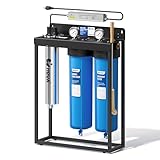
The WF3-03 is a different animal from a bare UV chamber. It is a free-standing, three-stage whole-house filtration system with a UV stage built in, and it is marketed as reducing heavy metals. That combination — sediment and carbon-type filtration plus a media stage aimed at metals, plus UV — addresses three problems that a UV-only unit cannot touch, and it does so in a single appliance rather than three separate housings plumbed together.
It suits a specific RV buyer: the full-timer parked on a private well or a rural hookup with questionable source water, the owner of a destination trailer or park model that does not move, or the RVer who wants one box on a pad outside the rig instead of a stack of cartridges crammed into a bay. If your water comes from a municipal system and you only want a microbiological backstop, this is more machine than you need.
Key Specs
- Configuration: 3-stage filtration with an integrated UV stage
- Form factor: Free-standing — it sits on the ground or a pad and connects with hoses or fittings
- Claimed capability: Marketed as reducing heavy metals, in addition to filtration and UV disinfection
- Power: 120V AC for the UV stage
- Consumables: Three filter stages plus the UV lamp, each on its own replacement interval
- Flow rating: Check the listing — free-standing multi-stage units typically carry a lower rated flow than a dedicated high-flow UV chamber of the same port size
Where It Earns Its Keep
Heavy metals are the specific reason this product exists in an RV conversation. UV light does not remove dissolved metals, sediment, or chlorine — it only inactivates microorganisms. If your source water has iron, manganese, or other metal content, a UV-only system leaves all of it in the glass. A staged system that includes a media stage aimed at metals is doing work that no UV chamber can do, and that is the honest argument for paying a premium here.
The free-standing design is also a genuine installation advantage in one narrow scenario: you do not have to cut into cabinetry or find mounting space inside the rig. You set it on a pad, run a supply hose in, run an outlet hose to the city water inlet, plug it in, and you are done. For a seasonal site or a park model, that is a twenty-minute job with no tools beyond a couple of wrenches.
The trade-off is that “free-standing” is the opposite of “travel-friendly.” This is not a device you stow for a travel day. It is a device you install where you park. If your RV actually moves every week, this belongs on a short list of products you admire and do not buy.
Pros
- Combines filtration, metal reduction, and UV in one appliance
- Free-standing format requires no interior cabinetry modification
- Addresses contaminants that UV alone cannot remove
- Same brand ecosystem as the HQUA-TWS-12, so lamp sourcing is familiar
- Ideal for seasonal sites, park models, and well-water hookups
Cons
- Premium tier pricing, and the most expensive ownership cost in this roundup
- Large footprint and weight — not practical to move with the rig
- Four consumables to track: three filter stages plus the UV lamp
- Needs 120V at the installation point, which usually means an exterior outlet
- Freeze protection is mandatory; exterior housings crack if left full in a hard freeze
- Rated flow is typically lower than a dedicated 12 GPM UV chamber — verify before you plan on high demand
How It Compares
Against the HQUA-TWS-12, the two products share a brand but not a mission. The TWS-12 is a mobile, inline, UV-only device that treats water inside your plumbing; the WF3-03 is a stationary, multi-stage appliance that treats water before it enters the rig. If you move, buy the TWS-12. If you park on a well and want one box to solve sediment, taste, metals, and microbes, the WF3-03 is the more complete answer — provided you have somewhere permanent to put it and a way to keep it from freezing.
3. iSpring UVF11A UV Water Filter — Best Budget Pick for Under-Sink RO

The iSpring UVF11A is the smallest and cheapest way into UV disinfection in this roundup, and it is designed for a specific job: sitting downstream of an under-sink water filter or reverse osmosis system. The model designation points to an 11-watt-class lamp, and units in this class are built for the low delivery rate of an RO faucet — typically well under a gallon per minute — rather than for whole-RV flow. That is not a limitation so much as a design intent, and understanding it is the difference between a smart purchase and a disappointing one.
It suits the RVer who already has an under-sink RO system and wants a final disinfection stage at the drinking-water faucet, plus small-trailer and van owners who have almost no installation space and only care about the water they actually drink. It also suits anyone on a tight budget who wants to test whether UV is worth the fuss before committing to a whole-house install.
Key Specs
- Class: 11-watt UV lamp class, based on the model designation
- Intended use: Under-sink water filters and reverse osmosis systems
- Flow: Low-flow by design, matched to a drinking-water faucet rather than a whole-RV system
- Connections: Small-diameter quick-connect fittings typical of RO tubing
- Footprint: Compact chamber roughly the size of a large drinking glass — easy to mount on a cabinet wall
- Power: 120V AC outlet required under the sink or at the cabinet
Why Low Flow Is Actually Good Here
Dose is intensity multiplied by contact time, and contact time goes up as flow goes down. A small 11-watt lamp in a narrow chamber with water trickling through at a fraction of a gallon per minute can deliver a very respectable dose precisely because the water is not moving quickly. This is the same physics that makes a 12 GPM unit perform so well on a 3 GPM RV pump, just scaled down. The catch is that the narrow chamber has less tolerance for turbidity — any sediment, iron, or cloudiness upstream shields the lamp and reduces performance — which is why the pre-filter or RO membrane ahead of it is not optional.
In practice, an RO membrane followed by a UV stage is one of the most thorough small-scale drinking-water setups you can put in an RV. The membrane handles dissolved contaminants and particulates; the UV handles anything biological that made it through or that grew in the storage tank. The two stages cover different failure modes, which is why they are so often paired.
Pros
- Lowest entry price of any product in this roundup
- Very small footprint — fits under almost any RV sink
- Very low power draw compared with whole-house units
- Low flow rate means high contact time and good dose for the lamp size
- Natural complement to an existing under-sink RO system
- Simple installation on flexible RO tubing
Cons
- Treats one faucet, not the whole RV — shower and tank water are unaffected
- Requires a 120V outlet inside the cabinet, which many RVs lack
- Depends entirely on upstream filtration; turbid water defeats it
- Small chamber means a smaller quartz sleeve and less forgiving maintenance
- Not appropriate for filling a fresh tank or supplying a shower
How It Compares
Against the Purewell Portable Electric RO with UV, this is the installed, permanent version of the same idea. The Purewell is portable and can run from a bucket or a hose anywhere you have power, which suits overlanders and boondockers who refuse to modify their plumbing; the iSpring is cheaper, smaller, and permanently mounted, but it only works where you have a water line and an outlet. Against the HQUA-TWS-12, the comparison is scope: the iSpring protects your drinking glass, the HQUA protects everything downstream of the wet bay. If you want to disinfect the shower and the tank too, you need the bigger unit.
4. Purewell Portable Electric RO with UV — Best for Boondocking and Travel

The Purewell Portable Electric RO with UV is the only product in this roundup that requires no installation at all. It is a portable reverse osmosis system with a UV stage, marketed as removing PFAS, and it produces drinking water on demand from a bucket, a hose, or a faucet adapter. For anyone who does not want to cut into an RV water system — or who splits time between a rig, a tent, and a rental — that flexibility is the entire point.
It suits boondockers who want genuinely high-quality drinking water without a plumbing project, overlanders and van lifers with limited space, and RVers who are uneasy about tank water but not ready to install a permanent system. It also suits anyone dealing with a specific dissolved-contaminant concern, because reverse osmosis removes things UV cannot: dissolved solids, PFAS-class compounds, and many metals.
Key Specs
- Type: Portable electric reverse osmosis system with an integrated UV stage
- Claimed capability: Marketed as removing PFAS
- Input: Requires a water source — typically a container, a hose, or a faucet adapter
- Power: Electric pump; requires 120V AC or a capable inverter
- Output: Produces drinking water in batches, filling bottles and containers rather than supplying a whole RV
- Consumables: RO membrane, pre-filter stages, and a UV lamp, each on its own schedule
What It Solves That UV Alone Cannot
Reverse osmosis is a membrane process. It pushes water through a semi-permeable membrane that rejects dissolved solids, and it is one of the few consumer-scale technologies that meaningfully addresses PFAS-class compounds and many dissolved metals. UV does none of that. So the Purewell is not a UV product with a pump bolted on; it is an RO product with a UV stage added to cover the biological side that the membrane does not fully guarantee. If your concern is what is dissolved in the water rather than what is living in it, this is the category you want.
The trade-off is throughput. Portable RO systems produce water slowly and in limited volumes, because membrane flux depends on pressure and membrane area, and neither is large in a countertop unit. You will fill bottles and a couple of gallon jugs. You will not fill a 40-gallon fresh tank, and you will not supply a shower. Plan on using it for drinking and cooking while the tank handles everything else.
There is also a waste-water consideration. Reverse osmosis produces a reject stream, and in a boondocking context that water has to go somewhere. It is not a problem — you can route it to a gray tank or water a plant with it — but it is a real planning item that a UV-only inline unit does not have.
Pros
- No installation and no modification to the RV water system
- RO stage addresses dissolved contaminants that UV cannot touch
- Marketeted PFAS reduction is a genuine advantage over UV-only products
- Portable between rig, tent, and home
- Excellent for drinking and cooking water quality
- Budget tier pricing despite combining two technologies
Cons
- Slow production — it fills bottles, not tanks
- Requires both a water source and electrical power to operate
- Produces a reject water stream that must be managed
- Three consumables to replace: membrane, pre-filters, and UV lamp
- Does not protect the shower, toilet, or tank water
- Counter space is consumed while it runs
How It Compares
Against the iSpring UVF11A, the Purewell is the portable, RO-equipped alternative. The iSpring is cheaper and permanent but treats only what passes through one faucet line and adds no dissolved-contaminant removal; the Purewell adds RO and portability but gives up permanence and throughput. Against the HQUA-TWS-12, they are not really competitors — one is a countertop appliance, the other is infrastructure. If you want to drink better water without touching the plumbing, buy the Purewell. If you want every fixture in the RV supplied with UV-treated water, buy the inline unit.
5. Aquaboon 55W 12 GPM UV System with Smart Flow Sensor — Best for Full-Timers Who Manage Power

The Aquaboon 55W 12 GPM UV system is the first product in this roundup to solve the biggest practical objection to UV in an RV: continuous power draw. It is a whole-house-class UV purifier rated at 12 GPM with a 55-watt lamp, and it includes a smart flow sensor switch that energizes the lamp when water is moving. For a full-timer on a lithium bank, that feature is worth more than any other spec on the page.
It suits the RVer who wants whole-RV UV protection but spends real time off-grid, and it suits anyone with high simultaneous demand who wants both flow capacity and dose margin. It is also a reasonable choice for someone who wants a lamp-life-friendly design, since a lamp that only runs during draw accumulates fewer hours than one that runs continuously.
Key Specs
- Lamp: 55-watt UV-C, a higher-intensity class than smaller inline units
- Flow rating: 12 GPM, matching the standard whole-house class
- Control: Smart flow sensor switch — the lamp activates when water flows and idles when it does not
- Power: 120V AC input
- Installation: Inline whole-house mounting, typically in a wet bay or utility compartment
- Consumables: UV lamp plus the quartz sleeve, on an annual replacement and cleaning schedule
The Power Math That Makes It Worth It
A 55-watt load on a 12-volt system is not trivial. Through a typical inverter running at about 85 percent efficiency, 55 watts at 12 volts works out to roughly 5.4 amps of DC current. Leave that running around the clock and you burn about 130 amp-hours per day — more than half of a 200 amp-hour lithium bank, every single day. That is simply not viable off-grid.
With flow-sensor switching, the same unit only draws when a tap is open. Two hours of cumulative daily use at 5.4 amps is under 11 amp-hours per day, or about 5 percent of that same 200 amp-hour bank. That is the difference between a system you can live with and a system you have to switch off at the breaker every night. If you boondock more than a weekend at a time, this single feature justifies the jump from a budget UV chamber to this one.
There is a second, quieter benefit: a lamp that runs only during draw accumulates fewer operating hours, which means you may get more useful calendar life out of each lamp before output degrades below the point where it is doing its job.
Pros
- Flow sensor dramatically reduces battery draw when boondocking
- 55W lamp class gives strong dose margin at the 12 GPM rating
- 12 GPM capacity handles every fixture in a large rig
- On-demand operation extends useful lamp life
- Mid-range pricing for a feature set that premium units charge more for
- Standard whole-house form factor simplifies mounting and adapter sourcing
Cons
- The flow sensor and its wiring are one more thing to fail in a damp bay
- Still a 120V AC appliance — the inverter is doing the work, not the unit
- No built-in filtration, so sediment and carbon stages are still required upstream
- Continuous disinfection of standing water is not provided by any inline UV unit, this one included
- Freeze protection and lamp clearance requirements are the same as any 12 GPM chamber
How It Compares
Against the DYLSDFQ 55W 12 GPM unit, this is the same wattage and flow class with one meaningful addition: the flow sensor. The DYLSDFQ is cheaper and simpler, with no sensor electronics to fail, but it draws continuously when powered. Against the HQUA-TWS-12, the Aquaboon trades the HQUA’s included spare lamp for on-demand power management. If you boondock, buy the Aquaboon. If you are almost always on shore power and want the simplest possible install with a spare lamp in the box, buy the HQUA.
6. DYLSDFQ 55W 12 GPM Whole House UV — Best Budget High-Flow Option

The DYLSDFQ 55W whole-house UV system is the value play for anyone who wants genuine 55-watt intensity and 12 GPM capacity without paying mid-range prices. It runs on 120 volts, uses 3/4-inch MNPT ports, and is built in the standard whole-house UV form factor. If your priority is getting a real UV chamber with real flow capacity into the rig for as little money as possible, this is the product that does it.
It suits budget-conscious full-timers, DIY installers who are comfortable sourcing their own adapters and bypass fittings, and anyone who is already on shore power most of the time and therefore does not need flow-sensor power management. It also suits the RVer who wants a simple, dumb, reliable inline device with as little electronics as possible.
Key Specs
- Lamp: 55-watt UV-C class
- Flow rating: 12 GPM
- Power: 120V AC
- Ports: 3/4-inch MNPT — a standard pipe thread that adapts easily to RV plumbing
- Form factor: Whole-house inline chamber with mounting bracket
- Packaging: The listing name indicates additional included items; confirm the exact box contents before ordering
Why 3/4-Inch MNPT Matters More Than You Think
MNPT stands for male national pipe thread, and it is the reason this unit is easier to install than it looks. RV plumbing is usually 1/2-inch PEX or a flexible braided line, neither of which matches a 3/4-inch threaded port directly. But NPT is a universal standard, so a 3/4-inch MNPT male port accepts a 3/4-inch FNPT-to-PEX adapter, a 3/4-inch FNPT-to-barb fitting for hose, or a 3/4-inch union, all of which are stocked at any hardware store or plumbing supply house. You are not hunting for a proprietary connector.
Compare that with a unit that uses quick-connect push fittings or a proprietary thread. Those are convenient when the manufacturer’s tubing matches your system, and a headache when it does not. For a DIY install in an RV, standard pipe threads are the safer bet every time.
The 12 GPM rating is the other important number. Running a 12 GPM chamber at the 2.5 to 3.5 GPM your pump actually delivers means the water lingers near the lamp, which raises the effective dose considerably above what the rating implies. That is a free performance margin you get simply by oversizing the flow rating, and it is why a 12 GPM unit is the right target even for a small trailer.
Pros
- Budget tier pricing for a true 55W, 12 GPM chamber
- 3/4-inch MNPT ports adapt easily to PEX, barb, or hose fittings
- No flow sensor or control board — very little to fail
- 12 GPM rating gives large dose margin on a standard RV pump
- Simple bypass installation for winterizing
- Standard whole-house form factor with mounting hardware
Cons
- No flow sensor, so it draws power continuously whenever it is switched on
- Less-established brand presence in the RV market, which can affect lamp and sleeve sourcing
- Documentation and support may be thinner than with a well-known brand
- No included pre-filtration
- Same freeze, clearance, and maintenance requirements as any inline UV chamber
- Confirm exactly what ships in the box before you plan the install
How It Compares
Against the Aquaboon 55W 12 GPM, the two units are near-twins on paper — same wattage, same flow class, same 120V requirement. The Aquaboon adds a flow sensor and typically costs more; the DYLSDFQ is the stripped-down version. Against the HQUA-TWS-12, this unit is a similar concept at a lower price point, without the included spare lamp. The honest ownership trade-off is consumable availability: