What's inside
- Best Hospital Beds for Home Care
- Best hospital beds by home-care situation
- Head-to-head: manual, semi-electric, and full-electric beds
- Specifications that matter more than the product name
- Mattress and rail compatibility
- Casters, controls, and setup requirements
- A simple fit calculation before ordering
- Durability and ownership realities
- How to choose the final model
- Best Hospital Beds for Home Care
- Best hospital beds by home-care situation
- Head-to-head: manual, semi-electric, and full-electric beds
- Specifications that matter more than the product name
- Mattress and rail compatibility
- Casters, controls, and setup requirements
- A simple fit calculation before ordering
- Durability and ownership realities
- How to choose the final model
As an Amazon Associate I earn from qualifying purchases. This post may contain affiliate links at no extra cost to you.
What we cover
- Best Hospital Beds for Home Care
- Best hospital beds by home-care situation
- Head-to-head: manual, semi-electric, and full-electric beds
- Specifications that matter more than the product name
- Mattress and rail compatibility
- Casters, controls, and setup requirements
- A simple fit calculation before ordering
- Durability and ownership realities
- How to choose the final model
Best Hospital Beds for Home Care
The best hospital beds for home care are usually full-electric models with a 36-inch sleeping surface, a 450–600-pound capacity, lockable 5-inch casters, compatible side rails, and pendant controls that both the user and caregiver can operate safely.
The right choice depends less on the number of adjustment positions than on whether the bed fits the room, accepts the mattress and rails you need, and can be maintained without making everyday care unnecessarily difficult. A basic manual bed can be sensible for occasional use, while a full-electric bed is normally easier to live with when the bed will be adjusted several times each day.
As an Amazon Associate we earn from qualifying purchases at no extra cost to you.
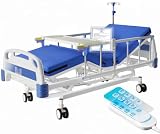


Best hospital beds by home-care situation
| Situation | Best bed type | Why it fits | Typical market range |
|---|---|---|---|
| Short-term or occasional use | Manual or semi-electric bed | Lower purchase cost; fewer motors and electrical parts | $500–$1,200 |
| Daily home care with limited bending | Full-electric height-adjustable bed | Independent head, knee, and height adjustment | $1,000–$3,000 |
| Small bedroom or narrow doorway | Narrow-frame bed, usually 30–34 inches wide | Improves clearance, but limits mattress and rail choices | $900–$2,500 |
| Higher user weight or frequent repositioning | Bariatric or heavy-duty electric bed | Wider deck and commonly 600–1,000-pound capacity | $2,000–$6,000+ |
| Need for low transfer height | Low-profile full-electric bed | Deck may lower to roughly 7–10 inches above the floor | $1,500–$4,000 |
Prices are broad equipment-market ranges and vary with mattress, rails, delivery, warranty, and whether the bed is new or refurbished. Confirm the manufacturer’s current specifications before ordering.
Head-to-head: manual, semi-electric, and full-electric beds
Manual hospital beds
Manual beds use hand cranks for some or all adjustments. They are the least expensive option and can remain usable during a power outage, but frequent cranking becomes tiring. A manual bed is most appropriate when the caregiver rarely changes the position or when the bed is used for a limited period.
Semi-electric hospital beds
A semi-electric design usually powers the head and knee sections with a pendant while the overall bed height is changed with a crank. This provides a useful compromise: the person in bed can often adjust comfort without asking for help, but the caregiver still has to handle height changes manually.
Full-electric hospital beds
Full-electric beds independently control head elevation, knee elevation, and overall height. Their main advantage is not luxury; it is reducing repeated bending and lifting during routine care. Look for a pendant with large, clearly labeled buttons and a control-lockout function that prevents accidental operation of selected movements.
Full-electric models include beds such as the Drive Medical Delta Ultra Light 1000 and Invacare 5410. Product generations and included accessories can change, so compare the exact model number rather than relying on the product family name. For higher capacities, look at heavy-duty or bariatric ranges from established medical-equipment manufacturers such as Invacare, Drive Medical, and Medline.
Specifications that matter more than the product name
| Feature | Useful home-care target | What to check before buying |
|---|---|---|
| Mattress surface | 36 x 80 inches for standard beds | Whether the frame accepts an 80-inch mattress, not just a similarly named size |
| Bed width | 36 inches standard; 42–48 inches for bariatric beds | Doorway, hallway, bathroom, and turning clearance |
| Weight capacity | 450–600 pounds for many standard beds | Whether the limit includes the user, mattress, rails, bedding, and accessories |
| Height range | About 15–24 inches for conventional full-electric beds | Lowest and highest deck height, not merely “adjustable height” |
| Casters | Four 5-inch locking casters | Individual wheel locks, swivel action, and replacement availability |
| Electrical backup | 9-volt emergency lowering or optional battery backup | Whether the battery is included and how often it must be replaced |
Mattress and rail compatibility
A hospital-bed frame is not automatically compatible with every medical mattress. Standard decks commonly take a 36-by-80-inch mattress, but the required thickness may be 5, 6, or 8 inches. A mattress that is too short can leave a gap at the head or foot; one that is too thick can reduce the effective height of a side rail.
Check whether the bed requires a specific mattress type, such as a three-section or four-section design with hinged areas that follow the deck. A conventional home mattress generally does not bend correctly on an adjustable hospital bed and may slide when the head section rises.
Rails also need careful matching. Full-length rails, half rails, assist bars, and transfer poles have different purposes and may attach only to particular frame brackets. Measure the mattress top to the rail’s upper edge after installation. A rail should not be treated as a substitute for supervision or a professional safety assessment; in some situations it can increase entrapment or transfer risks.
Casters, controls, and setup requirements
Five-inch casters are a practical minimum for many homes because they roll more easily over thresholds than small 3-inch wheels. The locks should engage firmly without requiring excessive force. Test all four wheels: a bed can still move if only one or two casters are locked. If the bed will remain in one place, confirm that the frame has a central brake or four independently lockable wheels.
Most electric beds arrive partly assembled. Expect to connect the head and foot sections, attach the deck or motor links, install the casters, connect color-coded motor plugs, and fit the pendant. Allow roughly 30–90 minutes for a careful setup, depending on the model and whether delivery includes assembly. Two adults are useful for positioning heavy sections, even when the instructions describe the bed as easy to assemble.
Before use, run every movement through its full range with the mattress removed or safely clear of moving parts. Check that cables do not pass under casters, through hinges, or across pinch points. Place the bed so the power cord does not become a trip hazard, and leave enough space for the caregiver to reach both sides when that is part of the care routine.
A simple fit calculation before ordering
Suppose a room has a 112-inch clear wall and you are considering a standard 36-inch bed. The frame itself may fit easily, but add approximately 30 inches for a caregiver aisle on one side and 24 inches at the foot:
36 inches of bed width + 30 inches of side clearance + 24 inches of foot clearance = 90 inches.
That leaves about 22 inches of spare wall length in this simplified example. A 48-inch bariatric bed would reduce the remaining width to about 10 inches, making furniture placement and transfers much more difficult. Measure the actual frame, not just the mattress, and account for door swing, nightstands, lifts, and oxygen or other equipment if applicable.
Durability and ownership realities
- Casters and wheel locks wear first. Hair, dust, and carpet fibers can restrict swivel movement. Inspect and clean them regularly; replace a damaged caster rather than relying on a weak lock.
- Pendants and cables are vulnerable. Do not drag the bed by its handset cable or allow the pendant to hang where it can be crushed by the frame.
- Mattresses are consumables. Covers may need replacement after punctures, persistent odors, seam failure, or fluid damage. Follow the cover manufacturer’s cleaning limits; harsh disinfectants can weaken waterproof coatings.
- Loose hardware creates noise and movement. Check fasteners after the first week and periodically afterward, following the service instructions. Do not improvise bolts or brackets.
- Battery backups need attention. If the model uses a backup battery, record its installation date and test it according to the manual. A battery that has never been checked should not be assumed to work during an outage.
How to choose the final model
Start with the user’s weight plus the mattress and accessories, then choose a bed with meaningful capacity margin. Confirm the mattress dimensions, rail attachment points, lowest height, and maximum height. Next, measure every route into the room, including the narrowest doorway and any threshold.
For daily use, prioritize full-electric controls, a dependable height range, four locking 5-inch casters, and readily available replacement parts. For occasional use, a semi-electric or manual model may save money, provided a caregiver can safely operate the crank. If transfers, falls, positioning, or side rails are concerns, ask a qualified healthcare professional or occupational therapist to assess the setup before purchase.
The best hospital bed is therefore the one whose adjustment range, capacity, accessories, and maintenance demands match the home—not simply the model with the most motors or the lowest advertised price.