What's inside
As an Amazon Associate I earn from qualifying purchases. This post may contain affiliate links at no extra cost to you.
The best portable washing machines for small homes are the GE Profile 2.8 cu. ft. UltraFast Combo if you need the closest thing to a full-size laundry appliance, the BLACK+DECKER BPWM09W for a compact automatic washer, the Giantex 17.6-lb twin-tub for larger loads on a budget, and the WonderWash for the smallest footprint and lowest power use.
“Portable” covers several very different designs. A small automatic washer fills and drains through hoses, a twin-tub separates washing from spinning, and a manual drum washer avoids electrical hookups altogether. The right choice depends less on the advertised capacity than on where you will drain it, how often you wash, and whether you can tolerate transferring clothes between tubs.
As an Amazon Associate we earn from qualifying purchases at no extra cost to you.


What we cover
Best portable washing machines at a glance
| Best for | Product or type | Capacity | Approx. footprint | Spin speed | Typical price range |
|---|---|---|---|---|---|
| Small-home convenience | BLACK+DECKER BPWM09W automatic washer | 0.9 cu. ft. | 17.7 × 18.1 in. | Up to 900 rpm | $250–$400 |
| Most washing capacity for the money | Giantex 17.6-lb twin-tub | About 2.0 cu. ft. combined | About 27 × 16 × 32 in. | Up to about 1,300 rpm | $150–$250 |
| Tiny apartment, RV, or occasional use | WonderWash manual washer | About 5 lb | About 16 × 12 × 12 in. | No powered spin | $60–$100 |
| Large loads without a permanent installation | GE Profile UltraFast Combo | 2.8 cu. ft. | About 32 × 25 × 43 in. | High-speed integrated spin | $2,000–$3,000 |
| Low-cost automatic washing | Compact 0.8–1.0-cu.-ft. automatic washer | 0.8–1.0 cu. ft. | Approximately 18–20 in. square | About 700–900 rpm | $200–$400 |
Dimensions and capacities can vary by revision and seller, particularly for generic twin-tub machines. Treat the table as a planning guide and check the current manual before measuring a cabinet, closet, or drain area.
Our picks by living situation
Best automatic option: BLACK+DECKER BPWM09W
The BPWM09W is a strong fit for one or two people who want a normal wash cycle without manually moving laundry between tubs. Its 0.9-cu.-ft. drum is suitable for several shirts, underwear, towels, and light bedding, but not a full household hamper. The built-in spin cycle reaches up to 900 rpm, which removes substantially more water than a manual wringer.
It generally uses a standard electrical outlet and includes an inlet hose that can be adapted to a suitable faucet. That makes it simpler than a twin-tub when space is limited, although it still needs a reliable drain route. Automatic machines also tend to be easier for frequent users because the washer controls filling, agitation, draining, and spinning.
The limitation is load size. A compact drum should be filled loosely to leave room for clothes to turn. Packing it tightly produces a poorer wash and can make the machine shake during spin.
Best budget capacity: Giantex twin-tub washer
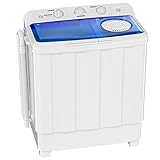
A Giantex twin-tub is the better choice when you wash several loads per week and value capacity more than convenience. The wash compartment and spin compartment operate separately, so you can wash one load while another load spins. Twin-tub designs often advertise a wash capacity around 11–12 lb and a spin capacity around 5–6 lb; the smaller spin side is normal, not a defect.
These machines commonly offer a wash timer of about 15 minutes and a separate spin timer of about five minutes. Their high-speed spin can remove a lot of water quickly, but clothes must be distributed evenly. A single heavy towel on one side can cause vibration, noise, or a walking machine.
The trade-off is hands-on operation. You must control water addition, move clothes from wash to spin, and monitor the drain hose. For a couple or small family in a utility room, that extra labor can be worthwhile. For someone who wants to press one button and leave, an automatic model is a better match.
Best for the smallest storage footprint: WonderWash
The WonderWash is a manual, non-electric drum washer for very small loads. It holds roughly 5 lb and occupies about 16 by 12 by 12 inches, so it can fit in a closet or under a counter when emptied and dried. It uses no electricity and does not require a permanent water hookup.
It is practical for underwear, baby clothes, gym clothing, and a few light garments. It is less suitable for jeans, towels, thick sweatshirts, or repeated family-size laundry. Washing requires adding water and detergent, turning the handle, draining, and rinsing manually. Because it has no powered spin, a separate spin dryer, wringer, or careful hand pressing is needed to reduce drying time.
Best premium space-saving replacement: GE Profile UltraFast Combo
The GE Profile UltraFast Combo is not a countertop appliance, but it is portable in the broader sense that it does not require separate washer and dryer units. Its 2.8-cu.-ft. capacity and integrated drying make it useful where floor area matters more than purchase price.
It needs a proper 120-volt outlet, water supply, and drain, and it is much heavier and deeper than compact portable washers. Installation and ventilation requirements should be checked carefully. This is the choice for a small home that can accommodate a full-height appliance but cannot spare room for a separate dryer—not for someone who needs to carry a washer into a bathtub after each use.
Head-to-head: what matters beyond capacity
Wash performance
Automatic compact washers usually provide the most consistent wash because they meter water and use programmed agitation. Twin-tubs can clean just as effectively when the load is small enough and the detergent is fully dissolved, but overloading quickly reduces movement. Manual washers depend most on the operator’s effort and are best for lightly soiled clothing.
Spin-dry speed
Spin speed is only part of the drying equation. A 900-rpm automatic washer can leave clothes reasonably damp, while a twin-tub with a faster advertised speed may still perform poorly if the load is uneven. Separate spin tubs also have lower weight limits. For towels and denim, expect longer air-drying than the specification alone suggests.
Hookups and drainage
Automatic machines need a stable drain arrangement. A sink drain may work, but the hose must be secured so water pressure cannot eject it. Faucet adapters are convenient but can leak if the threads do not match. Twin-tubs usually require manual filling or a hose connection and need the drain hose positioned lower than the washer during draining. The WonderWash needs neither electrical nor plumbing hookup, but it does require a bucket, sink, or bathtub for filling and rinsing.
Water and power use
A small automatic washer commonly uses roughly 10–20 gallons per load, depending on the program and load size. Twin-tubs can use more or less depending on how carefully you fill and reuse rinse water. A manual washer uses no electricity, but water use depends on how many rinse changes you perform.
For a rough electricity calculation, suppose an automatic compact washer uses 0.15 kWh per load and electricity costs $0.20 per kWh:
0.15 kWh × $0.20 = $0.03 per wash.
That figure excludes water, detergent, and drying. In most homes, the dryer or heated drying cycle costs more to operate than the wash cycle, so a powerful spin cycle and good airflow can matter more than saving a few cents of washing electricity.
Noise and vibration
Compact washers are usually quiet during washing but noticeably louder during spin. A firm, level floor matters more than a small difference in motor specifications. Place the machine on a rigid surface, adjust its feet, and leave clearance around it. Soft, uneven flooring and overloaded drums are common causes of excessive movement.
Decision matrix for choosing quickly
| Your situation | Best fit | Why | What to accept |
|---|---|---|---|
| One person, little storage, occasional laundry | WonderWash | Smallest footprint and no power requirement | Manual labor and no powered spin |
| One or two people, frequent laundry, minimal supervision | BLACK+DECKER BPWM09W or similar automatic washer | Programmable cycles and integrated spin | Small drum and required drain setup |
| Two or three people, several loads weekly, limited budget | Giantex twin-tub | More usable wash capacity for the price | Manual transfers and water management |
| Small home with room for one full-height appliance | GE Profile UltraFast Combo | Washes and dries in one cabinet | High price, weight, and permanent installation |
Setup and ownership details that affect results
- Measure the complete operating space. Include hose bends, lid or door movement, and at least a few inches for airflow and vibration. A machine that fits only when pushed flush against a wall may not be usable.
- Check the drain before buying. Confirm that the sink, standpipe, or tub can accept the discharge rate. Secure the hose with a clamp or hook rather than relying on its weight.
- Use less detergent than in a full-size washer. Small machines use less water. Excess detergent leaves residue, causes odors, and may require extra rinsing.
- Balance every spin load. Mix small and medium garments, and pause to redistribute clothes if the machine bangs or moves.
- Leave the lid open after use. Wipe the gasket, lint filter, and tub rim, then let the interior dry. This reduces mildew odors and buildup.
- Inspect hoses and the drain filter. Hoses can split at fittings, while lint, coins, and hair can restrict drainage. These inexpensive parts often cause trouble before the motor does.
Bottom line
Choose the BLACK+DECKER BPWM09W or another 0.8–1.0-cu.-ft. automatic washer for the best balance of convenience and compact size. Choose a Giantex twin-tub when capacity and low purchase cost outweigh manual work. Choose the WonderWash when storage, electricity, and hookup access are the main constraints. If you need integrated drying and can make a permanent installation, the GE Profile UltraFast Combo is in a different, more expensive class but can replace two appliances in a small home.