What's inside
- Best Car Vacuums for Fast, Deep Cleaning
- Quick picks by vehicle and cleaning routine
- Head-to-head comparison
- Suction power is only half the decision
- Corded versus cordless: calculate the real advantage
- Filter maintenance determines sustained performance
- Storage matters more than advertised capacity
- Decision matrix
- How to get a deeper clean from any car vacuum
- Bottom line
- Best Car Vacuums for Fast, Deep Cleaning
- Quick picks by vehicle and cleaning routine
- Head-to-head comparison
- Suction power is only half the decision
- Corded versus cordless: calculate the real advantage
- Filter maintenance determines sustained performance
- Storage matters more than advertised capacity
- Decision matrix
- How to get a deeper clean from any car vacuum
- Bottom line
As an Amazon Associate I earn from qualifying purchases. This post may contain affiliate links at no extra cost to you.
What we cover
- Best Car Vacuums for Fast, Deep Cleaning
- Quick picks by vehicle and cleaning routine
- Head-to-head comparison
- Suction power is only half the decision
- Corded versus cordless: calculate the real advantage
- Filter maintenance determines sustained performance
- Storage matters more than advertised capacity
- Decision matrix
- How to get a deeper clean from any car vacuum
- Bottom line
Best Car Vacuums for Fast, Deep Cleaning
The best car vacuums for most owners are a cordless handheld for quick maintenance, a corded wet/dry vacuum for the deepest clean, or a high-end cordless model when strong suction and portability matter more than price.
Quick picks by vehicle and cleaning routine
- Best for regular family-car cleaning: Dyson Car+Boat, because its long runtime, strong suction, and useful crevice tools handle seats, carpets, and hard-to-reach gaps.
- Best budget corded option: Armor All AA255, especially for SUVs, trucks, and vehicles that need wet pickup as well as dry debris.
- Best cordless value: BLACK+DECKER dustbuster AdvancedClean+ models, which are compact, easy to empty, and adequate for weekly crumbs and dust.
- Best for owners already using a battery platform: Milwaukee M18 Compact Vacuum or a Ryobi 18V ONE+ handheld vacuum. Sharing batteries can make either a better buy than starting a new system.
- Best for very fast spot cleaning: A lightweight 12V or USB-rechargeable handheld vacuum with a built-in crevice tool. These are convenient, but usually have shorter runtimes and less sustained suction.
Head-to-head comparison
The figures below are useful for comparing the machines’ operating limits, not as a guarantee of identical results in every configuration. Manufacturers may list different weights, runtimes, and suction figures depending on the battery, tool, or test method.
As an Amazon Associate we earn from qualifying purchases at no extra cost to you.



| Model or type | Power and runtime | Capacity | Approximate weight | Best use |
|---|---|---|---|---|
| Dyson Car+Boat | Up to 40 minutes; boost mode is shorter | 0.54 L bin | About 1.9 kg | Deep cleaning in cars, SUVs, and light trucks |
| BLACK+DECKER dustbuster AdvancedClean+ class | Up to about 25 minutes, model dependent | Roughly 0.5–0.75 L | About 1.5–2 kg | Routine crumbs, dust, and pet hair |
| Milwaukee M18 Compact Vacuum | Typically around 20–25 minutes with a 5.0Ah battery | About 0.95 L | About 2.2 kg without battery | Work trucks, workshop debris, and frequent use |
| Armor All AA255 | 120V corded motor; unlimited operating time | 2.5 gal, about 9.5 L | About 3.4 kg | Large vehicles, wet pickup, and heavy debris |
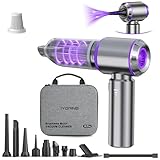
| Basic 12V or USB handheld | About 10–20 minutes | 0.2–0.4 L | About 0.6–1.2 kg | Emergency cleanup and glove-box storage |
Suction power is only half the decision
Peak suction figures can be misleading because manufacturers use different measurements. A vacuum that pulls hard through a narrow opening may still struggle with sand embedded in carpet if its airflow is weak. For car cleaning, look for a combination of strong airflow, a motorized brush, and a seal that does not leak around the filter or bin.
A motorized brush is particularly valuable for fabric seats and carpet. It agitates grit and hair so the airflow can remove them. For loose crumbs, a wide nozzle is faster. For seat rails, console seams, and the area between the seat and door, a long crevice tool matters more than a headline suction number.
Which nozzle reach do you need?
- Small hatchback or sedan: A 20–30 cm crevice tool is usually enough when the vacuum can be carried around the cabin.
- Three-row SUV or van: Choose a hose or extension system that provides at least 60–90 cm of reach. Otherwise, you will repeatedly kneel between rows or stretch the vacuum by its cable.
- Pickup truck: A long hose helps reach behind the front seats and into the rear floor area. A corded wet/dry design is useful if the truck also carries soil, sawdust, or muddy equipment.
Corded versus cordless: calculate the real advantage
Cordless vacuums win on setup time. There is no outlet search, cable management, or extension cord across the driveway. Their weakness is that maximum-power modes can consume a small battery quickly, especially when a brush head is loaded with hair.
Corded models are often the better choice for a neglected vehicle. Consider a 25-minute cordless vacuum that needs a recharge after one SUV, compared with a 120V wet/dry vacuum that can run continuously. If deep cleaning takes 45 minutes, the corded machine avoids a forced interruption and can maintain airflow while you empty the large tank only once.
For owners cleaning one small car every week, a 20–40-minute cordless runtime is normally sufficient. For a van, work truck, or multiple vehicles, either buy a model with a swappable battery or choose corded power. A second battery can be more useful than a higher peak-suction setting because it prevents the final seats from being cleaned in reduced-power mode.
Filter maintenance determines sustained performance
A vacuum can feel powerful on the first use and noticeably weaker after several cleanups if its filter is clogged. Fine sand, flour-like dust, and pet dander load filters faster than visible crumbs. A washable pleated filter is preferable for frequent vehicle cleaning, but it must be dried completely before reinstalling.
Use this maintenance routine
- Empty the bin before it reaches the fill line. An overfilled bin can restrict airflow and push debris toward the filter.
- Tap or brush the filter outside. Do this away from the vehicle so loosened dust does not return to the cabin.
- Wash only filters identified as washable. Use cool or lukewarm water without aggressive detergents unless the instructions permit them.
- Allow at least 24 hours to dry. A damp filter can reduce airflow and may damage the motor.
- Inspect seals and pre-filters. A split gasket or missing foam sleeve can let fine dust bypass filtration.
What wears first is usually not the motor. Brush-roll hair, stretched bin seals, cracked flexible hoses, blocked pre-filters, and worn battery packs are more common ownership problems. Check whether replacement filters, batteries, brush rolls, and nozzles are available before buying a specialized model.
Storage matters more than advertised capacity
A large bin is convenient, but a bulky vacuum that lives in a garage may be used less often than a smaller model stored in the vehicle. Measure the space under a seat, inside a side compartment, or in the trunk before buying. Also measure the vacuum with its longest nozzle attached; an apparently compact body can require considerable clearance once the tool is fitted.
For glove-box or door-pocket storage, choose a vacuum under about 35 cm long and under 1.5 kg. For a garage shelf, a detachable hose and wall charger may matter more than the body length. Corded wet/dry vacuums should be stored with the tank dry and the cable loosely coiled, not tightly wrapped around the motor housing.
Decision matrix
| Your situation | Recommended type | Minimum useful specification | Why |
|---|---|---|---|
| Small car, weekly crumbs | Compact cordless handheld | 15-minute runtime, washable filter, crevice tool | Fast to grab and simple to store |
| Family SUV, weekly cleaning | Full-size cordless handheld | 30-minute rated runtime, powered brush, 0.5 L or larger bin | Balances reach, comfort, and usable battery life |
| Van or three-row vehicle | Corded wet/dry vacuum or swappable-battery model | 60 cm or more of hose reach, 1 L or larger capacity | Avoids repeated trips and mid-cleaning recharge |
| Work truck with mud and sawdust | Corded wet/dry vacuum | 2 gal or larger tank, wet-rated operation, reusable filter | Handles heavier and occasionally damp debris |
| Limited storage | Small cordless model | Under 35 cm long and under 1.5 kg | Can remain accessible instead of being buried in the garage |
How to get a deeper clean from any car vacuum
Remove floor mats first and vacuum them outside the vehicle. Move the seats fully forward and backward to expose the tracks, then use the crevice tool before vacuuming broad carpet areas. For embedded grit, make slow overlapping passes with a brush head rather than sweeping quickly over the surface. Vacuum the dashboard and console last, using a soft brush to reduce scratching.
Do not use a dry-only handheld to collect liquids, wet mud, ash, or hot material. Do not block cooling vents while cleaning, and stop when the motor sounds strained. Those mistakes can overheat the unit or force debris into areas that are difficult to service.
Bottom line
Choose the Dyson Car+Boat when you want premium cordless performance and enough runtime for a complete car or SUV. Choose a BLACK+DECKER dustbuster AdvancedClean+ type for affordable weekly maintenance. Choose a Milwaukee or Ryobi platform vacuum if you already own compatible batteries. For the largest vehicles, wet debris, or uninterrupted deep cleaning, the corded Armor All AA255 type remains the practical choice. The best car vacuums are the ones whose reach, runtime, filter upkeep, and storage fit the vehicle you actually clean.