What's inside
As an Amazon Associate I earn from qualifying purchases. This post may contain affiliate links at no extra cost to you.
The best back massagers depend on whether you need broad, gentle coverage, concentrated pressure, heat, or a cordless tool you can use without help: choose a shiatsu cushion for repeated lower-back sessions, a percussion device for targeted muscle work, and a heated wrap or pad for the simplest low-effort option.
As an Amazon Associate we earn from qualifying purchases at no extra cost to you.


What we cover
Quick picks by situation
- Best all-around home choice: A full-back shiatsu cushion with adjustable heat and a moving massage mechanism.
- Best for targeted muscle pressure: A percussion massager with several heads, multiple speed levels, and a stall-resistant motor.
- Best for a partner-free upper-back session: A long-handled percussion massager or a back-and-shoulder massager with an angled grip.
- Best for relaxation rather than deep pressure: A heated vibrating pad or wrap with low, medium, and high settings.
- Best for travel: A compact cordless percussion massager, provided its battery lasts at least two hours between charges.
- Best for larger bodies: A cushion or wrap with a massage area at least 24 inches wide and straps that fit a firm chair.
Massage types compared
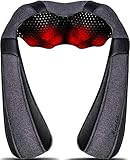
“Deep” does not mean the same thing across product categories. A shiatsu device uses rotating or kneading nodes to apply relatively broad, repetitive pressure. It is usually easier to position than a handheld tool, but the fixed track may not line up with every body shape.
Percussion massagers deliver rapid, short movements through a small attachment. They are better for treating a specific area, such as the muscles beside the shoulder blade or the broad muscles of the lower back. They require more control: pressing too hard, staying in one place too long, or reaching awkwardly can make a session uncomfortable.
Vibration pads and wraps provide a lighter, spreading sensation. They are useful when you want warmth and relaxation while seated, but their motors generally do not provide the focused pressure of shiatsu nodes or percussion attachments.
| Type | Typical coverage | Pressure feel | Typical power | Best fit |
|---|---|---|---|---|
| Shiatsu cushion | 16–28 in. tall massage track | Medium to firm, broad | 12–30 W, usually corded | Routine seated back sessions |
| Percussion massager | 2–5 in. treatment area at once | Light to very firm, targeted | 20–60 W, corded or cordless | Users who can control angle and pressure |
| Vibrating pad or wrap | 20–30 in. wide | Light to medium | 5–15 W, often corded | Relaxation and gentle everyday use |
| Massage gun with extension handle | Small, movable target area | Medium to firm | Typically 2–4 hours per charge | Independent upper- and lower-back access |
Heat, pressure, and control
Heat settings
Heat is most useful when it can be turned on independently from massage. Look for at least two heat levels or a selectable temperature range around 100–115°F. A fixed high-heat setting gives you less control, especially during a long session. Automatic shutoff after 15–30 minutes is a useful ownership and safety feature.
Heat should feel comfortably warm rather than hot. Do not sleep on a powered heating function, and use extra caution if reduced temperature sensation, circulation problems, or a condition affected by heat makes it difficult to judge temperature. Follow the product instructions rather than placing a heating device directly against bare skin for extended periods.
Pressure levels
For a shiatsu cushion, pressure is mainly changed by your body position: sitting farther back increases contact, while sitting more upright reduces it. A removable or adjustable neck pillow also matters because an incorrectly positioned upper section can push into the base of the skull instead of the neck muscles.
For percussion tools, compare speed range, stall force, and amplitude. A broad consumer range is roughly 1,500–3,000 percussions per minute, with amplitude commonly around 8–12 millimeters. More amplitude is not automatically better; a shorter stroke can be easier to control around the shoulder and upper back.
Start at the lowest setting for 30–60 seconds per area. Keep the device moving over muscle rather than holding it on one point. Avoid pressing directly on the spine, ribs, front of the neck, joints, or areas that are bruised, numb, swollen, or injured.
Corded versus cordless designs
| Consideration | Corded | Cordless |
|---|---|---|
| Power consistency | Usually steady for the entire session | May soften as the battery empties |
| Typical operating time | Unlimited while near an outlet | About 2–6 hours, depending on speed and heat |
| Weight | Often lighter because there is no battery | Commonly 1.5–3.0 lb for handheld devices |
| Best location | Chair, recliner, or bed near a socket | Travel, office, or rooms without a convenient outlet |
| Long-term concern | Cord strain and plug damage | Battery aging and eventual replacement limits |
A simple runtime calculation helps prevent disappointment. If a cordless massager claims 150 minutes and you use it for 15 minutes five times per week, the stated runtime equals about two weeks of sessions: 150 ÷ (15 × 5) = 2. Real runtime can be lower at maximum speed, so a model rated for at least 200 minutes is a better match for frequent use.
Fit for different body sizes
Measure the chair and your torso before buying a cushion. A narrow cushion can leave the outer back unsupported, while a tall track may place its upper nodes above the shoulder muscles. As a practical guide, look for a massage area about 16–20 inches tall for lower-back use and 24–28 inches for products intended to reach much of the back.
Check the strap length as well as the cushion width. A strap that fits a dining chair may not secure around a deep recliner. For broader bodies, prioritize a wide seat, a stable frame, and independently selectable zones. A device that has three massage programs but only one fixed track may fit less well than a simpler model with adjustable positioning.
Handheld devices have the opposite issue: reach. A short massager may work well on the lower back with one hand but be difficult to position between the shoulder blades. An extension handle, flexible arm, or partner’s assistance can matter more than an extra speed level.
Decision matrix
| Your situation | Most suitable design | Prioritize | Trade-off |
|---|---|---|---|
| Budget-conscious, occasional use | Basic corded vibration pad | Independent heat, washable cover, shutoff timer | Less concentrated pressure |
| Frequent seated use | Shiatsu cushion | Adjustable track, zone control, reinforced straps | Bulky and tied to a chair or outlet |
| Experienced with firm pressure | Multi-speed percussion device | Amplitude, stall resistance, controllable trigger | Requires careful technique |
| Small apartment or shared space | Compact cordless massager | Under 2.5 lb, quiet operation, carrying case | Battery eventually loses capacity |
| Larger frame or wide shoulders | Wide cushion or adjustable handheld tool | At least 24-in. coverage or long handle | May cost more or weigh more |
Ownership details that affect value
The first parts to wear are usually the fabric cover, elastic chair strap, charging port, cable, or battery—not the massage motor itself. Avoid storing a cushion compressed under heavy objects. Let heated products cool before folding them, and do not bend a power cord sharply where it enters the housing.
Clean contact surfaces with a lightly damp cloth and mild soap, then dry completely. Do not saturate the motor housing or use oils on moving nodes unless the manufacturer specifically permits it. Removable covers are valuable if the device will be used over clothing, after exercise, or by more than one person.
Common mistakes include using maximum pressure immediately, running a heated device for longer than its timer allows, and buying a cushion without checking chair dimensions. For percussion tools, do not use the device over bones or the spine, and stop if pain becomes sharp, radiating, unusually persistent, or associated with weakness or numbness.
Bottom line
Choose a shiatsu cushion for predictable, broad pressure during seated sessions; a percussion massager for adjustable, targeted work; and a vibrating heated pad for gentle comfort. Compare the actual massage area, heat controls, pressure range, reach, noise, battery runtime, and cleaning design—not just the number of programs. These products are general comfort tools, not a diagnosis or treatment for an underlying condition. If back pain is severe, follows an injury, or keeps returning, consult a qualified healthcare professional before relying on massage.