What's inside
As an Amazon Associate I earn from qualifying purchases. This post may contain affiliate links at no extra cost to you.
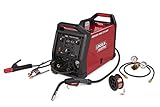
For most buyers, the Lincoln POWER MIG 211i MIG is the best all-around Lincoln MIG welder because it combines 120/230-volt flexibility, enough output for automotive and farm repairs, and a dedicated MIG layout without paying for unnecessary multiprocess functions.
As an Amazon Associate we earn from qualifying purchases at no extra cost to you.



What we cover
Lincoln MIG welders compared
The right choice depends less on the highest amperage than on your available power, material thickness, duty cycle, and whether you need stick or TIG capability. The figures below are representative published ratings; confirm the nameplate and manual for the exact package sold in your region, since included accessories and input plugs can differ.
| Model | Input | Output range | Duty-cycle reference | Wire and spool capacity | Best fit |
|---|---|---|---|---|---|
| POWER MIG 140 MP | 120 V | 30–140 A | 20% at 90 A | 0.025–0.035 in wire; up to 8 in spool | Home projects and light automotive work |
| POWER MIG 180 Dual | 120/230 V | 30–180 A | 20% at 130 A | 0.025–0.035 in wire; up to 8 in spool | Garage users who may add 230 V later |
| POWER MIG 210 MP | 120/230 V | 20–200 A | 25% at 200 A | 0.025–0.045 in wire; up to 10–12 in spool, package-dependent | DIY, automotive, trailer, and multiprocess work |
| POWER MIG 211i MIG | 120/230 V | 30–230 A | 25% at 200 A | 0.025–0.045 in wire; up to 12 in spool | Frequent home, farm, and small-shop MIG work |
| POWER MIG 215 MPi | 120/230 V | 20–220 A, approximately | Package and input dependent | 0.025–0.045 in wire; up to 12 in spool | Users wanting MIG, flux-cored, stick, and DC TIG functions |
“Duty cycle” is the amount of welding time possible in a 10-minute period at a stated output. A 25% duty cycle at 200 A means about 2.5 minutes of arc time followed by 7.5 minutes of cooling at that test condition. At lower amperage, the machine can normally weld for longer.
Which Lincoln MIG welder suits your work?
Best for occasional home repairs: POWER MIG 140 MP
The 140 MP is the sensible choice when your workshop has only a standard 120-volt receptacle and your projects are mostly sheet metal, brackets, lawn equipment, light gates, and small automotive repairs. It is compact and less demanding electrically than a 230-volt machine. Its 140-amp ceiling is adequate for many jobs using multiple passes, but it is not the ideal tool for repeatedly welding thick plate.
Expect the package to include a MIG gun, work clamp, gas hose, regulator, and starter consumables, although the precise contents should be checked before purchase. It also supports flux-cored wire, which is useful outdoors where shielding gas can be blown away.
Best dedicated all-purpose choice: POWER MIG 211i MIG
The 211i MIG is the strongest match for a buyer who specifically wants MIG and flux-cored welding rather than a multiprocess machine. On 120 V it can handle portable repair work; on 230 V it has more practical headroom for heavier material and longer welds. Its higher output and 0.045-inch wire capability make it more comfortable on farm implements, trailer frames, structural brackets, and thicker mild steel than a 140-amp unit.
It is also a better long-term purchase if you expect your projects to grow. You may begin on 120 V in a garage, then move to a 230 V circuit without replacing the welder. Check whether your selected package includes a spool gun if aluminum welding is important; a standard MIG package should not automatically be assumed to include one.
Best for varied processes: POWER MIG 210 MP or 215 MPi
Choose the 210 MP or 215 MPi when you need more than MIG. These machines are intended for combinations of MIG, flux-cored, stick, and DC TIG work, depending on the model and supplied accessories. Multiprocess flexibility is valuable for a small shop that occasionally repairs rusty outdoor steel with stick electrodes or wants to learn TIG.
The trade-off is control complexity and package cost. A multiprocess welder may include a basic TIG torch or stick lead but still require a separate torch, foot control, gas equipment, or consumables for a more complete TIG setup. If 90% of your work is wire welding, the dedicated 211i MIG usually puts more of the purchase toward the process you use most.
Best step-up from a 120-volt garage: POWER MIG 180 Dual
The 180 Dual occupies the middle ground. It remains usable on 120 V but gains useful capacity on 230 V. It is a practical option for occasional farm maintenance and medium-size fabrication when the 211i’s additional output is unnecessary or the 180 Dual is available at a substantially lower market price.
Decision matrix by real-world situation
| Your situation | Recommended direction | Reason |
|---|---|---|
| Under roughly 20 hours of welding per year, 120 V only | POWER MIG 140 MP | Lower electrical demand and sufficient capacity for light work |
| Beginner building automotive panels and small brackets | 140 MP or 180 Dual | Simple wire process and manageable output |
| Farm repairs several times each month | 211i MIG | 230 V headroom, larger wire range, and better sustained capability |
| Small fabrication shop welding long seams | 211i MIG or a larger shop-class machine | Higher duty-cycle capacity matters more than portability |
| One machine for MIG, stick, and occasional TIG | 210 MP or 215 MPi | Process flexibility outweighs dedicated MIG simplicity |
| Limited floor space and no 230 V circuit yet | 140 MP or 180 Dual | Compact footprint and 120 V operation reduce setup requirements |
Voltage, amperage, and material thickness
A 120-volt Lincoln MIG welder is convenient but typically has less reserve for thick steel. A 230-volt supply does not automatically make every weld better; it gives the inverter more electrical headroom, improves usable output, and reduces the likelihood that you will spend as much time waiting for thermal protection.
For mild steel, a rough planning rule is about 1 amp per 0.001 inch of thickness for a single-pass weld, but joint design, wire diameter, shielding gas, travel speed, and required penetration all change the result. A 1/8-inch joint may be comfortably within a 140-amp machine’s range, while repeated work on 1/4-inch plate is better suited to the 200-amp class and often requires beveling and multiple passes.
Do not select a welder solely by its maximum amperage. Compare its rated output at your intended voltage, its duty cycle at that output, and whether your home or shop circuit can support the required breaker and receptacle. An electrician should verify new 230-volt wiring.
What comes in the box—and what may not
Most Lincoln MIG packages include the welder, MIG gun, work lead and clamp, gas hose, regulator, contact tips, and a spool adapter. Some include a starter spool of solid wire; others are configured for flux-cored use or have accessory kits that vary by retailer and region.
- For clean indoor mild steel, budget for solid ER70S-6 wire and an argon/CO2 shielding-gas cylinder.
- For outdoor repairs, self-shielded flux-cored wire avoids a cylinder but produces more smoke, slag, and spatter.
- For aluminum, confirm compatibility with a spool gun or suitable push-pull arrangement; a standard long MIG gun is prone to feeding problems with soft aluminum wire.
- Plan for spare contact tips, nozzles, drive rolls matched to the wire, and a replacement liner.
Ownership realities and maintenance
The first parts to wear are usually contact tips, nozzles, liners, and drive rolls—not the power source. Spatter can bridge the nozzle and restrict shielding gas, while a worn liner creates erratic feeding that beginners sometimes mistake for a bad welder. Replace a tip when the wire hole becomes visibly enlarged or feeding becomes inconsistent.
Before each session, inspect the gun cable for sharp bends, make sure the drive-roll tension is firm but not crushing the wire, and check that the gas hose and regulator connections are leak-free. Keep the machine’s ventilation openings clear of dust and grinding debris. Store solid wire dry; surface rust can clog the liner and contaminate welds.
Bottom line
Buy the POWER MIG 140 MP for light, infrequent 120-volt work. Choose the POWER MIG 180 Dual when you want a compact bridge to 230 V. For the best dedicated Lincoln MIG welder for home, farm, and small-shop use, the POWER MIG 211i MIG offers the most useful balance of output, wire range, and future capacity. Pick the POWER MIG 210 MP or 215 MPi instead when stick and TIG capability is worth the added complexity and accessory cost.