Our Top Picks
 Caiman Premium Goat Grain TIG/Multi-Task Welding GlovesLarge (Pack of 1)6 x 1 x 12 inches0.4 poundsCheck on Amazon
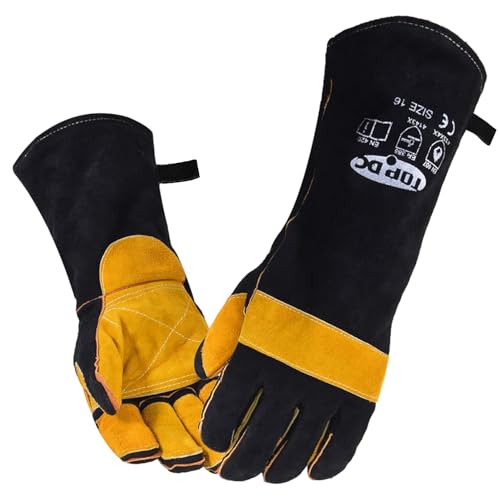 TOPDC Welding Gloves 16-Inch 932°F Heat Resistant Leather2 Count (Pack of 1)0.5 PoundsCheck on Amazon


What's inside
As an Amazon Associate I earn from qualifying purchases. This post may contain affiliate links at no extra cost to you.
Welding gloves aren’t one-size-fits-all. The heavy gauntlet that’s perfect for stick welding makes you clumsy at TIG. Matching the glove to the process keeps you both safe and precise.
Most people work this out backwards. They buy thick gauntlets because gauntlets look like welding gloves, then spend a year fumbling filler rod and wondering why their TIG beads come out chewed. Or they overcorrect, buy something thin and supple, and take a spatter burn through the palm on their first flux-core pass. Both problems come from the same mistake: treating gloves as one purchase instead of matching them to the arc.
As an Amazon Associate we earn from qualifying purchases at no extra cost to you.


Gloves are also the one piece of PPE you interact with constantly. The helmet goes on and you forget about it. Gloves are in the loop for every movement — every clamp adjustment, every rod change, every part flip. A glove that fights you costs you weld quality, not just comfort. That is why one pair for everything is a false economy. You pay the difference back in rework.
What we cover
MIG and stick: go heavy
High heat and spatter call for thick, insulated leather gauntlets that shrug off sparks. You trade some dexterity, but for MIG and stick you don’t need fine finger control — you need protection.
Think about what your hands are actually exposed to on these processes. Stick throws slag and hot spatter in every direction, and you are usually running longer arc times at higher amperage. MIG is cleaner but still peppers your gloves, and flux-core is dirtier than either. Most of the damage is not the odd hot ball landing on the back of your hand. It is sustained radiant heat soaking through the leather while you hold a steady position for thirty seconds at a time. That is what insulation buys you: not immunity, but enough time to finish the bead instead of flinching halfway through.
Look for split cowhide or a similar heavy hide, a genuine lining rather than a bare leather shell, and stitching that will not melt. Cotton thread burns through and the glove opens up at the seam while the leather is still fine. Aramid or Kevlar-type thread survives. A reinforced patch across the palm and thumb crotch is worth having, because that is where you rest the glove against hot work. Cuff length matters more than most buyers expect: gauntlets generally run somewhere in the 13 to 16 inch range overall, and the extra cuff is what saves your forearm when you weld with your arms extended or reach into a weldment. Overlap the cuff and your jacket sleeve so there is no gap of bare skin, and for overhead work check that nothing forms a funnel pointing at your elbow.
These suit anyone running stick, MIG, or flux-core as their main process, plus plasma cutting and general hot handling. Skip the heavy gauntlet if the majority of your arc time is precision TIG. You will hate it, and a glove you hate is a glove you take off.
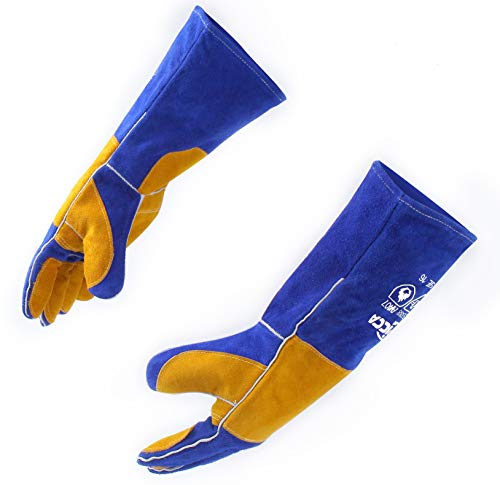
Heavy Leather Welding Gauntlets
Thick, heat-resistant leather that laughs off spatter, with a long cuff to protect your forearms. Built for the high-heat processes where protection beats finesse.
TIG: go thin
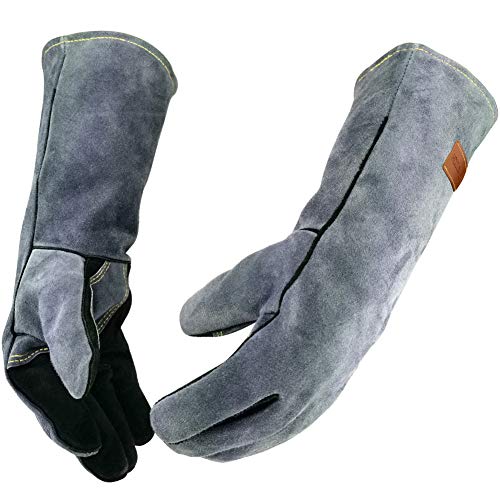
TIG runs cooler and demands feel — you’re feeding filler by hand. Thin, supple goatskin gloves give you the dexterity to work precisely while still protecting from the heat.
The specific thing you are protecting is your ability to walk filler wire through your fingers without looking at it. In a thick glove you cannot feel where the rod is, so you either look away from the puddle to check or you feed in clumsy jerks. Thin goatskin or kidskin, cut snug, lets you index the rod by touch. Unlined or lightly lined is the point here, not a compromise.
Fit is everything on a TIG glove. Too loose and the fingertip material bunches ahead of your actual fingertip, which destroys the feel you paid for. Too tight and the leather stretches, thins at the stress points, and splits early. You want it close enough that the fingertips track your fingers with no slack. Check where the seams sit while you’re at it, because a seam across the pad of your index finger is a hot spot you will notice on long welds. If the packaging lists a welding glove type, the dexterity-oriented classification is the TIG one; the higher-protection classification is for stick and MIG.
Accept that these are consumables. Radiant heat off the tungsten, hot filler ends, and hot parts will cook thin leather in a fraction of the time a gauntlet lasts. That is the trade. Thin gloves suit precision TIG on steel and thinner stainless, small aluminum work, and anyone doing fine fit-up. Skip them if you are running high-amp aluminum where the radiant load is punishing, or if your TIG work is mostly quick tacks on brackets. A mid-weight glove is the honest answer in both of those cases.
How to weigh the specs against each other
Almost every glove decision is a trade between heat resistance and feel. Once you know which side of that line you are shopping on, these are the details that separate a good pick from a bad one:
- Leather type. Cowhide for heat and abrasion, goatskin for feel and tensile strength at low thickness, pigskin and elkskin if your shop gets damp because they stay more supple after a soaking, deerskin for softness at the cost of durability.
- Split versus grain. Split leather is fuzzy and handles heat well for its thickness. Grain leather is smoother, tougher against abrasion, and gives better feel. Heavy gauntlets are usually split; TIG gloves are usually grain.
- Lining. Insulation for MIG and stick, minimal or none for TIG. A cheap foam liner that compresses flat after a week is worse than a decent cotton or wool one.
- Thread. Heat-resistant stitching, always. This is the single most common failure point and it costs the maker very little to get right.
- Cuff length. Long for out-of-position and high-spatter work, shorter for bench TIG where a long cuff just catches on things.
- Sizing honesty. Glove sizing varies wildly between makers. If reviews consistently say a model runs large or small, believe them.
What good looks like at each price band
The cheap tier
Bargain gloves are not automatically bad, but they fail in predictable places. Check the stitching first, because thread is where cost gets cut. Then flex the glove: if it is board-stiff out of the package, it will only get worse. Thin unlined “welding” gauntlets sold on price are the worst of both worlds, offering neither insulation nor feel. If you buy cheap, buy cheap TIG gloves and treat them as disposable, not cheap gauntlets you are relying on for protection.
The middle
This is where most people should land. Expect real lined split cowhide with heat-resistant thread and a reinforced palm on the heavy side, and properly cut goatskin with clean seams on the thin side. The difference between this tier and the cheap one shows up at about the two-month mark, when the budget pair has hardened and split and this pair has broken in.
The top tier
Premium pricing buys better hide selection, better seam placement, sometimes a wool-blend liner that handles heat and sweat better, and consistent sizing. It is worth it if you weld daily or if your hands are unusual enough that fit is a real problem. For weekend work, the money is better spent on a second pair for the other process.
- ✔ Right glove = safer & better welds
- ✔ Long cuffs protect forearms
- ✔ Leather lasts
- ✘ Need a pair per process
- ✘ Leather stiffens if it gets wet
Common mistakes
Buying gloves a size too big. People assume welding gloves should be loose. Loose gloves rotate on your hand, bunch at the fingertips, and slow you down when you need to drop something hot in a hurry.
Using welding gloves as oven mitts. They are rated for incidental contact, not for gripping a hot part while you carry it across the shop. Use pliers or vise grips. Every long grip on hot steel is heat you are storing in the liner.
Soaking them and then drying them fast. Wet leather near heat stiffens and shrinks, and it does not come back. Dry gloves slowly at room temperature and condition the leather if it feels dry. Do not park them on a heater.
Welding in sweat-saturated gloves. Moisture conducts heat and can steam. If a glove is soaked through, swap it or take a break.
Keeping them too long. Flex the palm and check the seams every so often. Hardened leather, thin spots, split stitching, or a pinhole you can see light through all mean the glove is done.
Leaving them cuff-up on the bench. An open cuff in the spatter zone collects hot debris that you then put your hand into. Store them fingers-up or somewhere out of the shower.
FAQ
Can I get away with one pair for everything?
You can, and a mid-weight MIG glove is the least bad single choice. But you will be under-protected on stick and over-gloved on TIG, and TIG is the process where the glove actually affects the weld. If you run all three, two pairs is the right answer.
How do I know when to replace them?
Judge by condition, not by calendar. Stiff, cracked, or shiny hardened leather has lost its insulating value. Any hole, any split seam, or any thin spot on the palm or thumb means it is time. TIG gloves wear out fast by design; budget for that instead of pushing a worn pair.
Should I wash them?
No. Brush off dust, wipe them if you must, and let them air out between sessions. Washing pulls the oils out of the leather and the glove dries hard and shrunken. A leather conditioner used sparingly does more good than any wash.
Do liners or inserts help?
A thin cotton liner adds a little insulation and a lot of comfort in a heavy gauntlet, and it soaks up sweat so the leather lasts longer. In a thin TIG glove a liner defeats the purpose. Skip it there.
Bottom line
Own a heavy pair for MIG/stick and a thin pair for TIG. It’s cheap insurance for your hands. Buy the heavy pair for lining, cuff length, and stitching, buy the thin pair for fit above everything else, and replace either one the moment the leather goes hard. Combine with a fast auto-darkening helmet and you’ve got the safety basics covered.