Our Top Picks




What's inside
- Where flux-core shines
- Flux-Core vs Gas MIG vs Stick at a Glance
- What actually matters when you pick one
- Matching Machine Class to the Steel You Weld
- Good picks and bad picks at each price band
- Flux-Core Welders Worth a Closer Look
- Flux Core Welder Review: The 12 Machines Compared
- Choosing Flux-Core Wire: Classification, Diameter, and Spool Size
- The mistakes that make people hate flux-core
- Safety Gear and Workspace Basics
- Who should buy one, and who should skip it
- FAQ
- Verdict
As an Amazon Associate I earn from qualifying purchases. This post may contain affiliate links at no extra cost to you.
Flux-core welding gets a bad rap, but for outdoor work, rusty steel, and getting started without a gas bottle, it’s genuinely useful. This review compares maker specifications, published documentation and recurring buyer feedback for flux-core machines aimed at the kind of dirty, real-world steel where MIG with gas struggles.
The bad rap is about half earned. Gasless beads are uglier than gas MIG, there is spatter to clean off, and there is slag sitting on top of every pass hiding whatever is underneath it. But most of what people blame on the process is really a polarity mistake, a settings mistake, or a technique mistake. All three are fixable in one afternoon on scrap.
As an Amazon Associate we earn from qualifying purchases at no extra cost to you.


What a flux-core welder actually buys you is independence. No cylinder to rent, no regulator to buy, nothing to strap upright in the truck bed, and no wondering whether there is enough gas left to finish the joint. You throw the machine in the back, find an outlet, and weld. On a fence post in a windy field, that is worth more than any argument about bead appearance.
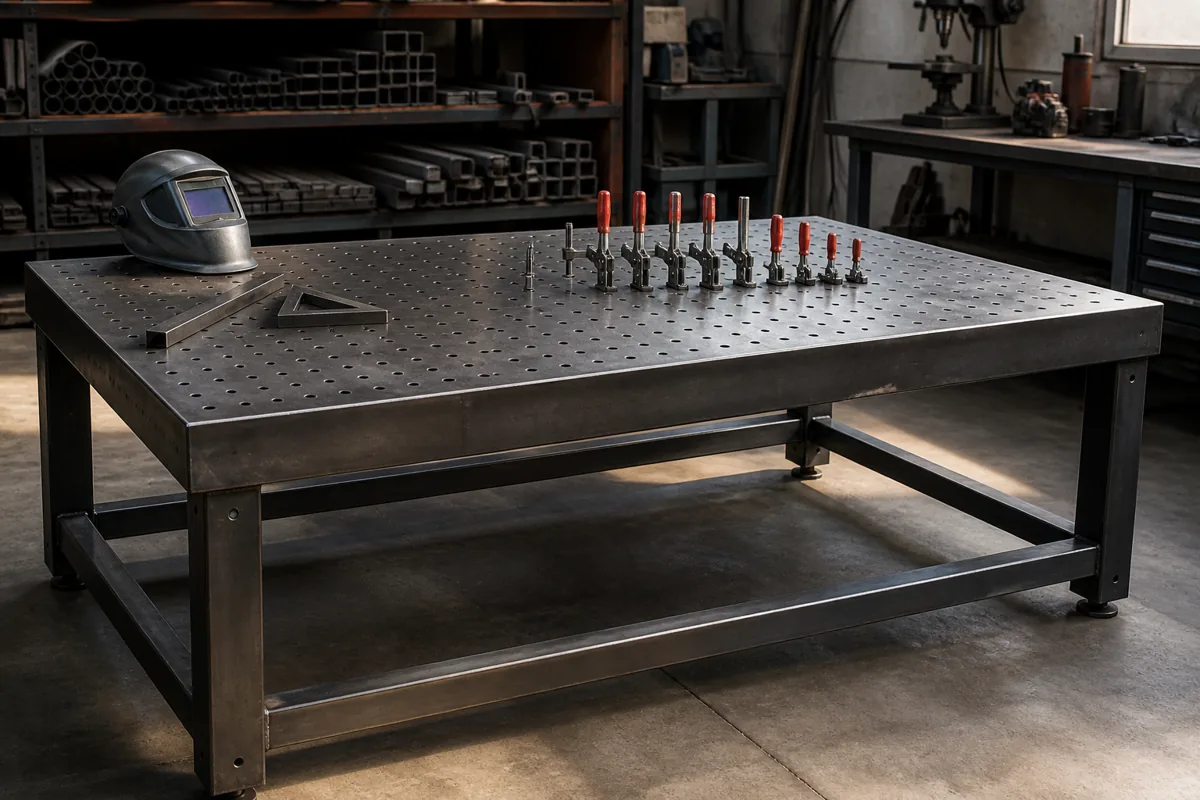
Updated October 2026 – In this flux core welder review, the short answer for most beginners is a 110V-120V inverter with synergic or infinite voltage control. Of the machines below, the YESWELDER 135A, the ARCCAPTAIN 135A and the Forney Easy Weld 140 FC-i fit that description best, while the ANDELI 135A and YESWELDER 160A add 220V input for thicker steel. Everything here is based on maker specifications and published documentation, not our own use of the machines.
What we cover
- Where flux-core shines
- Flux-Core vs Gas MIG vs Stick at a Glance
- What actually matters when you pick one
- Matching Machine Class to the Steel You Weld
- Good picks and bad picks at each price band
- Flux-Core Welders Worth a Closer Look
- Flux Core Welder Review: The 12 Machines Compared
- Choosing Flux-Core Wire: Classification, Diameter, and Spool Size
- The mistakes that make people hate flux-core
- Safety Gear and Workspace Basics
- Who should buy one, and who should skip it
- FAQ
- Verdict
Where flux-core shines
Wind blows shielding gas away, so outdoors, flux-core wins — the flux does the shielding from the inside. It also bites through mill scale and light rust better than clean-steel MIG. For fences, trailers and outdoor repairs, it’s the practical choice.
It takes very little wind to ruin a gas weld. A breeze you would barely notice on your neck is enough to pull coverage off the puddle and leave you with porosity you cannot see until the weld cracks or you cut it open. Gas MIG outdoors means building a windbreak, and a windbreak in a gusty yard is a full-time job. Self-shielded wire simply does not care.
The rust tolerance is a matter of degree, though, and people push it too far. Flux-core forgives mill scale, light surface rust, and the film on hot-rolled stock. It does not forgive flaking scale, paint, oil, galvanizing, or the crust on a trailer frame that has sat in a field for ten years. Prep still pays. You just don’t need surgical prep, and that is the difference between an afternoon of grinding and twenty minutes with a wire wheel.
Flux-Core vs Gas MIG vs Stick at a Glance
Most buyers weighing a flux-core machine are really choosing between three wire and rod processes. Here is how they compare on the things that decide whether a weld gets done in a driveway, a barn, or a clean shop.
| Factor | Flux-core (self-shielded) | Gas MIG (solid wire) | Stick |
|---|---|---|---|
| Shielding | Flux inside the tubular wire | Bottled shielding gas | Flux coating on the rod |
| Wind tolerance | Good | Poor without a windbreak | Good |
| Mill scale and light rust | Tolerant with basic prep | Needs clean metal | Most tolerant |
| Thin sheet metal | Difficult below about 16 gauge | Best of the three | Difficult |
| Bead appearance and cleanup | Spatter and slag to remove | Cleanest, little cleanup | Slag on every pass |
| Extra equipment | None beyond wire | Cylinder, regulator, hose | Rods and a dry place to store them |
| Portability | Excellent | Limited by the cylinder | Excellent |
| Learning curve | Easy to start, technique matters | Easiest | Steepest |
| Polarity | Electrode negative (DCEN) | Electrode positive (DCEP) | Depends on the rod |
| Running cost | Wire costs more per pound, no gas bills | Cheaper wire plus gas rental or refills | Rods are inexpensive but slower |
The pattern is clear: flux-core trades appearance and cleanup for independence from gas and weather. That is exactly why so many current budget machines are multi-process units that add stick and lift TIG to the gasless wire feeder.
What actually matters when you pick one
Start with input voltage, because it caps everything else. A 120 volt machine is limited by the circuit it plugs into, which means limited amperage, which means thinner practical capacity and less arc time before the thermal light comes on. A 240 volt machine gives you real output on 1/4 inch and up. Dual-voltage machines are the honest answer for anyone who welds both in a shop and out of a truck, and the flexibility is usually worth the premium.
Then look at duty cycle, and look at it at the amperage you will actually use, not at maximum output. Duty cycle is arc time inside a ten minute window, so a machine rated at 20 percent gives you roughly two minutes of welding and eight of waiting. That is fine for tacks, brackets, and short repair beads. It is miserable when you are running the length of a fence rail or filling out a long fillet, and stopping mid-bead to let a machine cool is how starts and stops end up in the wrong places.
Adjustment quality is the next thing, and it is where cheap machines quietly hurt you. Infinite voltage adjustment plus an independent wire feed control lets you dial in the arc for the actual joint in front of you. Four tapped voltage settings force you into compromises, and the compromises always land hardest on the thin end of the range. If everything you build is 1/8 to 1/4 inch, tapped settings are survivable. If your work varies, they will annoy you every session.
Two more things to check on the spec sheet. First, whether the machine can reverse polarity, because gasless wire runs electrode negative and gas MIG runs electrode positive. A machine with switchable polarity and a gas valve can grow into a gas MIG later; a machine locked to gasless never will. Second, spool size. Machines that only accept small 4 inch spools cost you more per pound of wire and run out at the worst moment. Support for 8 inch spools is a real feature.
Everything else is hardware quality: a metal wire drive rather than plastic, a gun and liner you can buy consumables for at any welding supply, leads long enough to reach around a workpiece without dragging the machine along, and a ground clamp with actual jaw pressure instead of a stamped spring. If you have to trade, trade adjustment range and cosmetic features for duty cycle, feed consistency, and parts availability. A plain machine that feeds smoothly beats a feature-loaded one that surges.
Matching Machine Class to the Steel You Weld
Maximum thickness claims on product pages are usually best-case numbers, often achieved with multiple passes and ideal joint prep. Use the table below as a realistic starting point, then compare it against the duty cycle published for the amperage you actually plan to run.
| Machine class | Typical output range | Comfortable everyday work | Where it struggles |
|---|---|---|---|
| 120V budget inverter | Around 90–140A | About 14 gauge to 3/16 inch: brackets, gates, light fencing | Long beads on low duty cycle, thick structural joints |
| 120V brand-name wire feeder | Around 90–140A | About 14 gauge to 3/16 inch with steadier feed and arc | Same power ceiling as other 120V machines |
| Dual-voltage 120/240V | Up to about 160–200A on 240V | Up to about 1/4 inch on 240V, lighter work on 120V | Full output needs a proper 240V circuit |
| Dedicated 240V | Around 180A and up | 1/4 inch and heavier with fewer passes | Needs shop wiring; less portable |
If most of your work sits at the top of a machine’s range, step up a class. Running a small welder flat out on every joint means more time waiting for the thermal cutoff and more cold starts in the middle of a bead.
Good picks and bad picks at each price band
At the cheapest end you are getting a 120 volt machine with tapped settings and a short, thin gun cable. That can still be a good buy. What separates a decent one from junk in this band is a metal drive roller, an amperage rating that is honest rather than a marketing number, and consumables in a common pattern so you can buy tips locally. Walk away from anything with no manual, no listed part numbers, and no way to identify what tip it takes.
In the middle of the market you should expect dual voltage or 240 volt input, infinite adjustment, published duty cycle figures at a stated amperage, and gas-ready polarity switching. This is where most buyers should shop, because it is the band where the specs stop being vague. If a mid-priced machine will only tell you maximum amps and nothing about duty cycle, that omission is the review.
At the top of the hobby range and into light industrial you are paying for feed consistency, a better arc at low settings, longer leads, a stouter ground, and a warranty backed by a parts network rather than a return window. Worth it if you weld weekly or earn money with it. Overkill if the machine lives under a bench between projects.
Flux-Core Welders Worth a Closer Look
The picks list at the top of this review is weighted toward budget multi-process inverters. These four machines fill the gaps: a budget dual-voltage option, a simple flux-only machine from an established brand, a long-running brand-name wire feeder, and a model that can grow into gas MIG. Check the published duty cycle at your working amperage, spool size, and consumable pattern before buying any of them.
ANDELI 135A Dual-Voltage Pulse Welder — Best Budget Dual-Voltage Option
As an Amazon Associate we earn from qualifying purchases at no extra cost to you.
It is listed as a 110V/220V flux-core MIG welder rated at 135A, with a pulse function plus stick and lift TIG modes. That means one box can run on a household outlet for light repairs and move to a 220V circuit when you need more headroom.
The pulse mode is aimed at controlling heat on thinner work, though it does not turn a flux-core machine into a sheet-metal specialist. As with any lesser-known brand, confirm the gun’s tip and nozzle pattern, whether replacement parts are listed, and what spool size the drive accepts. Read the duty cycle at the amperage you plan to use, not only at the low end.
Pros
- Dual-voltage input at a budget price
- Pulse function plus stick and lift TIG modes
- Compact multi-process package
Cons
- Parts network is thinner than established brands
- Spool size and duty cycle need confirming
Forney Easy Weld 140 FC-i — Best Simple Flux-Only Machine
Some buyers do not want menus, synergic modes, or extra processes. The Forney Easy Weld 140 FC-i is a 140-amp, 120-volt flux-cored wire feed welder designed for gasless work only, and that simplicity is its appeal.
The trade-off is that it is a flux-core-only machine, so it cannot be converted to gas MIG later. If you are certain your work will stay outdoors, on mild steel, in the 1/8 to 3/16 inch range, that limitation may never matter. Published figures put its duty cycle around 30 percent at 90 amps, which is adequate for repair work but not for long continuous beads.
Pros
- Simple, focused gasless design
- Established brand with available consumables
- Light enough to carry to the job
Cons
- No gas MIG upgrade path
- Higher price than feature-heavy budget inverters
Hobart Handler 125 — Best Brand-Name Flux-Core Feeder
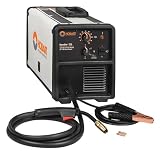
Hobart’s Handler line is a familiar name in farm and home shops, and this Handler 125 is listed as a flux-core wire feed welder with a 25–130 amp output range, aimed at steel around 1/8 inch.
What the extra money buys is mostly predictability: a brand with consumables stocked at many welding supply stores and a support network behind it. That matters more than a long feature list if the machine will see regular use. It is a 120V machine, so the power ceiling is the same as other household-outlet welders. Confirm whether the version you are buying can accept a gas kit before assuming an upgrade path.
Pros
- Recognized brand with widely available parts
- Wide 25–130A output range
- Focused on doing gasless wire welding well
Cons
- Expensive for a single-process 120V machine
- No stick or TIG modes
Hobart Handler 140EZ — Best for Growing Into Gas MIG

If there is any chance you will want clean gas MIG welds later, buy a machine that already supports it. The Hobart Handler 140EZ is listed as a 120V MIG welder with a 30–140 amp range that also runs flux-core wire, and it is spool gun ready, which opens a path to aluminum with the right accessory.
Start gasless for outdoor repairs, then add a cylinder and regulator for indoor work on clean steel and thinner sheet. Remember to switch polarity when you change processes. Budget for the gas setup and spool gun separately, since neither is cheap, and confirm what is included in the box.
Pros
- Runs flux-core now and gas MIG later
- Spool gun ready for future aluminum work
- Established brand support
Cons
- Highest price of the group
- Gas kit, cylinder, and spool gun add cost
Flux Core Welder Review: The 12 Machines Compared
Use this table to narrow the field; the four machines in the closer-look section above have individual notes. Specs come from the listing titles and maker information, and price tiers are rough ranges that change often.
| Machine | Input | Listed output and modes | Price tier | Best for |
|---|---|---|---|---|
| YESWELDER 135A 3-in-1 | 110V | 135A · flux core · lift TIG · stick · synergic control | Check on Amazon | First machine |
| ARCCAPTAIN 135A 3-in-1 | 110V | 135A · flux core · stick · lift TIG · synergic · 2T/4T trigger | Check on Amazon | Light, portable DIY |
| BESTMIG 135A 3-in-1 | 110V | 135A · flux core · lift TIG · stick · helmet and gloves included | Check on Amazon | Starter kit buyers |
| ANDELI 135A Pulse | 110V/220V | 135A · flux core · pulse · stick · lift TIG | Check on Amazon | Dual voltage on a budget |
| AZZUNO 130A | 110V | 130A · gasless wire feed · IGBT inverter | Check on Amazon | Lowest-cost entry |
| 145A 3-in-1 (7.5 lb) | 110V | 145A · flux core · stick · lift TIG · synergy control | Check on Amazon | Lightest to carry |
| ACEWELDER 130A | 110V | 130A · gasless flux core · synergy control | Check on Amazon | Tightest budget |
| YESWELDER 160A 4-in-1 | 110V/220V | 160A · MIG · flux core · lift TIG · stick · synergic | Check on Amazon | Growing into thicker steel |
| Lincoln Electric 90i FC | 120V | Flux-core wire feed · metal case · shoulder strap | Check on Amazon | Small repair jobs |
| Forney Easy Weld 140 FC-i | 120V | 140A · flux-core only · about 30% duty at 90A | Check on Amazon | Simple gasless work |
| Hobart Handler 125 | 120V | 25–130A · flux-core wire feed · 1/8 in steel | Check on Amazon | Brand-name support |
| Hobart Handler 140EZ | 120V | 30–140A · flux core and gas MIG · spool gun ready | Check on Amazon | Adding gas MIG later |
Whatever you buy, check duty cycle at the amperage you will actually weld at, the spool size the drive accepts, and whether the polarity can be switched.
Choosing Flux-Core Wire: Classification, Diameter, and Spool Size
The wire matters as much as the machine. Two spools that look identical on a shelf can be designed for very different jobs, so read the classification printed on the label before you load it.
| Choice | Option | Best use |
|---|---|---|
| Classification | E71T-GS | General-purpose gasless wire intended for single-pass welds on light steel |
| Classification | E71T-11 | Gasless wire that also supports multi-pass welds within the maker’s thickness limits |
| Diameter | .030 inch | Thinner material and lower-output 120V machines |
| Diameter | .035 inch | Thicker material and machines with more output |
| Spool | About 2 lb (4-inch spool) | Small machines and occasional use |
| Spool | About 10 lb (8-inch spool) | Regular use and lower cost per pound |
Flux-core wire is tubular, so it crushes under the pressure a solid-wire drive needs. Use a knurled drive roll sized to the wire, set tension just high enough to feed without slipping, and match the contact tip to the diameter. A V-groove roll cranked down hard is a common cause of erratic feed that gets blamed on the machine.
If you plan multi-pass joints on thicker steel, buy wire classified for multi-pass work and clean slag fully between passes. If most jobs are short single-pass repairs, general-purpose wire is fine. Either way, buy from a brand that prints the classification and recommended settings clearly on the spool.
The mistakes that make people hate flux-core
Wrong polarity is the big one. Gasless wire needs electrode negative, and plenty of machines ship wired for gas MIG. Get it backwards and you get a wandering arc, spatter everywhere, and a bead sitting on top of the metal with no penetration. Most people in that situation blame the wire or the machine. Check the polarity leads before you blame anything.
Second is technique. Gas MIG pushes; flux-core drags. You pull the gun so the slag trails behind the puddle instead of getting stirred into it. Keep stickout consistent, around 1/2 to 3/4 inch for most gasless wire, and shorter on thin steel. Stickout that wanders long and short is the fastest way to a ropey, porous bead.
The rest are housekeeping. Chip and brush slag between every pass, not just at the end, because trapped slag is a defect you cannot grind out later. Do not fight thin sheet with a gasless machine; 16 gauge and thinner turns into a burn-through contest you will lose. Feed a 120 volt machine with a short, heavy extension cord, 12 gauge or heavier, since a long thin cord starves it and makes a perfectly good welder look broken. Store spools sealed and dry, because flux absorbs moisture and a spool left on the machine in a damp shed all winter will give you porosity. And ventilate: self-shielded wire smokes hard, and the smoke rises straight into your hood.
Safety Gear and Workspace Basics
Flux-core throws more smoke and spatter than gas MIG, so the basics matter even more. None of this is complicated, and most of it costs less than a spool of good wire.
- A welding helmet with a suitable shade for the amperage you run, plus safety glasses underneath for chipping and grinding
- Leather welding gloves and flame-resistant clothing with no exposed skin, since spatter finds gaps in sleeves and collars
- Leather boots or boot covers, because hot balls of spatter land on feet constantly
- Good ventilation or fume extraction, and respiratory protection when fumes cannot be kept out of your breathing zone
- A cleared work area with no rags, sawdust, dry grass, or fuel nearby, and a fire extinguisher within reach
- A dedicated circuit or a short, heavy-gauge extension cord sized for the machine
Coated metals need extra care. Galvanized, painted, or plated steel releases hazardous fumes when heated, so remove the coating from the weld zone and follow the safety data for the material and wire. After you finish, check the area for smoldering material before you leave, especially outdoors in dry conditions.
Who should buy one, and who should skip it
Buy one if it is your first machine, if your work happens outdoors, or if you fix gates, fences, trailers, racks and farm equipment in the 1/8 to 1/4 inch range. It is also a smart second machine for someone with a gas rig who does not want to wheel a cylinder into the yard.
Skip it if your work is auto body panels or other thin sheet, if you need cosmetic welds you will not want to clean up, or if you run long production beads on clean steel indoors where gas MIG is simply better and quieter. It is also the wrong tool if aluminum is on your list.
FAQ
Do I really need no gas at all?
Correct. The shielding comes from flux inside the wire, so there is no cylinder, regulator or hose. The wire costs more per pound than solid MIG wire, but you are not renting, refilling or hauling a bottle.
Can I run flux-core wire in a gas MIG machine?
Usually yes, provided you can reverse the polarity to electrode negative and fit the right drive roller and contact tip. Some budget machines have no way to swap polarity, so check before you buy wire.
Is flux-core strong enough for a trailer or a frame repair?
Strength comes from fit-up, joint prep, correct settings and penetration, not from the label on the spool. Note that a lot of general-purpose gasless wire is specified for single-pass work, so read the spool before planning multi-pass joints, and hand anything safety-critical like hitches or suspension to a certified welder.
Why is my weld so spattery and rough?
In order of likelihood: reversed polarity, voltage and wire speed out of balance, too much stickout, pushing instead of dragging, or damp wire. Fix them in that order on scrap before you touch the real job.
How thick can a 120V flux-core welder weld?
Many 120V machines claim 3/16 to 1/4 inch at maximum, but those figures usually assume ideal prep and sometimes multiple passes. For everyday single-pass work with good penetration, about 14 gauge to 3/16 inch is a more realistic range. Bevel thicker joints, weld in passes with wire rated for multi-pass work, or step up to a dual-voltage machine on 240V.
Can flux-core weld galvanized steel?
The wire can join it, but the zinc coating is the problem. Burning through galvanizing produces hazardous fumes and also tends to cause porosity. Grind the coating back from the weld zone, weld with strong ventilation and appropriate respiratory protection, and restore corrosion protection afterward with a cold galvanizing compound or paint.
Can I weld aluminum or stainless steel with flux-core?
Not with standard flux-core wire, which is made for mild steel. Aluminum calls for gas MIG with a spool gun or TIG, and stainless requires wire made for stainless along with the shielding it specifies. If either metal is on your list, choose a machine that supports gas MIG or TIG from the start.
How can I tell whether my flux-core welds have good penetration?
Look for a bead that wets into both edges of the joint rather than sitting on top like a rope. Then prove it on scrap: weld a test joint with the same settings, cut through it, and check that the weld fuses into both pieces, or clamp a test piece in a vise and bend it to see whether it fails in the weld. Do this whenever you change wire, thickness, or machine.
Which is the best flux core welder for beginners?
A 110V-120V inverter with synergic or infinite voltage control and a metal wire drive. In this guide the YESWELDER 135A, ARCCAPTAIN 135A and Forney Easy Weld 140 FC-i fit that profile, based on their listed specs.
Is MIG welding better than flux-core?
Gas MIG gives cleaner beads and works better on thin sheet and clean steel indoors. Flux-core wins outdoors, on rusty or dirty steel, and costs less to start because there is no cylinder or regulator.
What can I weld with a 130-amp flux-core welder?
Mild steel from about 14 gauge to 3/16 inch in single passes, such as brackets, gates, trailer racks and light fencing. Thicker joints need bevels, multi-pass wire and a stronger machine or 220V input.
Do you push or pull flux-core welding?
Pull, or drag, the gun with a slight travel angle of roughly 10 to 15 degrees so the slag trails behind the puddle instead of getting pushed into it.
What are the downsides of flux-core welding?
More spatter, slag to chip off between passes, heavier smoke, wire that costs more per pound than solid MIG wire, and poor results on thin sheet below about 16 gauge.
Verdict
For outdoor and dirty-steel work, flux-core earns its place. Keep a wire brush handy for spatter cleanup and run a proper helmet. It’s a smart first machine or a rugged backup to a gas rig.
Buy for duty cycle and feed quality, get dual voltage if your work moves around, and spend the first spool learning what the arc should sound like. Do that and the process stops being the compromise everyone claims it is.