What's inside
As an Amazon Associate I earn from qualifying purchases. This post may contain affiliate links at no extra cost to you.
The cheapest welding machine worth buying is usually a basic inverter stick welder for occasional outdoor repairs, while a compact flux-core or MIG machine is the better budget choice for cleaner work on thin steel.
Low price alone is not a useful buying criterion. The machines that save money without becoming frustrating usually have a stable arc, a published duty cycle, replaceable consumables, usable controls, and enough support to obtain parts when something wears out. The biggest false economy is buying a welder with impressive peak amperage but poor low-amperage control, a short duty cycle, or no practical source of replacement tips, holders, liners, and torches.
As an Amazon Associate we earn from qualifying purchases at no extra cost to you.

What we cover
Best cheap welding machines by situation
| Situation | Best machine type | Useful specification | Typical market range in 2026 | Main compromise |
|---|---|---|---|---|
| Outdoor repairs and farm maintenance | Inverter stick welder | 120–180 A, 20–25% duty cycle at maximum output | $100–$220 | More difficult on thin sheet metal |
| Small projects in a garage | Flux-core or dual-voltage MIG | 90–140 A, 0.030–0.035 inch wire capacity | $170–$350 | Flux produces smoke and slag |
| Body panels and thin steel | Gas-capable MIG welder | 30–140 A range, voltage and wire-speed adjustment | $250–$550 | Shielding gas adds equipment cost |
| Portable repairs with limited power | 120-volt inverter stick welder | 80–120 A output, 10–15 A input circuit | $90–$180 | Limited penetration and short duty cycle |
Our budget picks that still make sense
Best overall cheap option: a 140–180 amp inverter stick welder
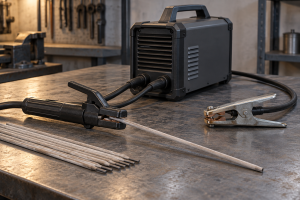
A compact stick welder offers the lowest entry cost and the fewest parts to maintain. It does not need a wire spool, drive rollers, shielding-gas bottle, regulator, or contact tips. A machine in the 140–180 amp class can repair brackets, gates, trailers, lawn equipment, and thicker mild-steel sections when paired with the correct electrode.
Look for adjustable current, hot-start assistance, anti-stick protection, a proper electrode holder, and leads at least 8 feet long. A stated duty cycle near 20% at maximum output is acceptable for a budget machine. A 20% duty cycle at 160 amps means roughly 2 minutes of arc time in a 10-minute period, followed by cooling time. At lower current, the usable time is usually much longer.
Stick is a poor choice for clean, thin sheet metal. Even a skilled operator can burn through 18-gauge steel more easily than with short MIG welds. For outdoor work, however, stick has a major advantage: wind is much less likely to disrupt the arc than it is with shielding gas.
Best low-cost garage machine: a flux-core MIG welder
A small flux-core machine is often the cheapest welding machine for someone who wants an easier learning curve than stick welding. It feeds continuously, starts quickly, and is practical for mild steel from roughly 1/16 inch to 1/4 inch, depending on joint design, preparation, and the machine’s output.
Choose a model with variable voltage and wire-speed control rather than a simple low/high switch. A machine that accepts 0.030- and 0.035-inch flux-core wire is more useful than one restricted to a single spool size. A removable gun liner, standard contact tips, and a spool compartment large enough for a 10-pound spool also reduce ownership costs.
Flux-core welding creates slag that must be chipped and brushed away between passes. It also produces more smoke and spatter than gas-shielded MIG. Those are manageable compromises, but ventilation and eye protection are essential.
Best inexpensive dual-voltage choice: a 120/240-volt inverter MIG or multiprocess welder
If the budget allows roughly $300 to $600, a dual-voltage machine can be a better long-term purchase than replacing a $150 welder later. The 120-volt setting suits light work and ordinary household circuits; 240 volts gives more stable output and better duty cycle for thicker steel.
Useful features include MIG, flux-core, and DC stick modes, polarity switching, inductance or arc-control adjustment, and a clearly stated output at both input voltages. Gas capability matters if you expect to weld thin material or want less cleanup. Avoid paying extra for a TIG mode unless the machine includes meaningful control over amperage and accepts the torch and accessories you actually intend to use.
Budget machines worth considering
Forney Easy Weld 180 ST
This compact stick machine is aimed at straightforward DC stick work and is a sensible example of a portable budget welder from an established welding-equipment brand. Its appeal is simplicity: fewer consumables, modest storage requirements, and enough output for common repair work. It is most appropriate for mild steel, occasional fabrication, and users who can work with 1/8-inch electrodes rather than expecting production performance.
Hobart Handler 140
The Handler 140 is a conventional 120-volt MIG machine suited to light fabrication and repair. It is more expensive than anonymous entry-level units, but the value is in the established parts and consumables ecosystem, predictable controls, and support. Its output is intended for thinner steel and moderate-duty work, not repeated welding of heavy structural sections.
Lincoln Electric POWER MIG 140 MP
This type of multiprocess machine is worth considering when one welder must cover flux-core, gas MIG, and DC stick work. The attraction is flexibility rather than maximum thickness. Confirm the included accessories and exact duty-cycle figures before purchase, because package contents can differ. It remains a light-duty machine and should not be treated as a replacement for a 240-volt shop welder.
Reputable 160–200 amp inverter stick machines from YesWelder and similar brands
Budget-focused brands such as YesWelder offer compact inverter welders with useful output for relatively little money. These can be good value when the machine has a clear manual, realistic duty-cycle figures, standard torch and electrode connections, and accessible warranty support. The key is to buy the specification rather than the large number printed on the front panel: a claimed 200 amps does not guarantee a stable arc at 40 or 60 amps, nor does it indicate how long the machine can operate at full output.
What to sacrifice—and what not to
- Reasonable savings: fewer digital presets, a smaller case, no built-in spool gun, and a shorter accessory kit.
- Risky savings: no published duty cycle, permanently attached leads, proprietary contact tips, an undersized ground clamp, or vague warranty terms.
- Amperage: prioritize a useful low-current range and stable arc control over a high peak number.
- Controls: variable voltage and wire speed are worth paying for on MIG machines. They make it possible to tune the arc instead of compensating for a fixed setting.
- Consumables: standard 0.030- and 0.035-inch tips and liners are easier to find and usually cheaper.
- Warranty: verify whether the warranty covers the power source, gun, cables, and labor, and whether registration or authorized service is required.
A simple cost calculation before buying
Suppose a $180 flux-core machine consumes one 10-pound spool costing about $35. If a beginner uses approximately 2 pounds of wire per small project, wire costs about $7 per project. Add roughly $3 for tips, electricity, and occasional nozzle replacement, and the consumable cost is about $10 per project before steel and safety equipment.
A $350 gas-capable MIG setup may require a regulator, hose, cylinder rental or purchase, shielding gas, and solid wire. The initial cost can exceed $500, but it may produce cleaner welds and less post-weld cleanup. For ten dirty outdoor repairs, flux-core may be the better value. For ten thin indoor fabrication projects, the cleaner gas-MIG process can save enough grinding time to justify the extra equipment.
Setup details that prevent cheap welders from behaving badly
- Use a dedicated circuit where possible. Check the machine’s input-current requirement and avoid long, lightweight extension cords, which can cause voltage drop and nuisance tripping.
- Clean the joint to bright metal. Paint, rust, oil, and galvanized coatings create porosity and unstable arcs. Remove coatings in a controlled, ventilated area and avoid welding unknown containers.
- Match electrode or wire to the metal. For common mild steel, 1/8-inch 6011 or 6013 electrodes suit many small stick jobs; flux-core wire must match the machine’s polarity and diameter instructions.
- Set current or wire speed from the material thickness. Run a test bead on scrap of the same thickness, then inspect penetration, bead profile, and spatter before welding the actual part.
- Allow cooling time. Repeatedly ignoring the duty cycle overheats budget inverters and can shorten the life of fans, thermal sensors, and power components.
- Maintain the consumable path. Keep the gun liner clean, replace worn tips, remove slag from the nozzle, and check that the ground clamp bites clean metal.
Final buying recommendation
Choose a 140–180 amp inverter stick welder if the priority is the lowest purchase price and reliable outdoor repair capability. Choose a variable-control flux-core MIG machine if ease of learning and small garage projects matter more. Spend extra on a dual-voltage MIG or multiprocess welder when you expect frequent use, need cleaner thin-metal work, or want a machine that can grow with your projects.
The best cheapest welding machine is not the one with the highest advertised amperage. It is the machine with standard consumables, honest duty-cycle information, controllable output, suitable input power, and support you can still reach after the first contact tip or liner wears out.