
What's inside
As an Amazon Associate I earn from qualifying purchases. This post may contain affiliate links at no extra cost to you.
Welding thick steel plate with a 7018 rod is mainly a power and technique problem. The machine must hold a stable arc at high amperage, recover quickly between starts, and deliver enough duty cycle that thermal overload does not interrupt the job. A small 120-volt hobby welder may run 1/8-inch 7018 acceptably, but it is the wrong tool for repeated passes on 1/2-inch plate.
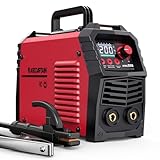
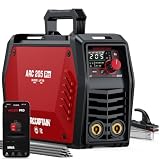
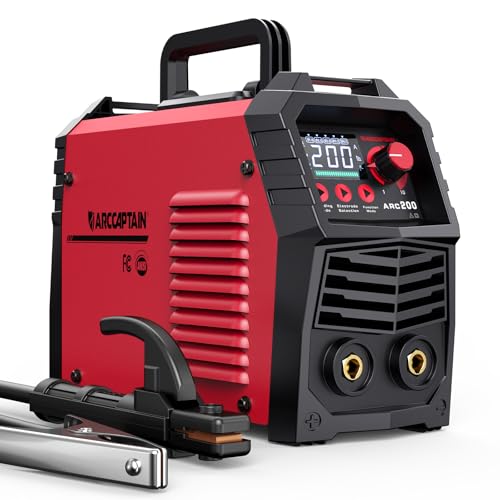
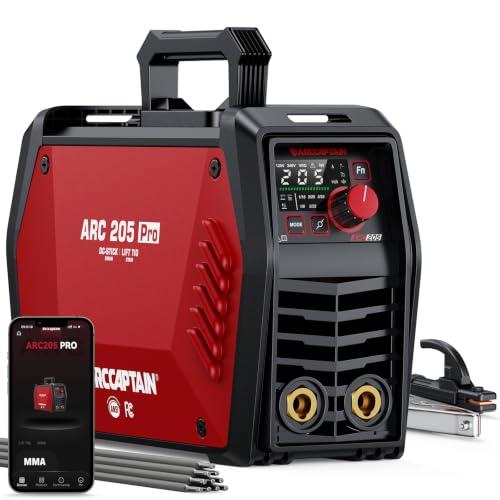
For serious plate work, start by looking at 240-volt stick welders rated around 200 amps. An inverter is usually easier to carry and more efficient; a transformer machine is heavier but often simpler and less vulnerable to dirty generator power.
As an Amazon Associate we earn from qualifying purchases at no extra cost to you.


What we cover
Our Top Picks
 Eastwood Elite 200 Amp Multi-Process AC/DC MP200i Welder200 Amp AC/DC MP200i143 PoundsCheck on Amazon
 YESWELDER 205Amp Stick Welder Digital Inverter IGBT ARCARC-205DS15.35 x 13.07 x 7.8 inches8.8 poundsCheck on Amazon

What to look for in a thick-plate stick welder
Output range matters more than the advertised maximum. A welder labeled 200 amps is useful only if it can produce close to that output without immediately overheating. For 1/8-inch 7018, you will normally use roughly 90 to 135 amps. A 5/32-inch rod commonly needs about 130 to 180 amps, while 3/16-inch 7018 can require 180 to 250 amps depending on position, joint design, and the electrode manufacturer.
For a practical thick-steel machine, look for at least 200 amps of usable output and a duty cycle of 60% or better near the amperage you expect to use. At a 60% duty cycle, you can weld for six minutes in a ten-minute period before allowing the machine to cool. This is not six minutes of uninterrupted arc time in normal fabrication, but it gives useful thermal headroom for long welds.
A 240-volt input is strongly preferred. At high output, a 120-volt welder draws substantial current and may require a dedicated circuit. Voltage drop from a long, undersized extension cord can make the arc weak and erratic. Use the cord and breaker size specified by the manufacturer, and do not assume a household receptacle can safely support the machine’s maximum setting.
| Welder type | Best use | Advantages | Limitations |
|---|---|---|---|
| 120-volt compact inverter | Occasional repairs and thin-to-medium stock | Cheap, portable, low power requirement | Limited duty cycle and marginal for 5/32-inch or larger rods |
| 240-volt inverter stick welder | Most home shops and mobile fabrication | Lightweight, efficient, adjustable arc characteristics | More sensitive to poor power, cables, and electronics damage |
| 240-volt transformer welder | Repeated heavy fabrication and shop use | Durable, simple, smooth arc, tolerant of rough service | Heavy, less efficient, usually no advanced arc controls |
| Engine-driven welder | Remote field work without utility power | High output and independent operation | Expensive, noisy, requires fuel and engine maintenance |
The best choice for most buyers
A 200- to 250-amp 240-volt inverter stick welder is the sensible default for welding thick plate with 7018. Choose one with adjustable hot start and arc force if possible. Hot start briefly increases current when the rod touches the work, helping prevent a cold, stuck start. Arc force adds current when the arc length shortens, which can reduce sticking and keep the puddle from going cold.
These controls are useful, but they do not compensate for inadequate power or poor fit-up. A cheap inverter is fine when the work is occasional, the plate is prepped correctly, and you are comfortable welding in shorter sequences. It becomes a false economy if you repeatedly trip thermal protection, weld at the machine’s maximum setting, or need to repair porosity and lack of fusion.
If you want the lightest practical setup, compare 250-amp 240-volt inverter stick welders. If the machine will live in a fabrication shop and portability is unimportant, a used or new transformer welder can be a better long-term purchase. Its weight is a nuisance during setup, but the basic power section is mechanically simple and often lasts for decades.
7018 rod sizes and settings
Use 1/8-inch 7018 for general plate work when access and joint design allow it. A starting range of 105 to 125 amps is typical, with slightly lower settings for vertical or overhead welding. Move to 5/32-inch rod for higher deposition on flat or horizontal joints, starting around 140 to 165 amps. Do not choose a larger rod merely because the plate is thick; the welding position, root opening, and available amperage matter just as much.
7018 is a low-hydrogen electrode. Keep it dry. Moisture can contribute to porosity, worm tracks, cracking, and unreliable weld metal, especially in restrained joints and thick sections. Store unopened electrodes according to the package instructions. A household oven is not a substitute for a proper electrode storage oven, and rebaking limits vary by manufacturer. If rods have been sitting open in a damp shop, use fresh electrodes rather than trusting their appearance.
Preparation determines penetration
Thick plate generally needs a beveled joint, not a square butt joint. A common preparation is a 30-degree bevel on each side, leaving a small land and a controlled root gap. The exact dimensions depend on the thickness and welding procedure, but the purpose is consistent: create room for the arc to reach the root and provide enough volume for multiple passes.
Remove mill scale, rust, paint, oil, and moisture from the weld zone. Tack parts securely and check alignment before welding. For heavy plate, preheating may be necessary to reduce cooling rate and hydrogen cracking risk. A temperature-indicating crayon or infrared thermometer is more reliable than guessing from the steel’s color.
Common failures and how to prevent them
Lack of fusion usually comes from low amperage, excessive travel speed, a dirty joint, or an electrode angle that directs the arc away from the sidewall. Increase heat modestly, slow down, and pause long enough at each toe to tie the bead into the plate.
Slag inclusions occur when slag is trapped between passes. Chip and wire-brush every pass, especially at the toes and in corners. Do not weld over a dark, glassy slag island just because the surface looks smooth.
Undercut is often caused by too much current or a long arc. Shorten the arc to roughly the rod’s core-wire diameter and use a controlled side-to-side motion rather than a wide, fast weave.
Arc starts that stick point to low hot-start current, damp electrodes, a poor work clamp, or undersized leads. Use stout welding cables, clean the clamp connection, and keep the work lead as short as practical. For thick plate and 7018, a solid ground connection is not optional.
Finally, buy the machine around the job’s actual duty cycle, not its biggest number on the box. A dependable 200-amp welder used within its limits will produce better plate welds than a nominally larger unit that cannot maintain output, has weak cables, or repeatedly shuts down.
Related guides
More from Amazon
Programs that pair well with the guide above. Offers and eligibility are set by Amazon and may change.
A free business account with business pricing and bulk-buying tools for work, shop or home office.
Create a business accountFree shipping on eligible items, Prime Video and more. Eligible new members can start with a free trial.
Start a Prime free trialAudiobooks and podcasts to listen to on the go. Eligible new members can start with a free trial.
Try Audible freeAd-free music streaming. Eligible new subscribers can start with a free trial.
Try Music Unlimited freeAs an Amazon Associate we earn from qualifying purchases.








Write Your Review
No reviews yet. Be the first to share your experience!