
Our Short List of 3
- Measuring range: 0–1250 µm
- Principle: magnetic induction (Fe) and eddy current (NFe), automatic substrate recognition
- Power: 1 × 9V battery (included)
- Weight: 180 g

- Measuring range: 0–2000 µm (0–78.7 mil)
- Accuracy: ±(2.5% + 1 µm)
- Units: µm, mm, mils
- Memory: 320 readings in 4 groups, kept when powered off

- Measuring range: 0–1500 µm (0–59.1 mil)
- Resolution: 0.1 µm / 0.01 mil
- Accuracy: ±(3% + 2 µm)
- Principle: magnetic induction (Fe) and eddy current (NFe)
All 5 Picks at a Glance
| Product | Specs | Action |
|---|---|---|
| RDINSCOS TC100 Coating Thickness Gauge |
| Check price on Amazon |
| ERAY P1 Mil Thickness Gauge |
| Check price on Amazon |
| EYPINS Paint Coating Thickness Gauge |
| Check price on Amazon |
 Abizarch HW-300PRO Coating Thickness Gauge |
| Check price on Amazon |
 VVV-Group CM-205FN Paint Thickness Gauge |
| Check price on Amazon |
Key takeaways
- Compare the best coating thickness gauge picks for paint, powder coat and plating on steel and aluminum, with ranges, accuracy and calibration tips.
What's inside
As an Amazon Associate I earn from qualifying purchases. This post may contain affiliate links at no extra cost to you.
As an Amazon Associate we earn from qualifying purchases.
If you weld, fabricate, or finish metal, the coating is the part of the job your customer actually sees, and the part that decides how long the work survives outdoors. Powder coat shot too thin over a weldment rusts at the edges within a season. Plating that runs heavy wastes material and can crack or peel. Paint laid on a trailer frame with no target film build is guesswork. A coating thickness gauge turns that guesswork into a number: set the probe flat on the finished surface and it reads the dry film in a second or two, without cutting, scraping, or marking the finish.
The five gauges below cover what a metalworking shop is likely to need, from a simple panel-checking meter to a data-logging tool that exports readings to a PC. Every pick reads coatings on steel and aluminum, so one tool covers most mixed-metal shop work. Each uses magnetic induction on ferrous metal and eddy current sensing on non-ferrous metal, switching between the two on its own.
Disclosure: This post contains affiliate links. If you buy through links on this page, we may earn a commission at no extra cost to you.
What we cover
Quick picks
- Best for logged inspections: ERAY P1 Mil Thickness Gauge — big memory, USB export, and limit alarms
- Best for fine paint work: EYPINS Paint Coating Thickness Gauge — 0.1 µm resolution with a published accuracy figure
- Best all-round shop pick: VVV-Group CM-205FN — balanced range with fine 0.1 µm resolution
- Best simple checker: RDINSCOS TC100 — auto substrate detection, full calibration kit included
- Best wide-range compact pick: Abizarch HW-300PRO — 0–2000 µm span with on-board statistics
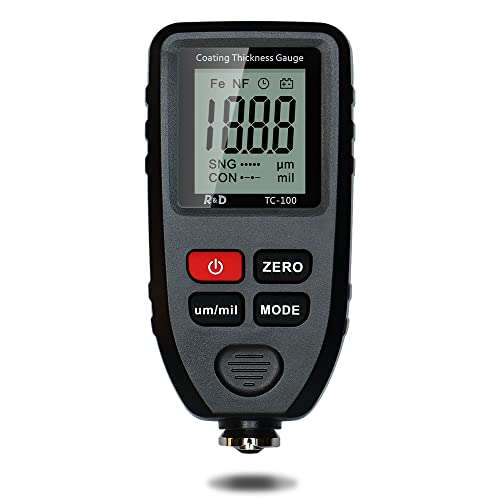
RDINSCOS TC100 Coating Thickness Gauge
- Measuring range: 0–1250 µm
- Principle: magnetic induction (Fe) and eddy current (NFe), automatic substrate recognition
- Power: 1 × 9V battery (included)
- Weight: 180 g
The RDINSCOS TC100 (model XWJ) is the gauge we would hand to someone who has never used one. It recognizes ferrous and non-ferrous substrates by itself, so there is no mode to set before you touch a painted steel panel or an anodized aluminum part. Readings show on a plain digital display, and the kit arrives ready to work: five calibration foils, iron and aluminum plates, a storage bag, and the 9V battery are all in the box.
In practical notes, the TC100 earns its keep as a comparator. Walk a part or a panel and read every few inches; even numbers mean an even coat, and a sudden jump flags filler, a respray, or heavy edge build. It will not log data or talk to a computer, but as a quick truth-teller for paint and light plating it is hard to fault.
Pros:
– Automatic steel and aluminum detection with nothing to set up
– Complete calibration kit and battery included
– Simple design anyone in the shop can use
Cons:
– No data storage or export
– Metal substrates only, like every gauge here
– Maker does not publish an accuracy figure for this model
ERAY P1 Mil Thickness Gauge
- Measuring range: 0–2000 µm (0–78.7 mil)
- Accuracy: ±(2.5% + 1 µm)
- Units: µm, mm, mils
- Memory: 320 readings in 4 groups, kept when powered off
The ERAY P1 is built for shops that need a record of their work. It stores up to 320 readings in four groups of 80, keeps them with the power off, and sends them to a Windows PC over USB for analysis with the included software. Set high and low limit alarms for a job and an out-of-range coat flags itself on screen while you scan.
Its 0–2000 µm span is the joint widest here, suiting heavy plating, galvanized layers, and thick protective coats as well as paint. The backlit screen stays readable under shop lights, and the kit ships in a hard toolbox with cable, software disc, and batteries. First-time calibration takes patience, but the routine is quick once learned.
Pros:
– Large memory with USB export for job records
– Limit alarms catch out-of-range coats during a scan
– Wide range suits plating and heavy protective coats
Cons:
– PC software is Windows only and dated
– Needs a 20 mm measuring area, larger than some rivals
– Calibration takes practice at first
EYPINS Paint Coating Thickness Gauge
- Measuring range: 0–1500 µm (0–59.1 mil)
- Resolution: 0.1 µm / 0.01 mil
- Accuracy: ±(3% + 2 µm)
- Principle: magnetic induction (Fe) and eddy current (NFe)
The EYPINS gauge is the fine-resolution pick for paint work. Its 0.1 µm resolution matches the CM-205FN, and its stated accuracy of ±(3% + 2 µm) across a 0–1500 µm range puts it among the tighter shop gauges here. It reads steel with magnetic induction and aluminum with eddy current sensing, recognizes the substrate on its own, and shows readings on a backlit display.
Our take: choose it when small differences matter, such as blending a repair coat into existing paint or confirming that a second powder coat pass actually added build. The battery is included, calibration follows the usual foil routine, and the compact body rides in a pocket. It keeps no records, so pair it with a notebook when a job needs a paper trail.
Pros:
– Fine 0.1 µm resolution spots small build changes
– Published accuracy figure, not just a range claim
– Battery included, ready out of the box
Cons:
– No data storage or export
– Plain feature set
– Smaller brand with thinner support channels
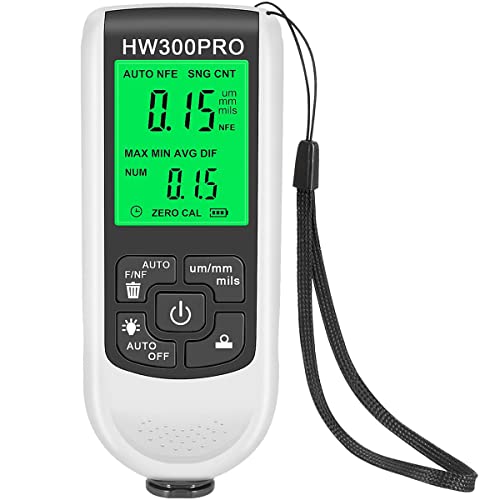
Abizarch HW-300PRO Coating Thickness Gauge
- Measuring range: 0–2000 µm
- Accuracy: ±(3% + 1 µm)
- Resolution: 0.1 µm below 100 µm, 1 µm from 100 to 999 µm
- Memory: up to 50 readings with average, maximum, minimum, and difference
The HW-300PRO is the small gauge that seems to live in every toolbox, sold under several brand names with the same core hardware. It reads 0 to 2000 µm on steel and aluminum with automatic substrate detection, and keeps simple statistics on board: up to 50 readings with average, maximum, minimum, and difference values on the backlit screen.
For a welding shop, that difference figure is the handy part: scan a powder-coated frame and it shows how far the thinnest spot sits from the thickest, no notebook involved. Units switch between µm, mm, and mils, and calibration films come in the box. It is a checking tool, not an inspection system: fast, plain, and good enough for daily film-build control.
Pros:
– Wide 2000 µm range in a pocket-size body
– On-board statistics with a useful difference readout
– Switches between µm, mm, and mils
Cons:
– Batteries are not included
– Small buttons are awkward with gloves on
– No data export
VVV-Group CM-205FN Paint Thickness Gauge
- Measuring range: 0–1500 µm (0–59.1 mil)
- Resolution: 0.1 µm / 0.01 mil
- Accuracy: ±3%
- Principle: magnetic induction (F) and eddy current (N) in one probe
The CM-205FN is the balanced middle pick: a 0–1500 µm range that covers paint, powder coat, and most plating a fabrication shop will meet, with fine 0.1 µm resolution. It pairs magnetic induction sensing for steel with eddy current sensing for aluminum in one probe head and recognizes the substrate on its own, so mixed batches need no settings changes between pieces.
Our take: this is the gauge to buy when you want one tool for the whole shop rather than a specialist. The backlit LCD reads easily at arm’s length, single and continuous modes suit spot checks and scanning, and calibration uses the included foils and base plates. It lacks the memory and export tools of the ERAY P1, but for daily film-build checks it covers the essentials well.
Pros:
– Fine resolution shows small build changes
– Balanced range covers paint, powder coat, and most plating
– Simple single and continuous modes
Cons:
– No data storage or export
– Fewer included extras than the RDINSCOS kit
– No statistics beyond the live reading
How to choose
Match the gauge to your metal. Magnetic induction probes read non-magnetic coatings on steel and iron. Eddy current probes read insulating coatings on aluminum, copper, and brass. A dual Fe/NFe gauge like all five picks here switches on its own, which suits shops mixing steel and aluminum work. All of them need a metal substrate; none reads a coating on plastic, wood, or fiberglass.
Buy range with headroom. Cured paint on fabricated work usually lands between 75 and 200 µm of total build, and powder coat commonly runs 50 to 150 µm. Zinc plating and galvanizing often sit between 25 and 125 µm, while heavy epoxy coats can pass 500 µm. A 1500 or 2000 µm gauge covers nearly all of it.
Check the accuracy figure and the calibration kit. Look for a published accuracy such as ±(3% + 1 µm) and calibration foils in the box. Zero the gauge on the bare substrate plate that matches your metal before a session, and confirm it against a foil when the reading really matters, such as a plating job with a written target.
Think about the surface and the paperwork. A smaller minimum curvature radius reads tighter tube and pipe curves, and the probe must sit flat and square for a true reading. If job sheets demand proof of film build, pick the gauge with memory and export: the ERAY P1. For bench checks, any of the five will do.
FAQs
Can a coating thickness gauge measure powder coating?
Yes. Cured powder coat is a non-magnetic, insulating layer over metal, so these gauges read it the same way they read paint. Measure after curing, and read several spots, since edges and welds run thinner than flat areas.
Why will my gauge not read on a plastic bumper or a fiberglass panel?
Both methods need metal under the coating: magnetic induction needs a ferrous base, eddy current a conductive one. Coatings on plastic, fiberglass, wood, or composites call for an ultrasonic gauge built for non-metal bases.
What is the difference between a mil and a micrometer?
A mil is one thousandth of an inch, and one mil equals 25.4 µm. Paint work in the US is often discussed in mils, while metric shops work in micrometers. All five gauges here switch between the two.
How often should I calibrate the gauge?
Zero-check on the matching bare plate at the start of each session, and run a foil check whenever a reading has to be defended or after a drop. The routine takes under a minute and separates a number you trust from a number you hope is right.
Conclusion
For most metalworking shops, the VVV-Group CM-205FN is the sensible default: honest range, fine resolution, and nothing to learn. Step up to the ERAY P1 for logged readings and limit alarms, or to the EYPINS gauge for fine paint resolution. The RDINSCOS TC100 and the Abizarch HW-300PRO cover everyday checking with the least fuss. Whichever gauge you pick, zero it on the right plate, check it against a foil, and let the numbers, not guesswork, set your film build.
Related guides
More from Amazon
Programs that pair well with the guide above. Offers and eligibility are set by Amazon and may change.
A free business account with business pricing and bulk-buying tools for work, shop or home office.
Create a business accountFree shipping on eligible items, Prime Video and more. Eligible new members can start with a free trial.
Start a Prime free trialAudiobooks and podcasts to listen to on the go. Eligible new members can start with a free trial.
Try Audible freeAd-free music streaming. Eligible new subscribers can start with a free trial.
Try Music Unlimited freeAs an Amazon Associate we earn from qualifying purchases.


Write Your Review
No reviews yet. Be the first to share your experience!