Our Top Picks



What's inside
- What Portable Actually Buys You, And What It Costs
- Amperage And Material Thickness, Plain English
- Portable Welding Machine Review: The Categories Worth Your Money
- Generators, Extension Cords And Why Machines Die
- PPE, Fume And Fire Risk, Because Portable Means Uncontrolled
- Torque, Fasteners And The Rest Of The Setup
- FAQ
- What Portable Actually Buys You, And What It Costs
- Amperage And Material Thickness, Plain English
- Portable Welding Machine Review: The Categories Worth Your Money
- Generators, Extension Cords And Why Machines Die
- PPE, Fume And Fire Risk, Because Portable Means Uncontrolled
- Torque, Fasteners And The Rest Of The Setup
- FAQ
As an Amazon Associate I earn from qualifying purchases. This post may contain affiliate links at no extra cost to you.
Most portable welders get bought for the wrong reason. Somebody sees a 20-pound box that claims 200 amps, buys it, then finds out it trips a 15-amp household breaker halfway through a fence repair. This portable welding machine review is about the specs that decide whether a machine finishes the job or cooks itself: duty cycle, input voltage, real output at real thickness, and how the thing behaves on a jobsite generator.
Portable means you carry it. That is the whole point. But carrying weight is only worth it if the machine still lays a bead on 1/4-inch plate when you get there. Every unit in this class trades something away. Your job is to pick which trade you can live with.
As an Amazon Associate we earn from qualifying purchases at no extra cost to you.




What we cover
- What Portable Actually Buys You, And What It Costs
- Amperage And Material Thickness, Plain English
- Portable Welding Machine Review: The Categories Worth Your Money
- Generators, Extension Cords And Why Machines Die
- PPE, Fume And Fire Risk, Because Portable Means Uncontrolled
- Torque, Fasteners And The Rest Of The Setup
- FAQ
What Portable Actually Buys You, And What It Costs
Inverter technology is the reason this category exists. Old transformer welders were heavy because copper and iron are heavy. Inverters switch power at high frequency, shrink the transformer, and drop the weight by two thirds or more. A modern 140-amp inverter stick machine can weigh under 15 pounds. That is a real gain.
What you give up is thermal headroom and, on the cheap end, arc stability at low amperage. A small case has nowhere to dump heat. So duty cycle drops. Duty cycle is stated as a percentage over ten minutes: 30 percent at 130 amps means three minutes of arc time, seven minutes cooling. Fabricators running long structural welds hate that. Anybody doing repair work, brackets, gates, trailer patches, will never notice.
The second thing you give up is input flexibility unless you pay for it. Dual-voltage machines that run 120V and 240V cost more but solve the biggest portability problem, which is that you rarely control the outlet you find.
| Machine type | Practical thickness range | Typical duty cycle | Weight class | Best use |
|---|
| Machine type | Practical thickness range | Typical duty cycle | Weight class | Best use |
|---|---|---|---|---|
| 120V inverter stick | 16 ga to 3/16 in | 20-30% at max | 10-20 lb | Outdoor repair, farm, rusty steel |
| Dual-voltage MIG (gasless capable) | 22 ga to 1/4 in | 20-40% at max | 25-45 lb | Auto body, sheet, general fab |
| Multiprocess MIG/stick/TIG | 24 ga to 3/8 in on 240V | 25-40% at max | 30-50 lb | One machine for mixed work |
| Engine-driven / battery hybrid | Varies, often 3/16 in plus | Varies widely | 60 lb and up | No-power sites, pipeline, fencing |
Read that thickness column as single-pass capability on clean steel with correct technique. Any machine will weld thicker material with multiple passes, beveled joints and preheat. Manufacturers quote the optimistic number. Assume you get 70 to 80 percent of the marketing claim in the real world, especially on 120V.
Amperage And Material Thickness, Plain English
The rule of thumb that has never failed on the shop floor: about 1 amp per 0.001 inch of steel thickness for mild steel. So 1/8-inch plate, which is 0.125 inch, wants roughly 125 amps. Quarter-inch plate wants around 250 amps for a single full-penetration pass. That is why a 140-amp machine is a 1/8-inch machine, not a 1/4-inch machine, no matter what the box says.
Now flip it. If the sticker says 200 amps but the unit runs on a 120V, 20-amp circuit, do the power math. A 120V, 20-amp outlet supplies about 2,400 watts. Welding output at 200 amps needs far more than that. Those numbers only line up on 240V. When you see one machine advertised with two amperage figures, the smaller one is your reality on household power.
Electrode diameter follows the same logic. A 3/32-inch 6013 rod runs comfortably around 70 to 100 amps. A 1/8-inch 7018 wants roughly 110 to 145 amps and, critically, wants a machine with enough arc force to keep that stiff-starting low-hydrogen rod alive. Cheap inverters stick 7018 to the plate. If you weld structural steel, test 7018 before you commit money.
Dual-Voltage Multiprocess Inverter Welders
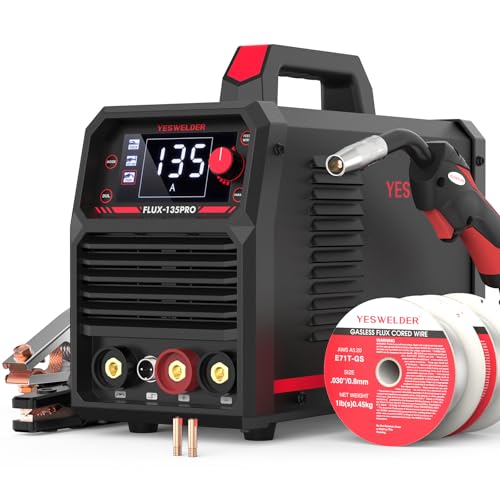
If you own one portable machine, make it a 120V/240V multiprocess unit. You get gas MIG for clean sheet, flux-core for windy outdoor work, and stick for rusted or painted steel where MIG will not penetrate. Look for a real spool-gun-capable or at least a switchable polarity setup, a chunky ground clamp, and a stated duty cycle at a specific amperage. If the spec sheet hides duty cycle, the number is bad.
Portable Welding Machine Review: The Categories Worth Your Money
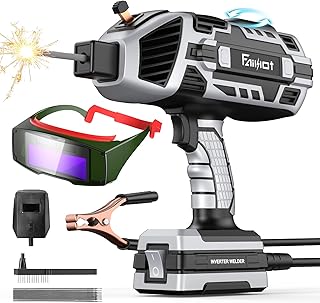
Small inverter stick machines. The most honest portable welders made. No gas bottle, no wire feed to jam, works in wind, works on rust. A 140 to 160 amp stick box handles gates, trailer tongues, hitch repair and equipment brackets. Downside is slag chipping and a learning curve. Lincoln, Miller, ESAB and Everlast all sell credible units, and the budget import tier has genuinely improved on arc starting.
Compact MIG and flux-core. Easiest arc to learn. Gas-shielded MIG gives clean, spatter-light welds on sheet metal, so this is the auto-body choice. Gasless flux-core trades cleanliness for wind resistance and no bottle to lug. Bottles are the hidden portability tax: an 80 cubic foot argon/CO2 cylinder weighs more than most of these welders.
Multiprocess. Now the default recommendation for a mixed shop. DC TIG on these is usually scratch-start or lift-start, fine for steel and stainless, useless for aluminum because you need AC and high-frequency start. Do not buy a multiprocess unit expecting to weld aluminum unless it explicitly says AC TIG.
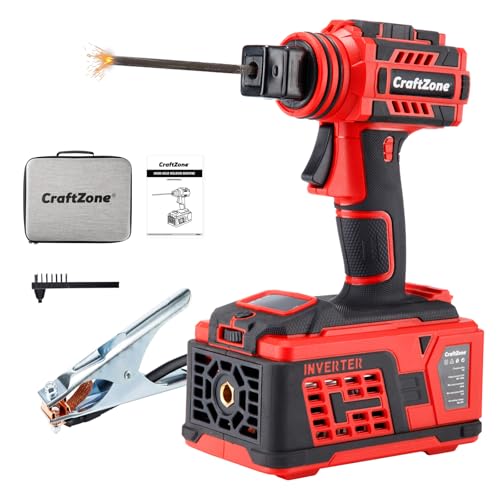
Battery and engine-driven. Battery welders from major cordless platforms are real now and genuinely useful for tack welding and short repairs far from an outlet. They are not production machines. Engine-driven units are the serious answer for no-power sites and are portable only by truck.
- ✔ Inverter weight makes one-hand carry realistic
- ✔ Dual-voltage models adapt to whatever outlet exists
- ✔ Flux-core and stick work outdoors where MIG fails
- ✔ Multiprocess units replace two or three machines
- ✔ Modern budget tier arc quality is much better than five years ago
- ✘ Low duty cycle interrupts long welds
- ✘ 120V output limits you to roughly 1/8 in single pass
- ✘ Cheap units struggle with 7018 low-hydrogen rod
- ✘ Gas bottles cancel out the weight savings
- ✘ Thin sheet metal cases dent and crack in truck beds
Generators, Extension Cords And Why Machines Die
More portable welders are killed by bad power than by bad welding. Two rules.
First, cords. Undersized extension cord equals voltage drop equals a wandering arc and an overheating machine. For a 120V welder at 50 feet, use 12 gauge minimum, 10 gauge if you can get it. Past 50 feet, go up a size. Never coil a cord tightly while welding.
Second, generators. Inverter welders are sensitive to dirty power. Check your machine’s manual for minimum generator output, usually stated in running watts, and add margin. A machine drawing 20 amps at 120V wants a generator rated well above 2,400 running watts, not exactly at it. Cheap contractor generators with poor voltage regulation can fry inverter boards, and that repair often costs more than the welder did.
PPE, Fume And Fire Risk, Because Portable Means Uncontrolled
Portable welding means welding where there is no fume hood, no fire-rated floor and no welding curtain. That raises risk, not lowers it.
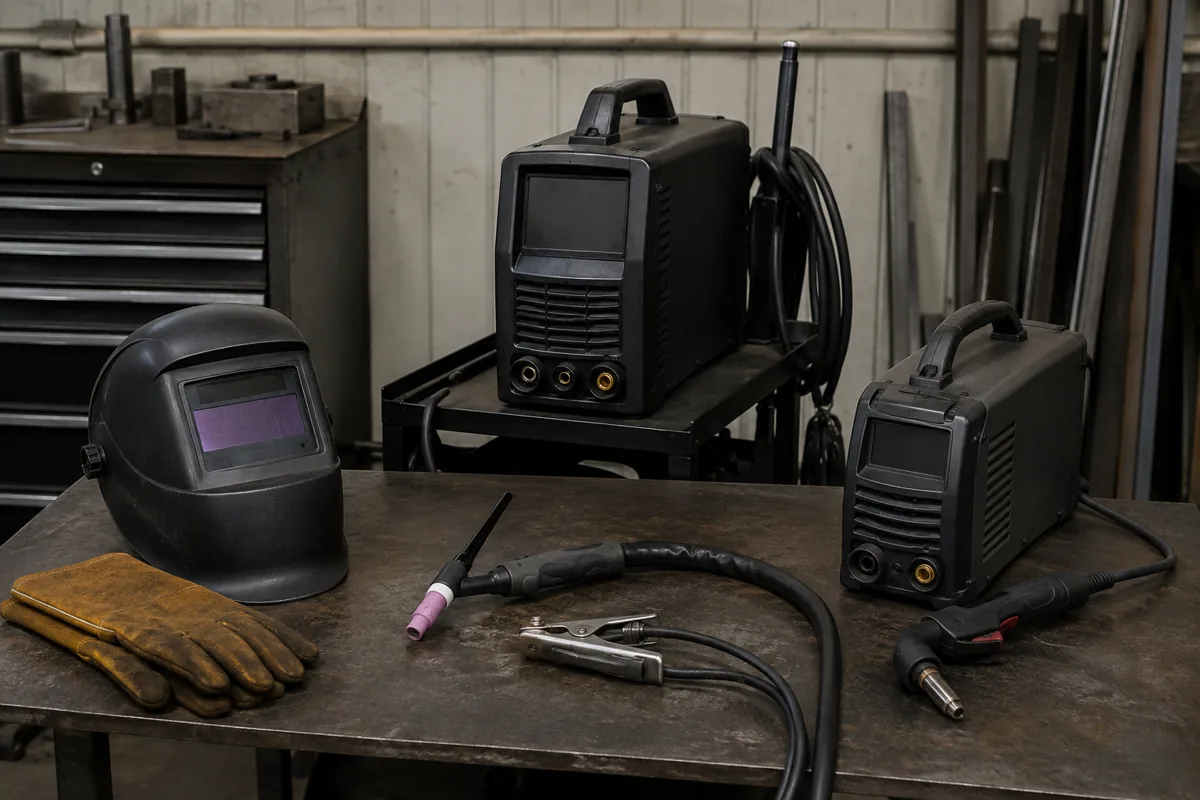
Eyes and skin. Auto-darkening helmet, minimum shade 10 for most portable work, higher as amperage climbs. Verify it is a genuine 1/1/1/1 optical class rating from a real brand. Arc UV burns skin like a sunburn through a single thin cotton layer, so wear a flame-resistant long-sleeve jacket or sleeves, not a t-shirt. Leather gloves. Leather boots, laces covered. No synthetic clothing anywhere near an arc, because polyester melts into the skin.
Fume. Welding fume is a respiratory hazard, and flux-core outdoors puts out a lot of it. Never weld galvanized steel without serious ventilation and respiratory protection, because zinc fume causes metal fume fever. Never weld anything coated, painted or degreased with chlorinated solvent, since some solvents break down into phosgene under UV. Position yourself so the plume moves away from your face, use a fan to move air across the work rather than into it, and consider a PAPR helmet if you weld indoors regularly.
Fire. Sparks travel 30 feet or more and grinding sparks travel farther. Clear that radius. Sweep sawdust, move fuel cans, wet down dry grass. Keep a rated fire extinguisher within arm’s reach every time, not in the truck. Watch the area for at least 30 minutes after you stop, because smoldering fires start slow. On a vehicle, disconnect the battery and never let welding current path through bearings or electronics. On anything that ever held fuel or chemicals, do not weld it, period, unless it has been professionally purged.
Ground clamp placement matters for safety and for weld quality. Clamp directly to clean parent metal, as close to the joint as practical. A rusty ground on a painted frame is why your arc wanders and why current finds another path.
Welding PPE Kits And Auto-Darkening Helmets
Budget the helmet and jacket into the machine price, not as an afterthought. A cheap helmet that flickers or darkens slowly will train you to weld with your eyes closed and will eventually give you arc flash. Spend on the lens, buy leather over cotton for the jacket, and get more gloves than you think you need since they wear out fast.
Torque, Fasteners And The Rest Of The Setup
Two torque points get ignored and both cause problems. Cable lugs on the machine and on your clamps must be tight. Loose connections build resistance, resistance builds heat, and a hot lug melts insulation and drops your arc. Hand-tight is not enough. Snug them with a wrench, then check again after the first heat cycle, since copper relaxes.
The other is the wire feed drive roll tension on MIG machines. Too loose and the wire slips, giving you stutter and burnback into the tip. Too tight and it deforms soft wire, especially flux-core, and jams the liner. Set it so the roll just barely slips when you pinch the wire coming out of the gun. That is the whole adjustment.
If you also bolt fabricated parts together, follow the fastener maker’s torque spec rather than feel, and remember that welding near a bolted joint can anneal the fastener and destroy its rating. Weld first, then bolt.
FAQ
Can a 120V portable welder weld 1/4-inch steel? Not in a single pass with full penetration. Using the 1 amp per 0.001 inch rule, 1/4-inch steel wants roughly 250 amps and a 120V circuit cannot supply that. You can join 1/4-inch material with a beveled joint and multiple passes, and it can be structurally sound if the prep and technique are right, but plan on 240V if 1/4-inch is routine work.
Flux-core or gas MIG for a portable setup? Flux-core if you work outdoors or move constantly, because wind blows shielding gas away and a cylinder is heavy and awkward. Gas MIG if you weld sheet metal, auto body or anything where cleanup and appearance matter. Many dual-voltage machines do both, so you can switch by changing polarity and wire.
Is duty cycle worth paying extra for? Depends on weld length. Repair work in short beads almost never hits the thermal limit. Long structural seams, fence runs or trailer decking will. If most of your work is continuous welding, buy duty cycle over peak amperage every time, since a machine that shuts off is worth zero amps.
Buy for the thickness you actually weld, the outlet you actually have, and the duty cycle your job demands. Then spend real money on the helmet.
Check prices on Amazon →