
Our Short List of 3
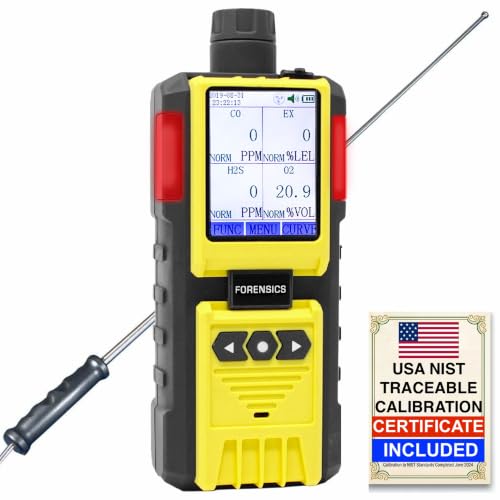
- Gases: combustible (LEL), oxygen (O2), carbon monoxide (CO), hydrogen sulfide (H2S)
- Ranges: LEL 0–100% (1%); O2 0–30% (0.1%); CO 0–999 ppm (1 ppm); H2S 0–100 ppm (1 ppm)
- Sensors: electrochemical (CO, H2S, O2) and catalytic (LEL); accuracy within ±5% of full scale
- Pump: built-in, telescopic probe reaching about 4 feet

- Gases: oxygen (O2), hydrogen sulfide (H2S), carbon monoxide (CO), combustible gas (LEL)
- Typical ranges: O2 0–30%; H2S 0–100 ppm; CO 0–500 ppm; LEL 0–100%
- Operation: single-button control, LCD showing all readings together
- Runtime: about 18 hours per charge

- Gas: carbon monoxide (CO), MSA part number 10092522
- Alarm set points: low 25 ppm, high 100 ppm on this configuration
- Sensor: electrochemical, MSA-built button sensor design
- Alarms: audible and vibrating, with bright LED indication
All 5 Picks at a Glance
| Product | Specs | Action |
|---|---|---|
| 1. Forensics Detectors 4 Gas Monitor with Built-in Pump |
| Check price on Amazon |
| 2. Honeywell BW GasAlertMicroClip XL |
| Check price on Amazon |
| 3. MSA ALTAIR Single-Gas Detector (CO) |
| Check price on Amazon |
 4. Sensorcon AV8 Inspector Carbon Monoxide Monitor |
| Check price on Amazon |
 5. Honeywell BW Clip BWC2-M Single-Gas CO Monitor |
| Check price on Amazon |
Key takeaways
- Compare the best gas detector for welding picks for tanks, pits and shops, covering CO, oxygen, H2S and LEL alarms, pumps and daily bump checks.
What's inside
As an Amazon Associate I earn from qualifying purchases. This post may contain affiliate links at no extra cost to you.
As an Amazon Associate we earn from qualifying purchases.
Welding changes the air around you fast. An arc inside a tank, pit, or small bay can push carbon monoxide up, let shielding gas displace oxygen, and stir fumes from coatings and residues, all where a worker cannot simply step back. A monitor clipped at the breathing zone notices trouble while there is still time to climb out and ventilate.
Finding the best gas detector for welding means matching the instrument to the space. Open shop work near engine-driven welders mostly calls for carbon monoxide coverage. Permit entries into vessels, silos, and trenches call for a four-gas instrument watching oxygen, combustible gas, CO, and hydrogen sulfide together, ideally with a pump that samples the space before entry.
Disclosure: This post contains affiliate links. If you buy through links on this page, we may earn a commission at no extra cost to you.
What we cover
Quick picks
- Best for confined space entry: Forensics Detectors 4 Gas Monitor with Built-in Pump — samples a vessel from outside before entry, then watches all four hazards during the weld.
- Best everyday four-gas monitor: Honeywell BW GasAlertMicroClip XL — compact, one-button operation, full-shift runtime.
- Best single-gas CO protection: MSA ALTAIR Single-Gas Detector (CO) — a light, sealed clip-on with triple alarm and event logging.
- Best for spot checks: Sensorcon AV8 Inspector — fast numeric CO readings, waterproof housing.
- Best set-and-forget option: Honeywell BW Clip BWC2-M — runs two years with no charging or sensor swaps.
Our top 5 picks in detail
1. Forensics Detectors 4 Gas Monitor with Built-in Pump
- Gases: combustible (LEL), oxygen (O2), carbon monoxide (CO), hydrogen sulfide (H2S)
- Ranges: LEL 0–100% (1%); O2 0–30% (0.1%); CO 0–999 ppm (1 ppm); H2S 0–100 ppm (1 ppm)
- Sensors: electrochemical (CO, H2S, O2) and catalytic (LEL); accuracy within ±5% of full scale
- Pump: built-in, telescopic probe reaching about 4 feet
If your crew welds inside tanks, vessels, or silos, this is the instrument our take keeps coming back to. The built-in pump draws air through a telescopic probe reaching about four feet, so an attendant can sample a vessel at several depths before the welder goes in. Inside, the same unit keeps monitoring with a color display, graphing, and data logging for the entry record. All four channels respond in under 30 seconds, and calibration is done in the maker’s Los Angeles lab against USA NIST traceable sources. Practical notes favor pumped units for one reason: a diffusion monitor only reads air that reaches it, while a pump gets the sample from where hazards pool.
Pros:
Cons:
2. Honeywell BW GasAlertMicroClip XL
- Gases: oxygen (O2), hydrogen sulfide (H2S), carbon monoxide (CO), combustible gas (LEL)
- Typical ranges: O2 0–30%; H2S 0–100 ppm; CO 0–500 ppm; LEL 0–100%
- Operation: single-button control, LCD showing all readings together
- Runtime: about 18 hours per charge
The MicroClip XL is the four-gas monitor many safety managers hand out because new hires learn it in minutes. One button runs it, the screen shows all four readings at once, and a flashing green IntelliFlash beacon tells a supervisor across the bay that the unit is on and has passed its checks. Runtime is a strong point too: about 18 hours per charge, enough for extended shifts. The impact-resistant housing handles harness wear and manway knocks, and bump checks plus calibration can run through the maker’s MicroDock II station.
Pros:
Cons:
3. MSA ALTAIR Single-Gas Detector (CO)
- Gas: carbon monoxide (CO), MSA part number 10092522
- Alarm set points: low 25 ppm, high 100 ppm on this configuration
- Sensor: electrochemical, MSA-built button sensor design
- Alarms: audible and vibrating, with bright LED indication
Not every welding job needs four channels. Where a welder shares air with a heater or engine-driven machine, carbon monoxide builds silently, and a dedicated CO clip is the sensible guard. The ALTAIR weighs just 3.2 ounces, clips to a collar or pocket, and watches CO around the clock, with alarms at 25 ppm and 100 ppm on this configuration. MSA builds it around a patented electrochemical sensor in a sealed, rubber-armored housing, with flashing LEDs, sound, and vibration, so a warning lands even over grinder noise. It logs alarm and test events and passes them to a computer by infrared link, helping prove the morning checks happened.
Pros:
Cons:
4. Sensorcon AV8 Inspector Carbon Monoxide Monitor
- Gas: carbon monoxide (CO); model AV8-CO-01
- Range: 0–500 ppm on LCD, 1 ppm resolution
- Alarm set points: 35 ppm low and 200 ppm high, LED plus audible signal
- Sensor type: electrochemical
Sensorcon builds the Inspector family in the USA for people who need a number, not just a beep. The AV8 pairs an electrochemical sensor with a clear LCD showing CO from 0 to 500 ppm at 1 ppm resolution, with preset alarms at 35 ppm and 200 ppm. For a welder checking air around a running engine drive, forklift, or shop heater before striking an arc, that fast numeric feedback is the point. The housing carries IP67 sealing, weighs four ounces, and rides on a steel clip or lanyard loop. A single CR123A cell runs it up to two years, and the maker offers sensor and battery service. Our take: a spot-check tool to pair with a four-gas monitor, not a replacement.
Pros:
Cons:
5. Honeywell BW Clip BWC2-M Single-Gas CO Monitor
- Gas: carbon monoxide (CO); model BWC2-M
- Alarm set points: 35 ppm low and 200 ppm high
- Service life: two years of continuous operation once activated
- Upkeep: maintenance-free design, no sensor or battery changes needed
The BW Clip takes the opposite approach to upkeep: switch it on and it runs continuously for two years, with no charging, sensor changes, or battery swaps. For a small shop needing CO coverage on every welder but with no one assigned to instrument care, that hands-off design removes the most common failure point, a monitor sitting dead in a toolbox when the job starts. Alarms trigger at 35 ppm and 200 ppm, and events log for later download. Practical notes agree on one point: even a maintenance-free clip deserves a glance at the display each shift.
Pros:
Cons:
How to choose the right monitor for your work
Start with the space, not the instrument. General shop welding mainly raises a carbon monoxide concern, especially with engine-driven machines, propane heaters, or vehicles in the bay, and a CO clip covers that risk well. Any entry into a tank, vessel, pit, or silo changes the picture: shielding gas can push oxygen down, and residues can release hydrogen sulfide or flammable vapors. Permit spaces call for a four-gas monitor, full stop.
Decide between diffusion and pumped sampling. Diffusion monitors read air that reaches the sensor, fine for personal protection once a worker is inside. A pump with a probe lets an attendant test a space from outside, at several depths, before entry. Crews doing pre-entry testing need the pumped unit, with diffusion clips as the personal layer inside.
Plan the bump check and calibration routine before buying. A bump check exposes sensors to a known gas to confirm they respond and alarm; it takes under a minute and belongs in the daily routine for confined space work. Full calibration adjusts readings against a known standard on the maker’s schedule, and docks automate both steps. Maintenance-free clips skip calibration by design, suiting CO-only roles, but still deserve a display check each shift.
Think about alarms your crew can actually perceive. Under a hood, with hearing protection in and a grinder running, a sound-only warning can be missed. Vibration plus bright flashing lights adds a second and third channel. Also match battery style to the work pattern: rechargeable units need a charging spot and a habit; sealed clips need neither but are replaced at end of life.
Frequently asked questions
Do I need a four-gas monitor for welding in a tank?
Yes. Inside a tank, shielding gas can push oxygen down, and coatings or residues can add carbon monoxide, hydrogen sulfide, or flammable vapor. A four-gas instrument watching oxygen, LEL, CO, and H2S, used with an attendant, ventilation, and your entry permit procedure, is the accepted setup.
What is a bump check, and how often should I do one?
A bump check is a short exposure to known test gas confirming each sensor responds and the alarms fire. Crews commonly bump check before each day of use, and after any drop or alarm event. A failed unit comes out of service for full calibration.
Can a carbon monoxide clip replace a four-gas monitor?
No. A CO clip is excellent at its one job, the right daily carry for shop welding near engines and heaters. It cannot warn about low oxygen or flammable gas, though, so it never substitutes for a four-gas monitor on entry. Many crews run both.
How long do gas sensors last?
Electrochemical sensors commonly serve two to three years, with oxygen sensors at the shorter end. Sealed clips are built around a fixed two-year life. Instruments with replaceable sensors last longer when calibration stays on schedule.
Conclusion
The best gas detector for welding matches the air you actually work in. For confined space entries, choose a four-gas monitor, pumped if your crew tests before entry, and keep a CO clip on every welder for the walk back through the shop. The Forensics pump unit leads this list for vessel work, the MicroClip XL covers daily four-gas duty with the least training burden, and the MSA, Sensorcon, and BW Clip options give shops three solid levels of CO protection. Pick coverage first, set the bump check habit on day one, and the instrument will do its quiet job.
Related guides
More from Amazon
Programs that pair well with the guide above. Offers and eligibility are set by Amazon and may change.
A free business account with business pricing and bulk-buying tools for work, shop or home office.
Create a business accountFree shipping on eligible items, Prime Video and more. Eligible new members can start with a free trial.
Start a Prime free trialAudiobooks and podcasts to listen to on the go. Eligible new members can start with a free trial.
Try Audible freeAd-free music streaming. Eligible new subscribers can start with a free trial.
Try Music Unlimited freeAs an Amazon Associate we earn from qualifying purchases.




Write Your Review
No reviews yet. Be the first to share your experience!