
Key takeaways
- Compare the best snowmobile belt options from Gates, Ultimax, Dayco, Polaris and Ski-Doo, with fitment tips, specs and break-in advice for your sled.
What's inside
As an Amazon Associate I earn from qualifying purchases. This post may contain affiliate links at no extra cost to you.
As an Amazon Associate we earn from qualifying purchases.
A worn drive belt can turn a good day on the snow into a long walk back to the trailer. The belt links the engine to the track inside a continuously variable transmission that constantly changes ratio as you climb, carve, and cruise. Heat, load, and alignment all punish it, so choosing the best snowmobile belt is less about brand name and more about matching construction, dimensions, and intended use to your sled.
In this guide we compare five proven options from Gates, Ultimax, Dayco, Polaris, and Ski-Doo, for riders from low-power vintage machines to modern high-output trail and mountain sleds. We explain construction in plain workshop terms, how to confirm fitment, and how to break a new belt in so it lasts.
Disclosure: This post contains affiliate links. If you buy through links on this page, we may earn a commission at no extra cost to you.
What we cover
Quick picks
- Best for high-output machines: Gates G-Force RedLine 48R4553 — built to handle heat on larger, harder-worked engines.
- Best Ultimax option in this lineup: Ultimax UA485 — aramid construction and a direct factory-number replacement for listed applications.
- Best for smaller stock sleds: Dayco HP3019 HP Snowmobile Drive Belt — a focused fit for lower-power, unmodified machines and relaxed trail use.
- Best factory Polaris fit: Polaris Drive Belt 3211216 — factory-engineered dimensions for listed RMK, Khaos, SKS, and MATRYX models.
- Best factory Ski-Doo fit: Ski-Doo Performance Drive Belt 417300531 — the BRP belt for listed 850 E-TEC applications.
Gates G-Force RedLine 48R4553 CVT Belt

Gates designed the G-Force RedLine line for hard-worked recreational machines, and the 48R4553 is the pick for riders whose engines run hot under sustained load. Gates describes RedLine as engineered for vehicles of 800cc and above, intended to keep delivering power in extreme conditions without fading as temperatures climb. In our take, that heat focus is the main reason to choose it: mountain riding, deep snow, and repeated full-throttle pulls cook a lesser belt.
The listing describes a ribbed CVT belt style, and Gates highlights better acceleration and less speed-ratio and energy loss in demanding environments. As with any Gates fitment, the part number is everything, so cross-check your year, model, and engine before ordering.
Specs
- Brand: Gates
- Model: 48R4553 G-Force RedLine
- Belt style: Ribbed CVT belt
- Intended use: Engineered for 800cc+ vehicles, per Gates
- Heat capability: Gates states the RedLine line takes heat up to 338°F without power loss
- ASIN: B08GJC9YBX
Pros:
– Purpose-built for high heat and sustained load
– Strong choice for larger engines and deep-snow work
– Gates application data is widely available in workshops
Cons:
– Overkill for small, low-power sleds
– Fitment is narrow, so the wrong part number will not work
Ultimax UA485 Drive Belt by Timken

Ultimax has a long history in snowmobile belts, with families such as MAX for lower-power machines, PRO for mid-range performance, and XS for high-horsepower sleds. The specific Ultimax listing we could verify here is the UA485, an aramid belt presented as a direct replacement for factory numbers 0JWA-055000 and 0JWA-055000-10000 on listed CF Moto applications. That makes it a drive-parts pick for workshops that also maintain utility machines, rather than a universal snowmobile fit, a distinction we flag clearly so nobody orders it for the wrong vehicle.
Within its listed applications, the appeal is straightforward: aramid material matched to the factory specification, and Ultimax manufacturing in the USA, according to the listing. Treat it exactly as presented, as an application-specific replacement. For a snowmobile-specific Ultimax, look to the MAX, PRO, or XS families in the correct part number for your sled, confirmed in the Ultimax belt finder.
Specs
- Brand: Ultimax
- Model: UA485
- Material: Aramid
- Belt style: Drive belt
- Replaces factory numbers: 0JWA-055000, 0JWA-055000-10000
- Compatible devices listed: ATV, UTV
- Origin listed: Made in USA
- ASIN: B0987Z6S2X
Pros:
– Genuine Ultimax aramid construction
– Direct replacement for the listed factory numbers
– Clear, narrow fitment reduces guesswork for listed machines
Cons:
– Not a snowmobile-specific belt; listed for ATV and UTV applications
– Useless for any machine outside its short fitment list
Dayco HP3019 HP Snowmobile Drive Belt

Dayco splits its snowmobile range by power level, which makes choosing easier. The HP line is designed for low- to mid-range horsepower sleds with stock engines up to 350cc and no modifications, for dependable, smooth leisure trail riding. The HP3019 is a representative HP fit, and for an older fan-cooled or utility sled that never sees engine work, that brief is exactly right.
Dayco builds HP belts from a fiber-reinforced polychloroprene rubber compound with aramid cords, aiming for strength and dimensional stability. That stability matters: a belt that holds its length and width keeps clutch shift behavior consistent. Our take is that the HP3019 suits riders who want a calm, factory-like replacement for a stock, modestly powered sled.
Specs
- Brand: Dayco
- Model: HP3019, HP Snowmobile Drive Belt
- Series: Dayco POWER HP, for stock engines up to 350cc with no modifications, per Dayco
- Construction: Fiber-reinforced polychloroprene rubber compound with aramid cords, per Dayco
- Dimensions listed: 43.18 x 15.24 x 3.81 cm
- Weight listed: 549 g
- ASIN: B000CIXYQ2
Pros:
– Well matched to small, stock, unmodified sleds
– Aramid cords help the belt hold its dimensions
– Sensible spare for vintage and fan-cooled machines
Cons:
– Not intended for modified or high-horsepower engines
– Riders with 350cc-plus sleds should step up to the HPX or XTX lines instead
Polaris Drive Belt 3211216

For Polaris owners, the factory belt remains the benchmark, and the 3211216 is the factory option for many mountain and crossover models, including SKS 155, RMK Khaos, Khaos MATRYX, and MATRYX Slash applications. Polaris says its engineered CVT belts are designed and tested to run cooler, even at high engine speeds, and that no clutch recalibration is required when the correct factory belt is fitted.
Polaris also emphasizes tolerances, stating the lowest tolerance available at 0.188 inch, meaning the least variation in width and length, for consistent performance from one belt to the next. The belts are made from aramid. In practical notes, that consistency is why many Polaris riders keep a factory belt as the spare: you know exactly how it will engage and shift. Confirm your model against the fitment list, because Polaris uses many similar part numbers.
Specs
- Brand: Polaris
- Part number: 3211216
- Material: Aramid, per Polaris
- Tolerance stated: 0.188-inch variation in width and length, per Polaris
- Clutch work: No clutch recalibration required, per Polaris
- Example fitments listed: SKS 155, RMK Khaos, Khaos MATRYX, Pro RMK AXYS, MATRYX Slash models
- ASIN: B07K4WNSQP
Pros:
– Factory dimensions and shift behavior for listed Polaris models
– Designed to run cooler at sustained high engine speeds
– Predictable as a primary belt or as the spare on the sled
Cons:
– Only suits the Polaris models on its fitment list
– Similar Polaris part numbers are easy to confuse when ordering
Ski-Doo Performance Drive Belt 417300531
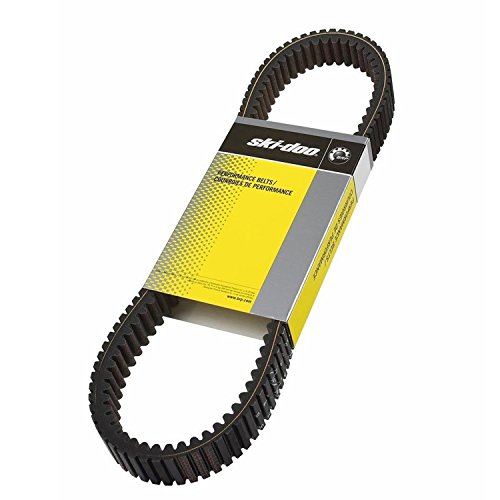
BRP owners get the same factory-fit argument with the Ski-Doo 417300531, listed for 850 E-TEC applications and described as a high-performance factory belt with a maximum-strength design. The manufacturer is BRP, the brand is Ski-Doo, and the item model number and factory part number are both 417300531, which makes cross-checking against your parts fiche simple. For a modern 850, where clutch calibration is closely matched to the factory belt, that direct match is a real advantage.
Our take mirrors the Polaris reasoning: if your Ski-Doo is stock and you value predictable engagement and backshift, the factory belt is the low-risk choice. Aftermarket belts can work well, but may shift slightly differently. Verify the number on your old belt before ordering, since Ski-Doo uses several close part numbers across E-TEC models.
Specs
- Brand: Ski-Doo
- Manufacturer: BRP
- Model: 417300531
- Factory part number: 417300531
- Dimensions listed: 48.26 x 15.24 x 5.08 cm
- Weight listed: 680 g
- Application noted: 850 E-TEC models, per listing summaries
- ASIN: B075G1Q94V
Pros:
– Exact factory match for listed Ski-Doo applications
– Simple part-number check against the BRP parts fiche
– Predictable clutch behavior on stock 850 E-TEC sleds
Cons:
– No benefit if your model calls for a different Ski-Doo number
– Factory fit only helps when the sled remains near stock calibration
How to choose
Start with fitment, not brand loyalty. Every belt above is application-specific, and a belt slightly off in circumference or width will shift poorly, run hot, or slip. Pull the part number from your manual, the belt on the sled, or the manufacturer belt finder, then match it to your preferred brand. Polaris and Ski-Doo owners should start from the factory number and work outward.
Next, match the belt family to your power. Small stock sleds do well on a Dayco HP or Ultimax MAX type belt. Mid-power trail sleds belong on a Dayco HPX or Ultimax PRO type belt. High-horsepower and heavily worked machines need the strongest families, such as Dayco XTX, Ultimax XS, or a Gates RedLine in the correct number. A weaker family than your engine demands shortens belt life fast.
Then think about heat and alignment, the two quiet belt killers. Deep snow, towing, and tall paddles raise belt temperature, so choose a heat-focused construction if that is your riding. Before fitting a new belt, clean the clutch faces, check for worn parts, and confirm alignment. A new belt on misaligned clutches will wear one edge, glaze, and fail early.
Finally, plan the spare and break-in. Carry the spare in its holder, away from fuel and sharp edges. Break a new belt in with varied, moderate throttle, avoiding sustained full-throttle pulls and heavy towing until it has seated, and re-check deflection after the first rides.
FAQs
How do I know which belt number my sled needs?
Check the manual, the number on the old belt, or the manufacturer lookup for your exact year, model, and engine, then cross-reference that number if you want an aftermarket equivalent. Never order by engine size alone, because the same model name can use different belts across years.
How long should a snowmobile drive belt last?
Service life varies with power, load, alignment, and heat, and many riders treat a belt as a seasonal wear item on hard-worked sleds. Inspect yours often for cracks, glazing, frayed edges, and narrowing, and replace it at the first clear signs rather than waiting for it to fail on the trail.
Can I use an aftermarket belt instead of the factory belt?
Yes, provided the part number cross-references correctly and the belt family matches your power level. Quality aftermarket belts from Gates, Dayco, and Ultimax are built to factory dimensions for listed applications. Expect a slightly different shift feel on some sleds, and always break the new belt in and re-check deflection after fitting.
What is the right way to store a spare belt?
Keep it flat or in the sled’s belt holder, away from fuel, solvents, direct heat, and sharp edges. Do not hang it on a nail, fold it tightly, or leave it compressed under heavy gear. A spare that has taken a set will not run well when you need it most.
Conclusion
The best snowmobile belt matches your exact fitment, power level, and the heat your riding creates. Choose the Gates RedLine 48R4553 for larger engines, the Dayco HP3019 for small stock sleds, and the factory Polaris 3211216 or Ski-Doo 417300531 when predictable stock clutch behavior matters most. Treat the Ultimax UA485 as a genuine Ultimax replacement for its listed utility applications, and use Ultimax snowmobile families in the correct number for sled needs. Confirm the number twice, break the belt in gently, and carry a good spare.
Related guides
More from Amazon
Programs that pair well with the guide above. Offers and eligibility are set by Amazon and may change.
A free business account with business pricing and bulk-buying tools for work, shop or home office.
Create a business accountFree shipping on eligible items, Prime Video and more. Eligible new members can start with a free trial.
Start a Prime free trialAudiobooks and podcasts to listen to on the go. Eligible new members can start with a free trial.
Try Audible freeAd-free music streaming. Eligible new subscribers can start with a free trial.
Try Music Unlimited freeAs an Amazon Associate we earn from qualifying purchases.




Write Your Review
No reviews yet. Be the first to share your experience!