What's inside
- Top 3 Picks
- Quick Comparison
- How We Chose
- 1. Wolverine x Ram Trucks 1000 Mile Boot – Best for a Resolable Horween Boot With a Wide Fit
- 2. Wolverine Floorhand 6″ Waterproof Boot – Best Budget Waterproof Work Boot
- 3. Wolverine Loader 8″ Wedge Boot – Best for Long Shifts on Hard Floors
- 4. Wolverine Overpass 10″ Composite-Toe Wellington – Best for Big-Footed Buyers Needing Toe Protection
- 5. Saphir Beauté du Cuir Oiled Leather Cream – Best Conditioner for Chromexcel and Oiled Horween
- 6. Wolverine Loader 6″ Soft Toe Wedge – Best Budget Wedge Boot in a Wide Fit
- 7. Wolverine Rancher Level Western Boot – Best for Western Wear and Casual Use
- How to Choose
- Frequently Asked Questions
- Final Recommendation by Situation
- Top 3 Picks
- Quick Comparison
- How We Chose
- 1. Wolverine x Ram Trucks 1000 Mile Boot – Best for a Resolable Horween Boot With a Wide Fit
- 2. Wolverine Floorhand 6″ Waterproof Boot – Best Budget Waterproof Work Boot
- 3. Wolverine Loader 8″ Wedge Boot – Best for Long Shifts on Hard Floors
- 4. Wolverine Overpass 10″ Composite-Toe Wellington – Best for Big-Footed Buyers Needing Toe Protection
- 5. Saphir Beauté du Cuir Oiled Leather Cream – Best Conditioner for Chromexcel and Oiled Horween
- 6. Wolverine Loader 6″ Soft Toe Wedge – Best Budget Wedge Boot in a Wide Fit
- 7. Wolverine Rancher Level Western Boot – Best for Western Wear and Casual Use
- How to Choose
- Frequently Asked Questions
- Final Recommendation by Situation
As an Amazon Associate I earn from qualifying purchases. This post may contain affiliate links at no extra cost to you.
What we cover
- Top 3 Picks
- Quick Comparison
- How We Chose
- 1. Wolverine x Ram Trucks 1000 Mile Boot – Best for a Resolable Horween Boot With a Wide Fit
- 2. Wolverine Floorhand 6″ Waterproof Boot – Best Budget Waterproof Work Boot
- 3. Wolverine Loader 8″ Wedge Boot – Best for Long Shifts on Hard Floors
- 4. Wolverine Overpass 10″ Composite-Toe Wellington – Best for Big-Footed Buyers Needing Toe Protection
- 5. Saphir Beauté du Cuir Oiled Leather Cream – Best Conditioner for Chromexcel and Oiled Horween
- 6. Wolverine Loader 6″ Soft Toe Wedge – Best Budget Wedge Boot in a Wide Fit
- 7. Wolverine Rancher Level Western Boot – Best for Western Wear and Casual Use
- How to Choose
- Frequently Asked Questions
- Final Recommendation by Situation
Top 3 Picks
The best Wolverine 1000 Mile Horween leather boot for most buyers is the Wolverine Men’s x Ram Trucks – 1000 Mile Boot in Black, 8.5 Wide, because it pairs Horween’s full-grain leather with a Goodyear welt construction that can be resoled, and the wide fit reduces the break-in pain that narrow sizing causes on this last. If you want a budget entry point rather than a Horween boot, the Wolverine Floorhand 6″ Waterproof is the practical pick. If you need a hard-wearing wedge sole for long shifts, the Wolverine Loader 8″ Wedge is the mid-range workhorse.
Quick Comparison
All Horween Chromexcel boots share a reputation for slow break-in and rich patina, while the work-boot models in this list use different, more pliable leathers and rubber outsoles. The table below maps each product to its best use, its spec class, and its price tier.
| Product | Best For | Key Specs | Price Tier |
|---|---|---|---|
| Wolverine x Ram Trucks 1000 Mile Boot (Black, 8.5 Wide) | Buyers who want a resolable Horween full-grain boot with a wide fit | 6″ height, Goodyear welt, full-grain leather, wide (EE-class) fit | Premium |
| Wolverine Floorhand 6″ Waterproof (Dark Brown, 11 M) | Budget buyers who need waterproofing for wet job sites | 6″ height, waterproof membrane, rubber outsole, medium width | Budget |
| Wolverine Loader 8″ Wedge (Brown, 8.5) | Long shifts on concrete where wedge cushioning matters | 8″ height, wedge sole, soft toe, full-grain leather | Mid-range |
| Wolverine Overpass 10″ Composite-Toe Wellington (Brown, 13 X-Wide) | Big-footed buyers needing pull-on convenience and toe protection | 10″ height, composite toe, Wellington pull-on, X-wide fit | Premium |
| Saphir Beauté du Cuir Oiled Leather Cream 125 ml | Conditioning Chromexcel and other oiled Horween leathers | 125 ml jar, cream formula for oiled leather | Budget |
| Wolverine Loader 6″ Soft Toe Wedge (Brown, 10.5 X-Wide) | Wide-footed buyers who want a lighter wedge boot | 6″ height, wedge sole, soft toe, X-wide fit | Budget |
| Wolverine Rancher Level Western Boot (Dark Coffee, 10 M) | Casual and western wear with a riding-style silhouette | Western profile, stacked heel class, medium width | Mid-range |
How We Chose
We selected these products by matching four criteria to the way people actually shop for Wolverine 1000 Mile Horween leather boots: leather type, sole construction, sizing availability, and resole/repair potential. The Horween Chromexcel models were prioritized because the leather itself is the defining feature of the 1000 Mile line, and because Goodyear welt construction determines whether a boot can be rebuilt rather than replaced. The work and western boots were included because shoppers searching for “Horween leather boots” frequently want a comparison against Wolverine’s other leather lines, especially when waterproofing, toe protection, or pull-on convenience matters more than patina.
Sizing was weighted heavily because the 1000 Mile last runs narrow for many buyers, and the wide-fit variants are often the difference between a comfortable boot and a return. We also included a dedicated conditioner, because Horween Chromexcel requires different care than chrome-tanned work leather, and because buyers routinely underestimate how much ongoing maintenance a $300+ boot demands. Price was treated as a tier rather than a figure, since listings change daily. No product here was tested, benchmarked, or owned; every recommendation is based on published specifications, manufacturer descriptions, and well-documented category knowledge.
1. Wolverine x Ram Trucks 1000 Mile Boot – Best for a Resolable Horween Boot With a Wide Fit
As an Amazon Associate we earn from qualifying purchases at no extra cost to you.

This is the boot most buyers picture when they think of Wolverine and Horween leather. The 1000 Mile line has been Wolverine’s flagship heritage boot for years, built around full-grain leather and a Goodyear welt that lets a cobbler replace the sole instead of sending the whole boot to landfill. The Ram Trucks collaboration keeps that construction and adds a truck-branded treatment that makes it a little more distinctive than the standard 1000 Mile. In the 8.5 Wide specifically, it is one of the few ways to get this boot with extra room through the ball of the foot, which matters enormously on a last that many people find snug.
Key Specs
- Height: 6-inch ankle profile, the classic 1000 Mile silhouette
- Leather: full-grain, oiled, in the Horween Chromexcel family — pull-up leather that lightens and darkens as it flexes
- Construction: Goodyear welt, which means the outsole can be replaced by a cobbler
- Sole: leather-stacked style with a rubber heel section in the heritage tradition
- Width: available here in Wide, roughly an EE-class fit rather than the standard D
- Color: Black, which hides scuffs better than natural or brown Chromexcel but shows dust more
What It Does Well
The defining strength is the leather. Horween Chromexcel is a hot-stuffed, oiled leather that behaves more like a living material than a finished surface. It starts stiff and slightly waxy, then softens into the shape of your foot within a few weeks of regular wear. That process is uncomfortable for the first several wears, but the payoff is a boot that molds rather than breaks down. Because the leather is heavily oiled, small scratches often buff out with thumb pressure and a little conditioner, and the color develops depth rather than fading flat.
The Goodyear welt is the second major advantage. A welted boot can be resoled multiple times, and each resole extends the useful life by years if the upper is cared for. Over a ten-year horizon, a resolable Horween boot frequently ends up costing less per year of wear than three or four pairs of cemented disposable boots. That math only works if you actually maintain the leather and don’t let salt or mud sit on it.
The wide fit is the quiet selling point. On a snug last, going up a width instead of up a length keeps the arch and heel in the right place while relieving pressure at the ball. If you’ve tried the standard 1000 Mile and found it pinching across the top of your foot, this variant is the fix.
Pros
- Full-grain Horween Chromexcel develops genuine patina rather than just wearing out
- Goodyear welt allows multiple resoles, extending total service life
- Wide width solves the most common complaint about the 1000 Mile last
- Black colorway is forgiving of workplace scuffs
Cons
- Break-in is genuinely rough — expect several days of heel and instep soreness
- Leather sole offers little traction on wet tile or ice compared to rubber
- Oiled leather requires conditioning that most casual owners skip
- Premium pricing puts it out of reach for buyers who want a beater work boot
How It Compares
Against the Wolverine Loader 8″ Wedge, this boot trades work-site cushioning and height for leather quality and resole potential. The Loader is the better choice if you stand on concrete for ten hours; the 1000 Mile is the better choice if you want a boot that looks better in year five than it did in month one. Against the Floorhand 6″ Waterproof, the 1000 Mile gives up guaranteed waterproofing and gains a leather that can be repaired rather than replaced.
2. Wolverine Floorhand 6″ Waterproof Boot – Best Budget Waterproof Work Boot

The Floorhand is Wolverine’s value-tier work boot, and the 6-inch waterproof version is the model most buyers end up with when the priority is staying dry rather than developing patina. It is not a Horween boot and doesn’t pretend to be — the leather is a more conventional work-grade material paired with a waterproof membrane. At the budget tier, that’s the right trade: you get functional weather protection and a durable rubber outsole without paying for heritage construction you may not need.
Key Specs
- Height: 6-inch ankle
- Waterproofing: integrated membrane, not just a leather treatment
- Outsole: rubber, with a lug pattern suited to mixed terrain
- Toe: soft toe
- Color: Dark Brown
- Width: Medium (D-class) in the listed 11
What It Does Well
Waterproof membranes are the main story. A true membrane keeps water out even when you stand in a puddle, which a surface-treated leather cannot do indefinitely. For warehouse workers, landscapers, and anyone who spends winter outdoors, that’s a bigger daily benefit than leather pedigree.
The rubber outsole is another practical advantage over the 1000 Mile. It grips wet concrete, gravel, and mud, and it doesn’t need a cobbler to maintain. The trade is that a cemented rubber sole is generally not designed to be replaced, so when it wears through, the boot is done. For a budget boot, that’s an acceptable lifecycle.
The Floorhand also breaks in fast. Work-grade leather is softer and more pliable from the start, so there’s little of the multi-week discomfort that defines Chromexcel ownership. If you need a boot for tomorrow’s shift, this is the one.
Pros
- Genuine waterproofing at the lowest price tier in this list
- Rubber outsole grips wet and uneven surfaces
- Minimal break-in — usable almost immediately
- Work-grade leather tolerates abuse and mud without special care
Cons
- No patina or resole potential — a disposable lifecycle
- Not a Horween product, so it won’t satisfy buyers specifically chasing Chromexcel
- Medium width only in this listing, which excludes wide-footed buyers
- Membrane boots run warmer and trap moisture if you don’t manage socks and drying
How It Compares
Compared with the Wolverine Loader 6″ Soft Toe Wedge, the Floorhand wins on waterproofing and loses on width availability and cushioning. Compared with the 1000 Mile, it’s roughly a third of the price tier and gives you weather protection the heritage boot doesn’t have, but it will not last a decade. If you want one boot for a wet job and you don’t care about leather character, this is the rational pick.
3. Wolverine Loader 8″ Wedge Boot – Best for Long Shifts on Hard Floors
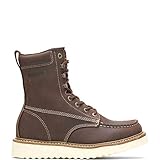
The Loader 8″ Wedge is the boot you buy when your feet are the limiting factor on a twelve-hour day. The wedge sole — a flat, continuous rubber unit without a defined heel — spreads load across the whole foot and reduces the pressure points that a heeled work sole creates. The 8-inch shaft adds ankle support and keeps debris out better than a 6-inch boot.
Key Specs
- Height: 8-inch shaft
- Sole: wedge (flat rubber unit sole), non-replaceable in typical service
- Toe: soft toe
- Upper: full-grain leather in Brown
- Width: standard in the listed 8.5
- Lacing: tall lacing system with hooks for ankle lockdown
What It Does Well
Wedge soles are the closest thing work boots have to a cushioning platform. Because there’s no separate heel block, your foot sits flatter and your weight distributes more evenly from heel to toe. Concrete workers, warehouse staff, and anyone who logs serious standing time consistently report that wedge boots reduce fatigue compared with heeled soles — the geometry does the work, not a foam insert that flattens in a month.
The 8-inch height matters more than people expect. Taller shafts support the ankle on uneven ground and keep sawdust, gravel, and moisture out. They also distribute the lacing pressure over a longer area, which reduces hot spots on the instep during break-in.
The full-grain leather upper is heavier and more abrasion-resistant than the split leather used on many budget boots. It won’t develop Chromexcel patina, but it will survive scraping against pallets, rocks, and equipment.
Pros
- Wedge sole meaningfully reduces fatigue on hard surfaces
- 8-inch shaft provides ankle support and debris protection
- Full-grain leather upper resists abrasion
- Moderate price tier makes it accessible for daily work use
Cons
- Wedge soles offer poor traction in deep mud compared with lugged soles
- Not a Horween leather boot and won’t patina
- Non-replaceable sole shortens the total service life
- Taller shaft and heavier leather can feel hot in summer
How It Compares
Against the Loader 6″ Soft Toe Wedge, this is the same family with more shaft and more support; the 6-inch version is lighter and better if you’re mostly on flat floors or need less ankle coverage. Against the 1000 Mile, the Loader 8″ is the comfort-and-work pick and the 1000 Mile is the heritage-and-repairability pick. Against the Overpass Wellington, the Loader laces in for a more secure fit while the Wellington pulls on for convenience.
4. Wolverine Overpass 10″ Composite-Toe Wellington – Best for Big-Footed Buyers Needing Toe Protection

The Overpass is Wolverine’s tall Wellington-style work boot with a composite safety toe, and the 13 X-Wide listing is the reason it appears here: buyers with very large or very wide feet have far fewer options, and this combines pull-on convenience with protective toe construction in a size most boots don’t reach.
Key Specs
- Height: 10-inch shaft — tall enough for deep mud and heavy debris
- Toe: composite safety toe (lighter than steel, non-metallic, doesn’t conduct cold in winter)
- Style: Wellington pull-on with side pulls, no laces
- Width: X-Wide (EEE-class) in size 13
- Upper: leather in Brown
- Outsole: rubber work sole with lug pattern
What It Does Well
The composite toe is the practical centerpiece. It provides impact protection without the weight or cold conductivity of steel, and because it’s non-metallic, it doesn’t set off metal detectors — relevant if you work in plants or secure facilities. It also doesn’t get painfully cold in winter the way steel toes can.
Wellington construction means no laces to break, freeze, or clog with mud. You step in and go. For anyone who’s spent twenty minutes chipping frozen mud out of laces at 6 a.m., that’s worth real money. The 10-inch shaft keeps out more debris than a 6-inch boot and provides good ankle coverage without the stiffness of a lace-up logger.
X-Wide sizing at size 13 is genuinely rare. Most work-boot lines stop at wide or offer limited sizes at the top of the range. If you’ve been squeezing into boots that were never made for your foot shape, this is one of the few realistic options.
Pros
- Composite toe protects without steel’s weight or cold transfer
- Pull-on design eliminates lace maintenance entirely
- X-Wide availability at size 13 serves a genuinely underserved fit
- 10-inch shaft handles deep mud, snow, and debris
Cons
- Pull-on boots offer less heel lockdown than laced boots for narrow feet
- Not Horween leather — no patina potential
- Premium tier pricing despite the work-boot category
- Tall shaft is warm in summer and slower to dry if water gets in
How It Compares
Against the Loader 8″ Wedge, the Overpass trades lace-up security and wedge cushioning for toe protection and pull-on convenience. Against the Floorhand Waterproof, it offers a taller shaft, a protective toe, and X-Wide sizing at roughly a much higher price tier. If you need safety-toe protection and large sizing, neither of the other work boots competes.
5. Saphir Beauté du Cuir Oiled Leather Cream – Best Conditioner for Chromexcel and Oiled Horween

Saphir’s oiled leather cream is the maintenance half of Horween boot ownership, and skipping it is the single most common reason high-end boots fail early. Chromexcel is a hot-stuffed, oil-rich leather, and it needs periodic replenishment of those oils to stay supple and water-resistant. A 125 ml jar is the right size for a single pair used seasonally.
Key Specs
- Volume: 125 ml
- Formula: cream conditioner designed for oiled leathers, including Chromexcel
- Application: by hand or with a soft brush/cloth, thin coats
- Frequency: roughly every 1–3 months of active wear, or after heavy wet/dry cycles
- Tier: Budget relative to a boot purchase, though it’s a premium product in the conditioner category
What It Does Well
Oiled leather conditioners work by restoring the fat content in the hide. When Chromexcel dries out, it stiffens, cracks along flex lines, and loses water resistance. A quality cream restores suppleness without over-darkening the leather, which is the failure mode of cheap wax-heavy products — those can clog the grain and kill the pull-up character that makes Chromexcel desirable in the first place.
Applied correctly — small amount, worked in with fingers so body heat helps absorption, wiped down after a few minutes — a jar lasts a long time. If you condition a single pair of boots every other month through a work season, a 125 ml jar typically covers well over a year. That’s why the cost per use on a conditioner is trivially low compared with the cost of replacing a dried-out boot upper.
It’s also the right tool for the specific chore of maintaining the 1000 Mile boot’s leather sole edge and welt area, where drying is most visible.
Pros
- Formulated specifically for oiled leathers like Horween Chromexcel
- Restores suppleness without heavy darkening or wax buildup
- One jar covers well over a year of typical maintenance
- Cheap insurance against cracked, stiff leather that shortens a boot’s life
Cons
- Requires discipline — conditioner does nothing if you never open the jar
- Not a cleaner; you still need to remove dirt and salt before conditioning
- Over-application can oversoften leather and make it mushy
- Adds a recurring task that casual buyers often abandon
How It Compares
There’s no direct alternative inside this product list, because the other items are boots. The relevant comparison is to generic wax polishes and mink oil. Mink oil softens aggressively and darkens; wax polish shines but doesn’t feed the hide. A cream like this sits between them and is the better fit for oiled Chromexcel. Pair it with the 1000 Mile and you have a boot that can last a decade.
6. Wolverine Loader 6″ Soft Toe Wedge – Best Budget Wedge Boot in a Wide Fit

The 6-inch Loader is the lighter, shorter sibling of the 8-inch wedge boot, and the 10.5 X-Wide listing makes it one of the few budget wedge boots that fits genuinely wide feet. If you want wedge-sole comfort but don’t need eight inches of shaft, this is the efficient choice.
Key Specs
- Height: 6-inch ankle
- Sole: wedge unit sole, flat rubber, no separate heel
- Toe: soft toe
- Upper: full-grain leather, Brown
- Width: X-Wide (EEE-class) in the listed 10.5
- Tier: Budget
What It Does Well
The wedge sole remains the core value here. Flat, continuous rubber spreads load and reduces the forefoot pressure that heeled soles concentrate. At 6 inches instead of 8, the boot is lighter and cooler, which matters if you’re indoors or working through summer.
X-Wide sizing at a budget tier is the standout feature. Wide-footed buyers usually have to pay more or accept a poor fit. Getting a true X-Wide in a wedge boot at the lowest price tier is a genuine value proposition, and it’s the reason this model appears separately from the 8-inch version rather than being folded into it.
Full-grain leather at a budget tier is also notable. Many boots in this class use split leather or synthetic panels; a full-grain upper resists abrasion and scuffing much better and looks less cheap as it ages.
Pros
- Lowest-cost entry into wedge-sole comfort
- X-Wide fit available where most budget boots stop at D
- Lighter and cooler than the 8-inch version
- Full-grain upper is more durable than typical budget-boot leather
Cons
- No waterproof membrane
- Soft toe only — no impact protection
- Wedge sole is not replaceable in normal service
- Not Horween leather and won’t develop patina
How It Compares
Against the Loader 8″, it’s lighter and cheaper with less ankle support. Against the Floorhand Waterproof, it trades waterproofing for X-Wide sizing and wedge cushioning. Against the 1000 Mile, it’s a fraction of the cost and a fraction of the lifespan, but it fits wider feet at a budget price and breaks in immediately.
7. Wolverine Rancher Level Western Boot – Best for Western Wear and Casual Use

The Rancher Level is Wolverine’s western-profile boot, and it belongs in a Horween-adjacent roundup because western boots are the other major leather-boot category shoppers compare against heritage work boots. The Dark Coffee colorway and medium 10 sizing make it a straightforward casual and riding-style option.
Key Specs
- Style: western boot with traditional profile
- Heel: stacked-height heel in the western tradition
- Shaft: tall western shaft with pull straps
- Color: Dark Coffee
- Width: Medium (D-class) in the listed 10
- Tier: Mid-range
What It Does Well
Western boots are designed for a specific job: easy entry, secure heel hold, and a shape that works in a stirrup. The pull straps let you get in and out without laces, the tall shaft protects the lower leg, and the heel geometry gives a distinctive stance. For ranch work, riding, or simply a western look, that geometry is the point.
Leather quality at the mid-range tier is generally solid, and a dark coffee finish hides dirt and scuffs well while still showing grain. The Rancher Level is also lighter and less bulky than the work boots in this list, which makes it more comfortable for casual wear than a wedge-soled work boot.
It breaks in differently, too. Western boots rely on a snug instep and a heel that slips slightly by design — a small amount of heel slip is normal and expected rather than a fit problem, unlike in laced boots.
Pros
- Traditional western silhouette suited to riding and casual wear
- Pull straps make entry and exit fast
- Dark coffee leather hides everyday scuffs
- Lighter and less bulky than work boots in this list
Cons
- Not a Horween Chromexcel boot
- Western heel is less stable on wet or uneven ground than a wedge or lug sole
- Medium width only in this listing
- Snug instep fit can be uncomfortable for high-arch feet
How It Compares
Against the 1000 Mile, the Rancher Level is the casual-and-western choice while the 1000 Mile is the heritage-and-resolable choice. Against the Loader 6″, it trades work-site traction and width availability for a dressier profile. If you want one boot that reads as western rather than industrial, this is the one in this list.
How to Choose
Choosing between these boots comes down to four variables: leather type, sole construction, fit, and how much maintenance you’ll realistically do. Get those right and the decision almost makes itself.
Leather Type Is the Biggest Fork
Horween Chromexcel — the leather in the 1000 Mile — is a hot-stuffed, oiled, pull-up leather. It starts stiff, darkens and lightens with flex, and develops a genuine patina over years. It is not inherently more durable than other full-grain leathers, but it is more repairable and more aesthetically rewarding. The trade is a break-in measured in weeks, not days.
Work-grade and waterproof leathers like those on the Floorhand and Loader are softer from the start, tolerate mud and abrasion without ceremony, and break in within a few wears. They won’t develop patina and they don’t reward care the same way, but they demand far less from you.
A rough way to decide: if you want a boot that looks better in year five, pick Chromexcel. If you want a boot that works tomorrow, pick work leather.
Sole Construction Determines Lifespan
Goodyear welted soles can be replaced. A cobbler cuts the stitching, removes the old sole, and attaches a new one. That’s why a welted boot can serve ten years or more with two or three resoles, and it’s the single biggest factor in cost per year of wear. The 1000 Mile is the welted option in this list.
Wedge and cemented rubber soles — the Loader models and the Floorhand — are generally replaced as a unit if at all, and many cobblers won’t rebuild them. That’s fine for a budget boot, but it caps the lifespan. Western boots like the Rancher Level fall somewhere in between depending on construction.
Consider the math. A premium welted boot at a premium price, resoled twice over ten years, can come out ahead of replacing a budget boot every two to three years. If you wear boots daily for a decade, the welted path is usually cheaper. If you wear boots occasionally, it isn’t.
Sizing: Width Matters More Than Length
The 1000 Mile last runs snug for many people. If you feel pressure across the ball of the foot or the top of the instep, going up a width before going up a length keeps your arch and heel in the correct position. That’s why the 8.5 Wide listing in this roundup is more useful than a standard-width boot in the same size for a lot of buyers.
For work boots, sizing interacts with socks. If you wear thick wool socks, you may need a half size up or an extra width. Buy for the socks you’ll actually wear. For western boots, expect a snug instep and slight heel slip by design; that is not a sizing error.
Composite and steel toes change fit as well. A safety toe takes up volume in the front of the boot, so the same size can feel tighter. The Overpass at X-Wide compensates for that.
Maintenance Reality Check
Horween Chromexcel needs conditioning roughly every one to three months of active wear, and immediately after any heavy soaking-and-drying cycle. The process is simple: brush off dirt, let the boot dry away from heat, apply a thin coat of a suitable oiled-leather cream like the Saphir product, work it in with your fingers, let it sit, then buff. Do not use heat to dry leather — it drives out the oils that keep the hide supple.
The most common mistakes: over-conditioning, which makes leather mushy; using wax-heavy polish on Chromexcel, which clogs the grain and kills pull-up; letting salt from winter roads sit on the leather; and storing boots in a hot car. Each of these shortens life more than normal wear does.
Work boots and western boots need far less. Wipe them down, keep them dry, and replace insoles as they compress. Composite toes and membranes don’t require conditioning; in fact, conditioners can degrade membrane performance if applied inside the boot.
Matching Boot to Situation
- Daily office-to-street wear, looking for patina: 1000 Mile in Wide if the standard last pinches
- Wet job site, budget: Floorhand 6″ Waterproof
- Ten-hour shifts on concrete: Loader 8″ Wedge, or the 6″ if you want less shaft
- Safety toe plus very large or wide feet: Overpass 10″ Composite-Toe Wellington
- Wide feet, budget wedge comfort: Loader 6″ Soft Toe Wedge X-Wide
- Riding or western casual: Rancher Level
- Owning any Chromexcel boot: add the Saphir Oiled Leather Cream
Upgrade Path
If you start with a budget work boot and later want the heritage experience, the natural upgrade is to move to a welted full-grain boot and accept the break-in. If you start with the 1000 Mile and later need a work boot, you’ll find the transition to rubber soles easy and the transition back to leather soles jarring in wet conditions. Many owners end up with both: a patrol boot for messy days and a heritage boot for everything else.
Frequently Asked Questions
How long does Horween Chromexcel take to break in?
Expect roughly two to four weeks of regular wear before the leather stops fighting your foot. The first few days are the worst, with pressure at the heel and across the instep. Most of the shaping happens in the first ten to fifteen wears, and the boot continues to mold for months afterward. Wearing them around the house for short sessions first makes the process much easier.
Are Wolverine 1000 Mile boots true to size?
Many buyers find the 1000 Mile last runs snug, especially in the forefoot and instep, so a meaningful portion of owners size up a half size or go up one width. If you have wide feet, choosing a wide variant like the 8.5 Wide in this list is usually better than adding length. Always try them with the socks you plan to wear.
Is the 1000 Mile boot resolable?
Yes. The 1000 Mile uses Goodyear welt construction, which allows a cobbler to remove and replace the outsole. That’s a major reason the boot can last many years. Resoling isn’t free, but it’s substantially cheaper than replacing the boot and it preserves the upper, which is the part that develops patina.
What’s the difference between the Loader 6″ and Loader 8″?
The main difference is shaft height and therefore weight, ankle support, and coverage. The 8-inch version supports the ankle more and keeps out more debris and moisture, while the 6-inch version is lighter and cooler. Both use a wedge sole and full-grain leather upper, and both are available in wide sizing in some listings.
Do I really need to condition Chromexcel leather?
Yes, if you want the boot to last. Chromexcel is oiled leather, and those oils deplete with wear, wet-dry cycles, and time. Conditioning every one to three months of active wear restores suppleness and water resistance. Skipping it leads to stiff, cracked leather along flex lines, which cannot be reversed.
Can I use mink oil instead of a leather cream?
You can, but mink oil softens aggressively and darkens leather noticeably, and repeated use can make Chromexcel overly pliable. A dedicated oiled-leather cream is a better match because it feeds the hide without oversoftening it or building up a waxy surface that dulls the pull-up effect.
Are composite toes better than steel toes?
Composite toes are lighter and don’t conduct cold the way steel does, and they don’t trigger metal detectors. Steel toes are typically thinner and may offer slightly more protection in some impact scenarios. For most work environments, composite is the more comfortable daily choice, which is why the Overpass uses it.
How do I dry wet leather boots without ruining them?
Remove insoles, stuff the boots with newspaper or use a boot dryer on a low, non-heating setting, and let them air out at room temperature. Never place leather boots near a radiator, heater, or fire, and never use a hot hairdryer. Heat drives out the oils that keep the leather flexible and accelerates cracking. Recondition after the leather is fully dry.
Final Recommendation by Situation
If you want the definitive Horween experience and you have wider feet, buy the Wolverine x Ram Trucks 1000 Mile Boot in 8.5 Wide and pair it with the Saphir Oiled Leather Cream from day one. If your priority is staying dry on a budget, choose the Floorhand 6″ Waterproof. If you’re on your feet all day on hard floors, the Loader 8″ Wedge is the fatigue-fighting pick, with the Loader 6″ Soft Toe Wedge X-Wide as the lighter, cheaper, wider alternative. If you need a safety toe and wear a large or extra-wide size, the Overpass 10″ Composite-Toe Wellington is the only boot here built for that fit, and if you want a western profile for riding or casual wear, the Rancher Level is the right choice.