What's inside
As an Amazon Associate I earn from qualifying purchases. This post may contain affiliate links at no extra cost to you.
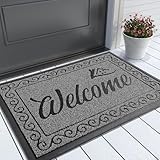
The best outdoor welcome mats pair a coarse scraping fiber (coir or synthetic bristle) with a non-slip rubber backing and enough thickness that water drains or evaporates before it pools—expect to pay $20–$35 for a solid budget mat and $45–$80 for a Waterhog-style polypropylene mat that survives multiple winters.
As an Amazon Associate we earn from qualifying purchases at no extra cost to you.


What we cover
What Actually Matters in an Outdoor Mat
Indoor mats get judged on softness. Outdoor mats live or die on five things:
- Scraping ability. Stiff fibers or raised ridges physically remove mud and gravel from shoe treads. Soft plush tops just trap dirt where you can see it.
- Drainage. Waterhog-style mats use a raised “waffle” or ribbed pattern that holds water below the walking surface until it evaporates—typically up to about 1.5 gallons per square yard in manufacturer claims. Coir absorbs moisture into the fibers instead, which is fine for light rain but means slower drying.
- Grip. A rubber or nitrile-rubber backing keeps the mat from skating across wet concrete or decking. Lightweight PVC-backed mats are the biggest offender here.
- Cleaning. A mat you can’t hose off will get replaced early. Rubber and polypropylene rinse clean in a minute; coir requires a good shake and drying time.
- Door clearance. This is the spec people forget. Measure the gap under your door before buying—most residential doors clear 1/2 to 3/4 inch at the threshold.
Fiber vs. Rubber: The Material Decision
The material choice matters more than the brand. Here’s how the main options stack up:
| Material | Best Season | Dirt Scraping | Drying Speed | Typical Lifespan Outdoors | Typical Price |
|---|---|---|---|---|---|
| Natural coir (coconut) | Spring/Fall | Excellent on dry mud | Slow—can take 24+ hrs if saturated | 1–2 years (fibers shed and flatten) | $15–$35 |
| Polypropylene w/ rubber border (Waterhog-style) | All four seasons | Very good on wet grit | Fast—channels water into grooves | 3–5+ years | $40–$80 |
| All-rubber scraper (open-grid) | Winter/snow | Best on packed snow and ice melt residue | Near-instant—water drains through | 4–6 years | $25–$60 |
| Synthetic turf/grass fiber | Summer | Good on grass clippings, sand | Fast | 2–3 years | $20–$45 |
The rule of thumb: if your mat sits under a covered porch, coir works beautifully and looks better than anything synthetic. If it takes direct rain or snow, skip coir entirely—it will stay soggy, shed fibers, and grow mildew smell within one wet season.
Picks by Situation
Best all-season: Waterhog-style polypropylene mats
The Andersen Company Waterhog and Apache Mills equivalents (sold under brands like Notrax and various Waterhog-pattern generics) are the category benchmark. The bi-level design scrapes shoes on the ridges while water falls into recessed channels below foot level. Backing is usually 100% rubber with cleats underneath for grip. Sizes run from about 18×30 inches up to 35×58 inches. These are the mats commercial buildings use, and there’s a reason.
Best for snow and ice: open-grid rubber scrapers
Mats like the Durable Heavy-Duty Rubber Doormat or similar open-lattice designs let snow, slush, and salt fall straight through rather than sitting in the mat. Salt residue is the silent mat killer in northern climates—it degrades coir fibers fast and stains lighter polypropylene. Rubber shrugs it off. You lose some dirt-trapping finesse on fine dust, but you gain a mat that essentially can’t be waterlogged.
Best under cover: natural coir
Calloway Mills and similar makers sell dense coir mats (often 1.5-inch thick, which is excellent for scraping but watch door clearance) with rubber or vinyl backings. Coir’s stiffness is genuinely better than synthetics at removing dry mud. The limitation is purely moisture exposure—under a porch roof or in a covered breezeway, a good coir mat will outlast its reputation.
Best for heavy foot traffic: commercial-grade rubber-edged mats
If you’ve got kids, dogs, and a gravel driveway, look for mats marketed for commercial entryways—Notrax and Gorilla Grip both make versions in the $30–$50 range. The rubber border keeps edges from curling (curling is the #1 failure mode in cheaper mats) and the weight—often 4–7 lbs for a 24×36 inch mat—keeps it planted.
Door Clearance: Measure Before You Buy
Mat thickness is the most-returned-product problem in this category. Here’s the worked check:
- Open your door and measure from the floor to the bottom edge of the door at its lowest point over the mat’s footprint. Sweep the door through its arc—some doors sit lower mid-swing than at the threshold.
- You want at least 1/4 inch of clearance over the mat surface, because mats gain height when wet fibers compress unevenly or debris builds underneath.
- Common thicknesses: coir mats run 0.5–1.75 inches; Waterhog styles run about 0.25–0.4 inches at the border; open-grid rubber runs 0.4–0.5 inches.
- If clearance is tight (under 1/2 inch), a low-profile polypropylene mat is your only safe choice.
Ownership Realities
- What wears first: On coir, the center fibers flatten and shed—visible within a year in heavy use. On rubber-backed mats, edge curling from freeze-thaw cycles or cheap PVC backing is the first failure.
- Cleaning: Hose down monthly in muddy seasons. Coir: shake it out and let it dry flat in sun, not draped (draping warps the backing). Rubber and polypropylene: hose, or pressure-wash on low setting.
- Salt damage: Rinse de-icing salt off any fiber mat weekly in winter or it will eat the fibers by spring.
- Common mistakes: Buying a “welcome mat” sized 18×30 for a double-door entry (aim for the mat to be at least as wide as the door opening, ideally wider), and placing any mat on a slick painted deck without grip—use a rubber underlay pad if needed.
Frequently Asked Questions
How long should a good outdoor mat last?
Rubber and Waterhog-style mats: 3–5 years with rinsing. Coir in a covered spot: about 2 years. Coir exposed to weather: often under one season.
Can I leave a mat out in freezing temperatures?
Rubber-backed mats handle freezing fine. Natural rubber stays flexible down to roughly -40°F; PVC backings can get stiff and crack below about 0°F, which is why cheaper mats curl after their first winter.
What size should I buy?
Match the door width at minimum. For a standard 36-inch door, a 24×36 or 30×48 mat gives enough stepping room. The goal is two full steps on the mat before the door—that’s what actually cleans shoes.