What's inside
- Quick picks by cooking situation
- Clay tagines: the traditional choice
- Ceramic tagines: easier care, variable performance
- Cast-iron tagines: the dependable workhorse
- Stainless-steel tagines: practical rather than traditional
- Size, capacity, and the space trade-off
- How to choose without damaging the pot
- What wears out first?
- Final verdict
- Quick picks by cooking situation
- Clay tagines: the traditional choice
- Ceramic tagines: easier care, variable performance
- Cast-iron tagines: the dependable workhorse
- Stainless-steel tagines: practical rather than traditional
- Size, capacity, and the space trade-off
- How to choose without damaging the pot
- What wears out first?
- Final verdict
As an Amazon Associate I earn from qualifying purchases. This post may contain affiliate links at no extra cost to you.
The best tagine pot for Moroccan cooking is a glazed or unglazed clay tagine for traditional flavor, a cast-iron tagine for frequent stovetop use, a ceramic tagine for attractive serving and moderate cooking, or a stainless-steel model when durability and induction compatibility matter most.
As an Amazon Associate we earn from qualifying purchases at no extra cost to you.



What we cover
- Quick picks by cooking situation
- Clay tagines: the traditional choice
- Ceramic tagines: easier care, variable performance
- Cast-iron tagines: the dependable workhorse
- Stainless-steel tagines: practical rather than traditional
- Size, capacity, and the space trade-off
- How to choose without damaging the pot
- What wears out first?
- Final verdict
Quick picks by cooking situation
| Situation | Best choice | Why | Main compromise |
|---|---|---|---|
| Traditional Moroccan cooking on gas | Unglazed or glazed clay | Gentle, even heat and the classic cone-shaped cooking environment | Fragile and usually unsuitable for high heat or direct electric burners |
| Frequent stovetop meals | Cast iron | Works on gas, electric, and usually induction; retains heat well | Heavy, slower to heat, and requires seasoning care |
| Cooking and serving in one attractive vessel | Glazed ceramic | Presentable at the table and easier to clean than porous clay | Thermal shock can crack it; stovetop use depends on the manufacturer |
| Induction, durability, and easy maintenance | Stainless steel with a magnetic base | Light, tough, nonporous, and induction-friendly when specified | Does not provide the same heat retention or traditional clay cooking behavior |
| Occasional use or limited storage | Small ceramic or stainless steel tagine | Typically lighter and easier to store than cast iron | Small capacity limits browning and leftovers |
Clay tagines: the traditional choice
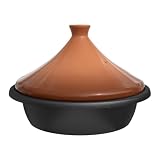
Clay is the strongest choice if your priority is the traditional Moroccan cooking method rather than maximum convenience. The wide, shallow base gently cooks meat, vegetables, legumes, and dried fruit while the conical lid encourages condensation to run back into the dish. This makes it useful for long, low-temperature cooking with relatively little added liquid.
Unglazed clay is porous and can absorb moisture and cooking aromas. That can contribute to its cooking character, but it also means more careful cleaning and drying. Glazed clay is less absorbent and generally easier to maintain, although the glaze can still chip if the pot is knocked or exposed to sudden temperature changes.
Stovetop compatibility
Do not assume that every clay tagine can sit directly on a burner. Many require a heat diffuser, especially on electric or glass cooktops. On gas, use the lowest practical flame and keep the flame beneath the base rather than climbing up its sides. A clay tagine should normally be warmed gradually, not placed over a preheated burner at full power.
For a new unglazed clay tagine, follow the maker’s preparation instructions. Common guidance includes soaking the base and lid, drying them, rubbing the interior with a small amount of oil, and warming the vessel gently. These steps reduce the risk of cracking, but they do not make a clay pot immune to thermal shock.
Ceramic tagines: easier care, variable performance
Ceramic tagines are often the practical middle ground. A glazed ceramic interior resists staining and does not absorb as much oil or odor as porous clay. It is also attractive enough to use as a serving dish. However, “ceramic” describes a broad category: some models are designed only for oven or table use, while others are formulated for direct stovetop cooking.
Check the product instructions for gas, electric, halogen, and induction compatibility before buying. Even if the base is labeled stovetop-safe, gradual heating remains important. Ceramic can crack when a cold vessel is placed on a hot burner, when cold liquid is added to a hot pot, or when a hot pot is set on a cold, wet surface.
Ceramic generally does not require cast-iron-style seasoning. A maker may still recommend soaking, oiling, or a first-use cure, particularly for unglazed ceramic. Treat that instruction as specific to the vessel rather than assuming all ceramic tagines need the same preparation.
Cast-iron tagines: the dependable workhorse
Cast iron is usually the best tagine pot for Moroccan cooking when you cook regularly and need reliable stovetop performance. It tolerates stronger heat than most clay vessels, holds heat for a long time, and is commonly compatible with gas, electric, and induction cooktops. A heavy cast-iron base is also less likely to shift while stirring.
The trade-off is weight. A medium cast-iron tagine can weigh several kilograms before food is added, making it less convenient to move from hob to table. Its excellent heat retention also means that the pot stays hot long after the burner is turned off, so sauces can continue reducing unless you remove it from the heat.
Seasoning and cleaning
Uncoated cast iron needs a thin protective layer of seasoning. After washing, dry it promptly and wipe the cooking surface with a very light coat of neutral cooking oil. Avoid leaving acidic tomato, lemon, or vinegar-based food in uncoated cast iron for long periods, particularly when the seasoning is new. Enameled cast iron does not require seasoning, but its enamel can chip if struck or heated abruptly.
Rust, sticky oil, and dull seasoning are the ownership problems most likely to appear first. Excess oil creates a gummy surface; leaving the pot wet promotes rust. Use moderate heat, avoid harsh scraping on enamel, and check whether the lid is cast iron or ceramic before applying the same cleaning method to both parts.
Stainless-steel tagines: practical rather than traditional
Stainless steel is the simplest choice for cooks who prioritize low maintenance. It is nonporous, resistant to rust, dishwasher-friendly when the manufacturer permits it, and does not need seasoning. A multi-layer base can distribute heat better than thin single-layer steel, while a magnetic base is necessary for induction.
Stainless steel does not retain heat like cast iron and may develop hot spots if the base is thin. It also lacks the moisture behavior of porous clay. The cone-shaped lid still helps condensation return to the dish, but the cooking result is closer to a conventional stainless-steel pot than to a traditional earthenware tagine.
Size, capacity, and the space trade-off
| Nominal diameter | Practical food capacity | Best use | Approximate storage footprint |
|---|---|---|---|
| 20–22 cm | 1–2 portions | Single meals or side dishes | About 25 cm wide with lid |
| 25–27 cm | 2–3 portions | Couples and small batches | About 30 cm wide with lid |
| 30–32 cm | 4–5 portions | Family meals and leftovers | About 35 cm wide with lid |
| 35 cm or more | 5–7 portions | Entertaining and large cuts of meat | Often needs a dedicated cupboard shelf |
These capacities are working estimates rather than fill-to-the-rim measurements. Leave space around ingredients so vegetables can cook evenly and liquid does not bubble into the lid. A 30 cm tagine may look efficient in a listing, but the conical lid and wide base can occupy more shelf and dishwasher space than a similarly sized saucepan.
How to choose without damaging the pot
- Identify the hob first. For induction, choose cast iron or stainless steel with a confirmed magnetic base. Clay and ceramic require a compatible diffuser only if the manufacturer permits that arrangement.
- Choose the portion size. For two people, a 25–27 cm vessel is usually more manageable than a large family tagine. For four or more, look toward 30–32 cm.
- Check the lid fit. The lid should sit securely without wobbling excessively. A loose lid allows steam to escape and can lengthen cooking time.
- Inspect the base and handles. Look for a stable, flat base, no hairline cracks, and handles that remain clear of the hottest part of the burner.
- Start with gentle heat. Warm the vessel gradually, add ingredients according to the recipe, and increase heat only when the instructions and material allow it.
- Cool before washing. Never put a hot clay or ceramic tagine under cold water. Let it cool naturally, then clean with warm water and a soft sponge.
What wears out first?
On clay and ceramic models, the vulnerable points are hairline cracks, chipped glaze, and a lid that no longer sits properly. These problems usually result from thermal shock, impact, or a burner that is too hot. On cast iron, seasoning and exposed edges need the most attention. On stainless steel, the base can warp or discolor after overheating, while rivets and handles may loosen over years of use.
Replacement lids are not always interchangeable because the rim shape and diameter vary. If a broken lid would make the pot unusable, choose a model with clearly available spare parts or buy a conventional covered vessel instead.
Final verdict
Choose clay for traditional low-and-slow Moroccan cooking, cast iron for frequent use and broad stovetop compatibility, ceramic for attractive serving with moderate convenience, and stainless steel for induction, durability, and the least maintenance. For most households, a 25–32 cm glazed clay or cast-iron tagine offers the best balance of usable capacity, cooking control, and storage in 2026.