What's inside
As an Amazon Associate I earn from qualifying purchases. This post may contain affiliate links at no extra cost to you.
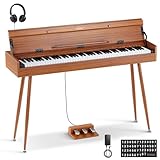
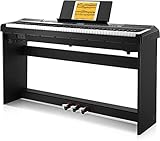
The best digital pianos with weighted keys for most players in 2026 are the Yamaha P-225 and Roland FP-30X for portable use, the Kawai ES-520 for the most realistic touch under $1,500, and the Yamaha YDP-165 or Kawai KDP120 for furniture-style cabinets, with your choice depending on key action weight, speaker power, and how much floor space you have.
Weighted keys are not all the same. Fully weighted 88-key actions try to replicate an acoustic piano’s hammer mechanism, but they vary in weight progression, escapement feel, key surface, and how the sound engine responds to velocity. For beginners, any graded hammer action will build proper finger strength, while experienced players will notice differences in repetition speed, dynamic control, and pedal behavior.
As an Amazon Associate we earn from qualifying purchases at no extra cost to you.


What we cover
How Weighted Key Actions Actually Differ
Understanding the action type matters more than marketing names. Here is what to look for:
- Graded Hammer Standard (GHS) / Entry Weighted: Lighter overall touch, heavier in the bass and lighter in the treble. Found on Yamaha P-145, Casio CDP-S110, and Kawai ES-120. Good for beginners and easy to play for long sessions, but can feel less substantial for classical repertoire.
- Graded Hammer 3 / PHA-4 Standard / Responsive Hammer Compact: Mid-range actions with better sensors (usually 3 sensors per key) and ivory-feel key tops. Examples include Yamaha P-225 (GHC), Roland FP-30X (PHA-4 Standard), and Kawai ES-520 (Responsive Hammer Compact). These add escapement or let-off simulation, which creates a subtle click near the bottom of the key travel like an acoustic grand.
- Wooden / Hybrid Actions: Real wood keys or wood-composite with longer pivot lengths. Found on Kawai CA401/CA501 (Grand Feel Compact), Yamaha CLP-725/CLP-825 (GrandTouch-S), and Kawai MP11SE. Longer pivots mean the key feels more even when you play toward the back of the key, closest to an acoustic piano. Preferred by advanced and returning pianists.
Two other specs that affect realism: polyphony (how many notes can ring at once; 192 notes is the minimum to avoid cut-off with sustain pedal, 256 is ideal) and sensor count. Triple-sensor actions handle fast repeated notes and half-pedaling more accurately than dual-sensor entry actions.
Spec Comparison: Popular Weighted-Key Models in 2026
This table compares current, widely available models across the features that affect daily use: action, sound engine, speaker power, and cabinet footprint.
| Model | Action Type | Sound Engine / Polyphony | Speaker Output | Dimensions (W x D x H) | Weight |
|---|---|---|---|---|---|
| Yamaha P-145 (Portable) | GHS, Graded Hammer Standard, matte black key tops | CFIIIS Grand, 64-note polyphony | 2x 7W (8cm x 2) | 52.2 x 10.9 x 5.2 in (1326 x 272 x 129 mm) | 24.9 lbs (11.3 kg) without stand |
| Yamaha P-225 (Portable) | GHC, Graded Hammer Compact, triple sensor | CFX Grand, 192-note polyphony | 2x 7W + 2x 3W tweeters | 52.2 x 10.9 x 5.3 in (1326 x 272 x 134 mm) | 26.0 lbs (11.8 kg) without stand |
| Roland FP-30X (Portable) | PHA-4 Standard, escapement, ivory feel | SuperNATURAL Piano, 256-note polyphony | 2x 11W (12cm x 2) | 51.2 x 11.2 x 5.9 in (1300 x 284 x 151 mm) | 31.1 lbs (14.1 kg) without stand |
| Casio CDP-S110 (Slim Portable) | Scaled Hammer Action II, 3-sensor | AiR Sound Source, 64-note polyphony | 2x 8W | 52.2 x 9.1 x 5.5 in (1322 x 232 x 141 mm) | 23.1 lbs (10.5 kg) without stand |
| Kawai ES-520 (Portable) | Responsive Hammer Compact, triple sensor | Harmonic Imaging, 256-note polyphony | 2x 20W (Onkyo) | 52.4 x 11.2 x 5.9 in (1340 x 285 x 150 mm) | 32.0 lbs (14.5 kg) without stand |
| Yamaha YDP-165 (Furniture) | GH3, Graded Hammer 3, synthetic ebony/ivory tops | CFX Grand, 192-note polyphony | 2x 20W | 53.4 x 16.6 x 33.1 in (1357 x 422 x 849 mm) | 92.6 lbs (42 kg) with bench |
| Kawai KDP120 (Furniture) | Responsive Hammer Compact, triple sensor | Harmonic Imaging, 192-note polyphony | 2x 20W | 53.5 x 16.1 x 36.0 in (1360 x 405 x 855 mm) | 84 lbs (38 kg) with bench |
| Roland F107 (Slim Furniture) | PHA-4 Standard, escapement | SuperNATURAL, 256-note polyphony | 2x 8W | 53.5 x 13.6 x 30.8 in (1360 x 345 x 783 mm) | 75.3 lbs (34.2 kg) |
Takeaway: Portable models save 8 to 10 inches of depth and 50+ lbs compared to furniture cabinets. Speaker wattage does not tell the whole story, but models with 20W or more and larger drivers project bass more realistically without needing external speakers.
Decision Matrix: Which Piano Fits Your Situation
Match your space, budget, and playing level to the right category instead of chasing the highest spec.
| Your Situation | Best Category | Why | Specific Models to Consider |
|---|---|---|---|
| Beginner, tight space/apartment, budget $400-$700 | Slim portable 88-key | Lightest weight, smallest depth (around 9-11 inches), headphone practice, easy to move | Casio CDP-S110, Yamaha P-145 |
| Beginner to intermediate, wants best value touch and sound $700-$1,000 | Mid-range portable | Triple sensors, ivory feel, better speaker projection, CFX/SuperNATURAL sound holds up for years | Yamaha P-225, Roland FP-30X |
| Intermediate to advanced, focused on classical technique, no space limit | Portable with premium action | More realistic repetition and dynamic control, 256-note polyphony for dense pedaling | Kawai ES-520, Kawai ES-520 with F-302 stand |
| Family / living room, want furniture look and built-in 3-pedal unit | Console cabinet | Stable stand, covered keys, integrated pedals with half-damper, stronger speakers | Yamaha YDP-165, Kawai KDP120, Roland F107 for narrow rooms |
| Advanced player replacing upright, silent practice needed | Console with wooden action | Longer key pivot, wooden keys, grand piano sound modeling, better pedal nuance | Yamaha CLP-725, Kawai CA401, Kawai CA501 |
Key Criteria Explained
1. Sound Engine and Speaker Output
Entry engines sample a single grand piano at a few velocity layers. Mid-range and up use multi-layer sampling or modeling (Yamaha CFX, Roland SuperNATURAL, Kawai Harmonic Imaging) that changes tone more smoothly from pianissimo to fortissimo. For speaker output, consider room size: 2x 7W to 2x 11W is adequate for a bedroom with headphones as the primary output, while 2x 20W fills a 150-250 sq ft living room without distortion at moderate volume. If you plan to use external monitors or headphones 90% of the time, prioritize action over wattage.
2. Pedal Support
All weighted pianos include a single sustain pedal, but implementation varies. Entry portables include a basic footswitch that is only on/off. Models like the Yamaha P-225, Roland FP-30X, and Kawai ES-520 support half-pedaling and continuous damper when paired with their optional 3-pedal units (Yamaha LP-1/LP-5A, Roland KPD-70/RPU-3, Kawai F-302/GFP-3). Furniture models include the 3-pedal board as standard with damper, sostenuto, and soft, plus half-pedal and re-pedaling support in the sound engine. If you study classical pieces that require half-pedaling, budget for the correct pedal unit from the same brand; universal pedals often do not send continuous data.
3. Cabinet Size and Placement
Measure before you buy. A portable on an X-stand needs about 52 inches wide x 14-18 inches deep when in use, plus 24 inches for a bench, but can be folded to 52 x 11 inches for storage. A furniture console is 53-54 inches wide x 16-18 inches deep x 32-36 inches tall and cannot be folded; it needs 2 inches of clearance from the wall for the back panel and cable access. Slim cabinets like the Roland F107 and Casio AP-550 save 2-3 inches of depth, which matters in apartments or hallways. Weight also affects floors and moving: portables are 23-32 lbs and can be carried by one person, consoles are 75-120 lbs and require two people and assembly.
Durability and Ownership Realities
Digital pianos are low-maintenance, but these are the parts that show wear first and the mistakes that shorten lifespan:
- Key wear: Shiny spots develop on ivory-feel coatings after 2-4 years of heavy use. Clean with a lightly dampened soft cloth, not alcohol or cleaners, which strip the texture. Dust under keys can cause clicking; keep the fallboard or dust cover closed when not in use.
- Pedals and jacks: The sustain jack and triple-pedal connector are the most common failure points from stepping on cables. Route cables behind the stand and avoid rolling bench legs over them.
- Speakers: Do not leave volume at maximum for extended periods to compensate for a noisy room; portables with small drivers can distort and overheat. Use headphones for late practice instead.
- Power supply: Use the included AC adapter. Replacement adapters with wrong voltage or polarity are a frequent cause of no-sound or board damage.
- Humidity and temperature: Unlike acoustics, digitals do not need tuning, but avoid placing consoles against radiators or in direct sunlight, which warps particle-board cabinets and dries key felts.
There are no consumables like strings or regular tuning costs. Expect 10-15 years of service with average home use if kept clean, covered, and on a stable stand. The most common upgrade reason is outgrowing an entry action, not mechanical failure.
Sizing for Your Hands and Setup Height
Standard digital piano key width is identical to acoustic (about 23.5mm per white key), so fit is about height, not width. For proper technique, the top of the white keys should sit about 28-29 inches from the floor when assembled on its stand. Most furniture consoles hit this height automatically. For portables, check stand height: the Yamaha L-200 and Kawai F-302 stands place the P-series and ES-series at correct height, while generic X-stands often sit 1-2 inches too high or low and wobble under fortissimo playing. If two players share the piano (adult and child), choose a model with adjustable touch sensitivity (Light/Medium/Hard) to compensate for finger strength without changing hardware.
Frequently Asked Questions
Do weighted keys make it harder for beginners?
Weighted keys require slightly more finger strength at first, but they build the technique needed to transition to an acoustic piano later. Most teachers recommend starting on fully weighted 88 keys with graded weighting. If a young child under 7 finds it fatiguing, use the lighter touch setting temporarily rather than switching to unweighted keys.
Is 64-note polyphony enough?
For simple practice without heavy pedaling, 64 notes can be sufficient. With sustain pedal held through layered sounds, reverb, and dual-voice modes, notes can cut off prematurely. For long-term use, 192 or 256-note polyphony provides headroom and is now standard on mid-range portables and all furniture models.
Can I learn on a 61 or 76-key keyboard instead?
You can learn basic reading and chords, but repertoire after the first year often uses the full 88-key range, especially bass notes below A0 and treble notes above C7. Weighted 88-key instruments also teach dynamics and pedal control that unweighted smaller keyboards do not replicate.
Do I need a three-pedal unit right away?
Not for the first 6-12 months. A single damper pedal covers most beginner method books. Add the matching 3-pedal board when you start pieces that mark sostenuto or soft pedal, or when your teacher introduces half-pedaling exercises.