What's inside
As an Amazon Associate I earn from qualifying purchases. This post may contain affiliate links at no extra cost to you.
The Everlast PowerTIG 255EXT is a strong choice for aluminum fabrication and mixed TIG work if you want advanced AC controls, a broad 5–250 amp range, and more capacity than a typical 200-amp machine, but its value depends on whether you will use its adjustable waveform and pulse features often enough to justify the price and learning curve.
As an Amazon Associate we earn from qualifying purchases at no extra cost to you.


What we cover
Everlast PowerTIG 255EXT at a Glance
| Specification | PowerTIG 255EXT | Why it matters |
|---|---|---|
| Process | AC/DC TIG and DC stick | Handles aluminum, steel, stainless steel, and many other weldable metals |
| Output range | Approximately 5–250 A | Low enough for thin sheet and high enough for substantial fabrication |
| Input power | Dual-voltage 120/240 V, model-dependent configuration | 240 V is preferred for full output; 120 V improves portability for lighter work |
| Duty cycle | About 60% at maximum output; higher at reduced amperage | Suitable for production-style work with planned cooling pauses |
| AC frequency | Adjustable, roughly 20–250 Hz | Lower settings widen the arc; higher settings tighten arc control |
| Pulse frequency | Adjustable into the high-kilohertz range, depending on revision | Useful for heat control, appearance, and thin-material work |
| Cooling | Air-cooled | Simpler and less expensive than a water-cooled system, but torch heat management matters |
| Approximate machine weight | About 60 lb, depending on version and accessories | Portable for a high-output TIG machine, though not a casual carry |
Everlast has released updated versions and package configurations over time, so confirm the specifications on the exact nameplate and seller listing before purchase. In particular, input requirements, included torch hardware, and duty-cycle presentation can vary between revisions.
AC/DC TIG Performance and Aluminum Capability
The main reason to buy the everlast 255ext is its AC TIG system. Aluminum naturally forms an oxide layer that melts at a much higher temperature than the base metal. AC alternates between electrode-negative and electrode-positive portions of the cycle, allowing the machine to combine penetration with oxide cleaning.
The 255EXT gives the operator considerably more control than a basic AC/DC TIG welder. Adjustable AC balance lets you favor penetration or cleaning, while adjustable AC frequency changes the shape and feel of the arc. A higher frequency can produce a narrower, more focused arc that is useful around joints and edges. A lower frequency creates a broader arc and can be more forgiving on larger flat sections.
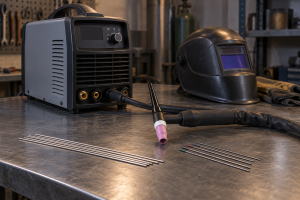
That flexibility is valuable on aluminum, but it does not remove the need for correct preparation. Clean the material with a dedicated stainless-steel brush, remove oil and marker residue, use clean filler rod, and keep the tungsten from touching the puddle. For most aluminum work, a 3/32-inch lanthanated or ceriated tungsten is a practical starting point. Thicker sections may call for 1/8-inch tungsten and more amperage.
Practical aluminum expectations
- Thin aluminum sheet is well within the machine’s capability, although heat control and fit-up become the limiting factors.
- At roughly 200–250 amps, it can handle demanding aluminum joints, but actual thickness depends on joint design, preheating, travel speed, and thermal mass.
- A foot pedal or remote amperage control makes it easier to reduce heat as the workpiece warms.
- Large plates and castings may absorb heat faster than an air-cooled torch can comfortably deliver.
The machine is powerful enough for many repair, motorsport, fabrication, and small-production applications. It is not a substitute for a high-amperage water-cooled production TIG system when long aluminum welds are routine.
Controls: Powerful, but Not Beginner-Simple
The control panel is aimed at welders who want to tune the arc rather than select only a material preset. Typical adjustments include pre-flow, start current, upslope, peak current, downslope, end current, post-flow, AC balance, AC frequency, pulse frequency, pulse width, and background current. Exact menus differ by revision.
These controls are useful when you have a specific problem to solve. For example, increasing post-flow helps protect a hot tungsten from oxidation, while changing pulse settings can reduce average heat input on thin stainless steel. However, changing several variables at once makes troubleshooting difficult. New users should begin with conservative settings, alter one control at a time, and record settings that work.
The digital interface is more precise than a simple analog dial, but menu-based controls can slow down quick adjustments while welding. A foot pedal remains important for aluminum because the correct amperage often changes during the weld even when the programmed peak current stays the same.
Output Range and Duty Cycle in Real Use
A nominal 5–250 amp range gives the PowerTIG 255EXT useful versatility. The low end suits fine stainless work, thin steel, and small brackets; the upper end provides headroom for aluminum and heavy joints. The machine’s rated duty cycle is commonly presented at approximately 60% at maximum output, meaning about six minutes of arc time in a ten-minute period under the stated test conditions.
A simple planning example shows what that means. If a repair job requires 18 minutes of actual arc time at maximum output, allow at least three ten-minute duty-cycle periods: roughly 30 minutes of operating time, including the required cooling intervals. In practice, fit-up, repositioning, filler changes, and inspection often provide natural breaks, so the machine may feel faster than that calculation suggests.
At lower amperage, the available duty cycle generally improves. Short aluminum beads, brackets, tanks, and intermittent fabrication are a better match than continuous long seams on thick plate.
Included Accessories and Setup Value
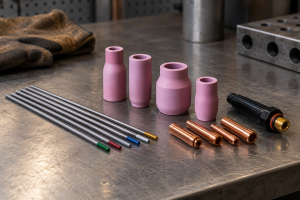
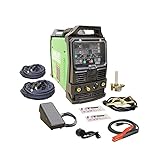
Package contents vary, but an Everlast PowerTIG 255EXT package commonly includes an air-cooled TIG torch, torch consumables, a work clamp and cable, a gas regulator or flowmeter, a stick-electrode holder, and a foot pedal or remote control. Check every package carefully: torch length, connector type, pedal inclusion, and consumable sizes can differ.
Budget for additional consumables even if the box is ready to weld. A practical starter stock includes:
- 3/32-inch and 1/8-inch tungsten electrodes
- Collets, collet bodies, and ceramic cups
- Gas lenses for improved shielding on stainless and precision work
- Suitable aluminum and stainless filler rods
- 100% argon and a correctly sized cylinder
- Replacement torch parts and a spare pedal cable if the machine will be used frequently
Use a dedicated 240-volt circuit sized according to the manual and local electrical requirements when running near maximum output. A long, undersized extension cord can cause voltage drop and nuisance faults. Keep the machine’s ventilation openings clear and position the gas cylinder securely.
Ownership Realities: What Wears First?
On an air-cooled TIG setup, the torch consumables and pedal are usually more exposed to wear than the inverter itself. A cracked ceramic cup, damaged torch lead, loose gas fitting, contaminated tungsten, or worn pedal cable can make a sound machine appear unreliable.
Clean the torch after contaminated welds, replace damaged insulators promptly, and inspect the gas hose and regulator connections for leaks. Allow post-flow to finish before lifting the torch away from the work. Do not use compressed air aggressively inside the machine unless the service instructions permit it; moisture and debris can be driven deeper into electronics. Keep the fan intake free of grinding dust, especially in a steel-fabrication shop.
Common mistakes include using inadequate shielding gas flow, welding aluminum with a dirty brush, selecting excessive AC cleaning action, and expecting a small air-cooled torch to tolerate uninterrupted high-amperage work. These issues are often mistaken for machine defects.
Who Should Buy the Everlast 255EXT?
| Your situation | Fit | Reason |
|---|---|---|
| Mostly thin steel, occasional TIG work, limited budget | Possible overbuy | A simpler 200-amp AC/DC machine may provide better value |
| Regular aluminum brackets, tanks, frames, or vehicle parts | Strong fit | AC controls and 250-amp headroom reduce limitations |
| Beginner learning TIG | Good hardware, steeper learning curve | It offers room to grow, but many settings can initially be distracting |
| Small shop with a 240-volt circuit | Strong fit | Full output is more practical and voltage drop is easier to manage |
| Frequent long, high-amperage aluminum seams | Limited fit | A water-cooled torch and industrial-duty machine may be better suited |
| Portable repair work at different sites | Conditionally suitable | The machine is movable, but its weight and dependable power access matter |
Value Verdict
The Everlast PowerTIG 255EXT earns its place when AC/DC TIG is a central part of the shop rather than an occasional feature. Its broad output, adjustable AC frequency and balance, pulse functions, remote control compatibility, and stick capability make it considerably more adaptable than an entry-level TIG welder. The main compromises are the learning curve, air-cooled high-output limitations, and the need to verify package contents and electrical requirements for the exact revision.
For aluminum users who will take advantage of its arc-shaping controls, the machine offers meaningful value. For someone welding only thin steel a few times a month, a less feature-heavy model may be easier to operate and less expensive to own. Choose the 255EXT when you need its aluminum performance and headroom—not simply because its maximum amperage is higher.