What's inside
- Cheapest TIG Welders Worth Buying for Beginners and Small Shops
- Best low-cost TIG welders by situation
- What the cheapest TIG welder must have
- Head-to-head: inexpensive DC versus AC/DC TIG
- Specific low-cost models worth considering
- How much machine do you need?
- Ownership costs beginners often miss
- Common mistakes that make a cheap machine seem bad
- Bottom line
- Cheapest TIG Welders Worth Buying for Beginners and Small Shops
- Best low-cost TIG welders by situation
- What the cheapest TIG welder must have
- Head-to-head: inexpensive DC versus AC/DC TIG
- Specific low-cost models worth considering
- How much machine do you need?
- Ownership costs beginners often miss
- Common mistakes that make a cheap machine seem bad
- Bottom line
As an Amazon Associate I earn from qualifying purchases. This post may contain affiliate links at no extra cost to you.
What we cover
- Cheapest TIG Welders Worth Buying for Beginners and Small Shops
- Best low-cost TIG welders by situation
- What the cheapest TIG welder must have
- Head-to-head: inexpensive DC versus AC/DC TIG
- Specific low-cost models worth considering
- How much machine do you need?
- Ownership costs beginners often miss
- Common mistakes that make a cheap machine seem bad
- Bottom line
Cheapest TIG Welders Worth Buying for Beginners and Small Shops
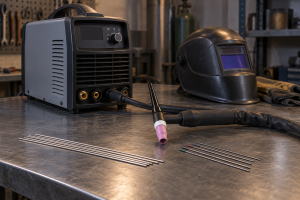
The cheapest TIG welder worth buying is usually a $400–$700 DC inverter with a real foot-pedal or hand-control option, HF start, and enough output for the material you actually weld—not the lowest-priced machine on a marketplace.
For most beginners, a 200-amp DC TIG welder is the best value. It can handle mild steel and stainless steel from thin sheet up to roughly 1/4 inch in practical shop work, while remaining affordable to run. Choose an AC/DC model only if you need to weld aluminum; the added circuitry commonly raises the price to about $700–$1,300.
As an Amazon Associate we earn from qualifying purchases at no extra cost to you.


Best low-cost TIG welders by situation
| Situation | Best type or example | Typical price range in 2026 | Why it makes sense |
|---|---|---|---|
| First TIG machine for steel and stainless | 200-amp DC inverter TIG, such as the AHP Alpha-TIG 203Xi | $500–$700 | Useful amperage, HF start, pulse, and manageable size |
| Lowest practical budget | 140–160-amp DC TIG inverter | $250–$450 | Good for sheet metal and light fabrication, but limited on thick work |
| Small shop with occasional aluminum work | 200–250-amp AC/DC inverter, such as the PrimeWeld TIG225X or Eastwood TIG 200 AC/DC | $700–$1,100 | AC balance and frequency make aluminum possible without buying a second machine |
| Frequent fabrication and service work | AC/DC inverter with established parts support, such as an Everlast PowerTIG model | $900–$1,500 | Better duty cycle, controls, torch options, and long-term support |
Prices are broad market ranges for the welder and commonly included accessories, not a guarantee of current promotional pricing. Check the package contents carefully: one inexpensive machine may include a foot pedal and regulator, while another may require both purchases.
What the cheapest TIG welder must have
HF start or dependable lift-arc
High-frequency start initiates the arc without touching the tungsten to the workpiece. That matters because accidental contact contaminates the tungsten and can leave a mark on stainless steel. Lift-arc is usable when cost is critical, but it requires more practice and is less convenient for repeated starts.
At least 160 amps for general learning
A 120-amp machine can weld thin sheet, but it leaves little headroom once the joint draws heat away through a larger plate or fixture. A 160- to 200-amp inverter is a better beginner target. For example, a 200-amp machine can commonly weld 1/8-inch steel comfortably and approach 1/4-inch material with proper joint preparation, multiple passes, and sufficient duty cycle.
Real current control
A foot pedal is helpful for beginners because it lets you reduce heat at the end of a joint or slow down when a corner begins to overheat. A torch-mounted amperage control is smaller and more convenient for field work. Either is preferable to a machine with only a fixed front-panel setting.
Consumables that are easy to replace
Look for a standard air-cooled torch, commonly based on a 17-, 18-, or 26-series design, with readily available collets, collet bodies, cups, back caps, and tungsten electrodes. A proprietary torch or unusual fittings can turn a cheap purchase into an expensive ownership problem.
Head-to-head: inexpensive DC versus AC/DC TIG
A DC-only machine is the economical choice for mild steel, stainless steel, chromoly, and most copper work. It is also simpler: there is no AC balance or frequency to learn, and more of the purchase price goes toward the power supply and torch.
AC/DC is necessary for practical aluminum TIG welding because alternating current helps disrupt the oxide layer on aluminum. The additional capability is valuable for a small shop making brackets, tanks, repair parts, or motorcycle components, but it does not automatically make the machine better on steel.
| Specification | Budget DC machine | Budget AC/DC machine |
|---|---|---|
| Typical output | 160–200 A | 200–250 A |
| Input power | 120 V or 120/240 V | 120/240 V preferred |
| Practical steel thickness | Sheet to about 1/4 inch, depending on joint and duty cycle | Sheet to about 1/4 inch, with more reserve at 240 V |
| Aluminum | Not suitable for normal TIG work | Suitable when AC controls are properly configured |
| Typical machine weight | 15–35 lb | 30–50 lb |
| Useful duty-cycle target | At least 20% at maximum output | At least 25% at maximum output |
Duty cycle describes how long the welder can operate during a ten-minute period before thermal protection may intervene. A 25% rating at 200 amps means roughly 2.5 minutes of welding followed by 7.5 minutes of cooling at that stated output. Real joints usually involve repositioning, tacking, and pauses, so the machine may work longer in ordinary fabrication.
Specific low-cost models worth considering
AHP Alpha-TIG 203Xi
The Alpha-TIG 203Xi is a well-known example of a compact DC TIG inverter aimed at home users and light fabrication. Its approximately 200-amp output, 120/240-volt operation, HF start, pulse capability, and included foot-pedal configuration make it more useful than the very cheapest lift-arc units. It is a sensible choice for steel and stainless if aluminum is not part of the plan.
PrimeWeld TIG225X
The TIG225X is an AC/DC machine with approximately 225 amps of advertised output. Its appeal is the combination of AC aluminum capability, HF start, pulse controls, and a foot pedal at a price generally below many established professional machines. It is a strong value for a small shop, but buyers should verify the current warranty, torch configuration, and replacement-parts availability before ordering.
Eastwood TIG 200 AC/DC
The Eastwood TIG 200 AC/DC targets hobby and light-shop users who want aluminum capability without moving to a large industrial power source. Its 200-amp class output and dual-voltage design are appropriate for repair work and small fabrication. The important ownership advantage is access to a recognizable support channel and standard consumables, although a small shop should still confirm local service arrangements.
Everlast PowerTIG machines
Everlast offers several TIG machines spanning budget and more capable shop categories. Models in the PowerTIG range are worth comparing when duty cycle, AC adjustment, pulse settings, and torch options matter more than buying the absolute cheapest unit. They may cost more than entry-level imports, but the extra price can be justified when the welder will be used every week.
How much machine do you need?
Use material thickness and electrical supply together. A 200-amp welder on 240 V is more useful than a nominally similar machine restricted to a lightly loaded 120 V circuit. Thin stainless tubing may require only 40–80 amps, while 1/4-inch steel can demand 180–220 amps depending on joint design and preheating.
As a rough example, suppose a 1/8-inch stainless joint requires 75 amps and you spend three minutes welding each 10-inch section. A 200-amp inverter has substantial current reserve, allowing you to reduce amperage for corners and control distortion. A 120-amp machine may still complete the joint, but it has less margin if the fit-up is poor or the fixture absorbs heat.
Ownership costs beginners often miss
- Argon: TIG requires pure argon, normally supplied through a regulator or flowmeter. A 40-cubic-foot cylinder is portable; an 80-cubic-foot cylinder reduces refill frequency but is heavier and costs more initially.
- Tungsten: Keep separate electrodes for steel and aluminum work. A 2% lanthanated tungsten in 1/16-, 3/32-, and 1/8-inch sizes covers many beginner jobs.
- Gas lenses and cups: These improve shielding and access, but ceramic cups are consumable and can crack when dropped or overheated.
- Foot pedal: Replacing a damaged pedal can be surprisingly expensive. Confirm that the connector and replacement part are available before buying.
- Cooling and cleanliness: Keep ventilation openings clear, blow dust from the machine periodically with clean, dry air, and avoid storing it where grinding dust can enter the fan.
Common mistakes that make a cheap machine seem bad
Many poor results come from insufficient argon flow, dirty base metal, an excessively long arc, or a contaminated tungsten rather than from the inverter itself. Degrease the joint, brush stainless with a dedicated stainless brush, sharpen the tungsten consistently, and keep the electrode about 1/8 inch from the puddle.
Do not set gas flow excessively high. Around 15–20 cubic feet per hour is a common starting range for an air-cooled torch, while too much flow can create turbulence and pull air into the shielding envelope. Use a gas lens, shorten the stick-out where possible, and protect the weld from drafts.
Bottom line
For the lowest responsible budget, choose a 160- to 200-amp DC inverter with HF start, standard consumables, and a usable control pedal. The AHP Alpha-TIG 203Xi represents this category well. If aluminum is a genuine requirement, move directly to an AC/DC model such as the PrimeWeld TIG225X or Eastwood TIG 200 AC/DC rather than buying a cheap DC machine and replacing it later. For a shop that welds every week, paying more for duty cycle, parts support, and a better torch is usually cheaper than replacing an under-equipped welder.