What's inside
- Miller product families at a glance
- Pick Millermatic for the simplest route to MIG
- Choose Multimatic when one machine must do several jobs
- Buy Syncrowave for controlled TIG work
- Use Bobcat when the job site has no reliable outlet
- A decision matrix for common buyers
- What does a Miller welding machine cost?
- Ownership details that affect the buying decision
- Miller product families at a glance
- Pick Millermatic for the simplest route to MIG
- Choose Multimatic when one machine must do several jobs
- Buy Syncrowave for controlled TIG work
- Use Bobcat when the job site has no reliable outlet
- A decision matrix for common buyers
- What does a Miller welding machine cost?
- Ownership details that affect the buying decision
As an Amazon Associate I earn from qualifying purchases. This post may contain affiliate links at no extra cost to you.
Choose the Miller welding machine family by process first: Millermatic for MIG, Multimatic for one machine that covers several processes, Syncrowave for precision AC/DC TIG, and Bobcat for engine-driven welding away from mains power.
The right choice depends less on the Miller nameplate than on your material, outlet, duty cycle, portability needs, and willingness to buy accessories. A hobbyist repairing mild-steel brackets has a different requirement from a fabricator welding aluminum or a contractor working at a remote site.
As an Amazon Associate we earn from qualifying purchases at no extra cost to you.


What we cover
- Miller product families at a glance
- Pick Millermatic for the simplest route to MIG
- Choose Multimatic when one machine must do several jobs
- Buy Syncrowave for controlled TIG work
- Use Bobcat when the job site has no reliable outlet
- A decision matrix for common buyers
- What does a Miller welding machine cost?
- Ownership details that affect the buying decision
Miller product families at a glance
| Family or example | Primary processes | Rated output range | Power or fuel | Typical weight | Best fit |
|---|---|---|---|---|---|
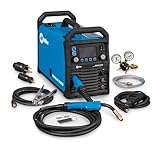
| Millermatic 211 | MIG and flux-cored | 30–230 A | 120/240 V single-phase | About 41 lb | Home shops, automotive work, general steel fabrication |
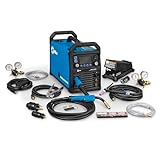
| Multimatic 220 AC/DC | MIG, flux-cored, DC TIG, AC TIG, stick | Up to 200 A on most processes | 120/240 V single-phase | About 57 lb | One machine for steel, stainless steel, aluminum, and occasional field work |
| Syncrowave 210 | AC/DC TIG and stick | 5–210 A | 120/240 V single-phase | About 52 lb | Clean, controlled welds on aluminum and thin materials |
| Bobcat 225 | Stick, DC TIG, and engine-driven MIG with accessories | 40–225 A | Gasoline engine; auxiliary generator output | Roughly 250–300 lb | Maintenance trucks, farms, gates, trailers, and remote repairs |
| Bobcat 260 | Stick, TIG, and engine-driven MIG with accessories | 40–260 A | Gasoline engine; auxiliary generator output | Roughly 500 lb in common configurations | Higher-output field welding and contractor use |
Output, weight, and included accessories can vary by revision and package, so treat the table as a shopping guide rather than a substitute for the current Miller data sheet. Duty cycle matters as much as maximum amperage: a welder rated for 200 A at a 20% duty cycle is not equivalent in production use to one rated for 200 A at 60%.
Pick Millermatic for the simplest route to MIG
A Millermatic is usually the best starting point when the work is mostly mild steel and speed matters more than maximum process flexibility. MIG uses a continuously fed wire, making it easier for many beginners to produce consistent beads than manual stick welding. Flux-cored wire extends the range to outdoor work and dirtier steel, although it creates more smoke and spatter.
The Millermatic 211 is a particularly practical small-shop choice because it can run from either 120- or 240-volt power. On a normal household circuit it is convenient for light work; on 240 V it has more usable headroom for thicker material. It suits brackets, carts, mower repairs, workbenches, tubing, and automotive fabrication.
Choose a larger Millermatic when you regularly weld heavier sections or need longer uninterrupted runs. Do not select by amperage alone. Confirm the wire-size range, maximum spool size, duty cycle, circuit requirements, and whether the package includes a regulator, gas hose, spool gun, or only the basic MIG gun.
Choose Multimatic when one machine must do several jobs
Multimatic machines target buyers who would otherwise need separate MIG, TIG, and stick welders. A model such as the Multimatic 220 AC/DC can cover MIG, flux-cored, DC TIG, AC TIG, and stick, including aluminum work when paired with the appropriate spool gun or TIG torch setup.
This flexibility has a cost. A Multimatic generally costs more than a comparable single-process MIG machine, and changing processes means changing leads, consumables, shielding gas, and settings. It is valuable when your projects change often: steel furniture one week, stainless components the next, and aluminum repair after that.
It is also a good choice for a small workshop with limited floor space. One roughly 57-pound machine can replace several boxes, but it is not automatically the best production welder. If you spend nearly every working day on MIG, a dedicated Millermatic with a larger duty cycle may provide better workflow and lower setup time.
Buy Syncrowave for controlled TIG work
Syncrowave is the Miller family to search when weld appearance, heat control, and aluminum capability matter more than fast wire deposition. AC TIG is useful for aluminum because the alternating current helps disrupt the oxide layer while the operator controls amperage with a foot pedal or hand control. DC TIG is suited to steel and stainless steel.
The Syncrowave 210 provides a compact 120/240-volt entry into AC/DC TIG. It can also perform stick welding, which is useful for outdoor repairs or thicker steel when shielding gas is impractical. Compared with a MIG setup, TIG demands more coordination: one hand controls the torch, the other feeds filler, and a pedal or remote adjusts heat.
Do not buy Syncrowave solely because it has a higher-sounding feature count. TIG also requires a proper torch, tungsten electrodes, collets, cups, filler rod, argon cylinder, regulator, and clean preparation. The machine may be the largest single cost, but the complete setup can add several hundred dollars.
Use Bobcat when the job site has no reliable outlet
Bobcat is a portable welding machine in the engine-driven sense: it carries its own gasoline engine and alternator rather than relying on a wall outlet. That makes it practical for fencing, structural repairs, farm equipment, trailers, and construction sites. It can provide welding output and auxiliary electrical power, depending on the model and configuration.
The trade-off is substantial size, noise, fuel consumption, and maintenance. A Bobcat belongs on a truck, trailer, or service body more often than on a basement workbench. It also needs engine oil, filters, spark-plug service, battery care, and periodic fuel-system attention. A compact inverter machine is much easier to move by hand, even when its amperage is similar.
Choose Bobcat 225 for general field maintenance and Bobcat 260 when higher output, heavier work, or greater auxiliary power is important. If you need wire-feed MIG in the field, budget for the compatible wire feeder, gun, cables, and shielding-gas arrangement rather than assuming the engine-driven unit is a complete MIG package.
A decision matrix for common buyers
| Your situation | Best family to search | Why | Watch for |
|---|---|---|---|
| Under about $1,500 and mostly mild steel | Millermatic | Lowest-cost path to productive MIG | Gas bottle, helmet, wire, and clamps are extra |
| Beginner who wants one machine for future projects | Multimatic | Supports several processes without buying multiple power sources | More setup complexity and higher initial price |
| Aluminum, stainless, thin sheet, or visible welds | Syncrowave | AC/DC TIG provides fine heat and arc control | Requires clean preparation and more accessories |
| Frequent remote repairs | Bobcat | Works without building power and can supply auxiliary electricity | Truck space, fuel, noise, and engine maintenance |
| Small shop with limited storage | Multimatic or compact Millermatic | Portable inverter format and reduced equipment count | Verify input voltage and extension-cord limits |
What does a Miller welding machine cost?
As a general 2026 market range, a compact Millermatic may cost about $900–$1,600, while a more capable Multimatic or AC/DC TIG package commonly falls around $2,000–$3,500. A Syncrowave package can range from roughly $2,000 to over $4,000 depending on output, accessories, and included cart. Bobcat engine-driven machines often begin around $4,000 and can exceed $7,000 in contractor-oriented configurations.
The price of a Miller welding machine is only part of the ownership cost. Add approximately $150–$400 for a basic auto-darkening helmet and personal protective equipment, $150–$350 for a regulator and first gas cylinder, and additional amounts for a cart, spool gun, TIG torch, leads, filler metal, and consumables. A $1,100 MIG package can therefore become a $1,600–$2,000 ready-to-work setup.
Ownership details that affect the buying decision
Consumables usually wear before the power source does. MIG contact tips enlarge from heat and wire friction; nozzles collect spatter; liners clog from dirty or rusty wire; and drive rolls can slip when tension is excessive or the wrong groove is installed. Keep wire covered, use the correct drive-roll profile, and replace a damaged liner instead of increasing tension indefinitely.
TIG users most often spend time on contaminated tungsten, blocked gas cups, worn collets, and poor gas coverage. Grind tungsten in the correct direction, keep the torch away from drafts, and inspect the gas hose for leaks. Stick welding is mechanically simpler, but damp electrodes can produce unstable arcs and porosity; store them as the electrode manufacturer recommends.
Before buying any Miller electric welding machine, check the circuit amperage, plug type, extension-cord length, and ventilation. A 120/240-volt welder is flexible, but its full output may require a properly installed 240-volt circuit. For engine-driven machines, plan safe exhaust ventilation, stable placement, fuel storage, and lifting or tie-down equipment.
In short, search Millermatic when MIG productivity is the priority, Multimatic when versatility and space savings justify the premium, Syncrowave when TIG precision is central, and Bobcat when independence from mains electricity outweighs portability and maintenance costs.