Our Top Picks
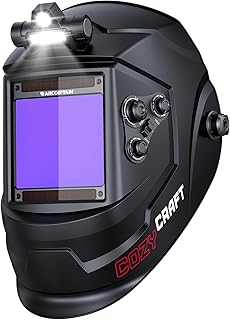
 MIGVAN Welding Helmet Auto Darkening True Color LargeAdjustable9.65 x 7.76 x 11.69 inches2.4 PoundsCheck on Amazon



What's inside
As an Amazon Associate I earn from qualifying purchases. This post may contain affiliate links at no extra cost to you.
Your eyes don’t get a second chance. A cheap or slow auto-darkening helmet that flashes you a few times a day is doing real damage over a career. We compared several; one stood out for lens speed, clarity and reliability.
Arc eye is a sunburn on the surface of your cornea. It heals in a day or two, which is exactly why people shrug it off. What does not heal as neatly is the cumulative load: the slow lens that lets a bright pulse through on every strike, the sensor that misses a low-amp TIG start, the scratched cover lens you have been squinting through for six months. None of that reads as an injury on any given day. It shows up years later as eye strain that never quite goes away and headaches by mid-afternoon. A good helmet is not a luxury purchase. It is the cheapest insurance policy in the shop.
As an Amazon Associate we earn from qualifying purchases at no extra cost to you.


What we cover
Lens reaction speed matters most
The spec that counts is switching speed — how fast the lens darkens when the arc strikes. A quality helmet reacts in a fraction of a millisecond, so you never catch a flash. Cheap ones lag, and your eyes pay.
Manufacturers quote it as a fraction of a second. Budget lenses sit at the slow end of that scale, better ones are several times faster, and past a certain point the number stops mattering because your eye cannot resolve the difference. What still matters at every price is consistency. A lens that switches fast when it is warm and on a fresh battery, but hesitates on a cold morning in an unheated shop, is not a fast lens. Check the stated operating temperature range, not just the headline speed. Lenses slow down in the cold, and that is where the cheap ones fall apart.
It is worth knowing what the flash actually is. The UV and infrared filtering in a quality lens is built into the glass and does not switch. It blocks at full strength whether the lens is light or dark. What switches is visible light. So a lagging lens is not frying your retina with UV on every strike; it is hitting you with a blast of raw brightness that causes the glare, the afterimages and the fatigue. That is not a reason to relax about switching speed. It is the reason cheap helmets leave you tired rather than blind, and the reason “I have never had arc eye from mine” is no proof a helmet is any good.
Optical clarity: read the four-digit code
Every real auto-darkening lens carries a four-number rating covering optical class, diffusion of light, variation in shade across the lens, and angle dependence. Lower is better in each position, and a straight run of ones is the top of the scale. Ignore this and you will buy a helmet that is technically dark enough and still miserable to weld in. Poor diffusion looks like a slightly dirty window that no amount of cleaning fixes. Poor angle dependence means the shade shifts as you look off to the side of the puddle, which is exactly what you do all day. If a listing will not tell you the code, that silence is the answer.
Sensors, sensitivity and delay
Two sensors is enough for open bench work where the arc is right in front of you. Four is what you want if you weld out of position, in tight corners, inside fixtures, or anywhere your own hand and the workpiece can shadow the sensors. Sensitivity sets how much light is needed to trigger the lens, and this is where low-amp TIG separates the good helmets from the rest — a very small arc simply does not put out much light. If you TIG thin material at low amperage, buy a helmet that specifically claims a low trigger threshold and adjustable sensitivity. Delay controls how long the lens stays dark after the arc stops. Short delay for rapid tacking, longer delay for heavy amps where the puddle is still glowing bright enough to hurt.
Shade range, viewing area and comfort
A variable range that covers roughly shade 8 through 13 handles essentially all arc welding, with a lighter grind or cut setting for setup work. Fixed-shade lenses are cheaper and dead reliable, but if your amperage varies you will end up running the wrong shade half the time. On viewing area, bigger genuinely means less head movement and better peripheral awareness, but marketing numbers are inflated and a big window on a poorly balanced shell puts weight out front. Try the headgear before you commit if you can. Weight, a ratchet that actually holds, and adjustable tilt and depth matter more than any spec, because an uncomfortable helmet gets flipped up — and flipping up is how people get flashed by the welder next to them.
What you actually get at each price band
- Bargain bin. Slow switching, unlisted optical class, two sensors, a sealed battery you cannot replace, and headgear that loosens as you work. Fine as a spare hanging on the wall for a visitor. Not fine as your daily helmet.
- Entry level, decent. Real switching speed, a published clarity rating, adjustable shade and sensitivity, replaceable battery. This is the floor for anyone who welds regularly, and it is where most hobbyists should land.
- Midrange. Four sensors, a genuinely large window, better clarity across the whole lens, comfortable headgear, and a shell that clears safety glasses or a respirator. The sweet spot for serious home fabricators and most working welders.
- Premium. Enhanced colour optics, wide low-amp trigger range, grind and cut modes, memory settings, replaceable parts you can still buy in five years, and support if something fails. Worth it if you are in the hood daily or doing precision TIG.
The jump from bargain bin to decent entry level buys you more eye protection than every step above it combined. Spend there first.
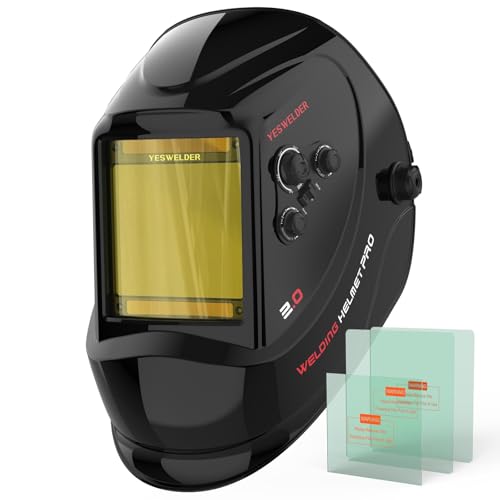
Auto-Darkening Welding Helmet
Fast lens reaction, a wide clear view, and grind mode for setup. Comfortable enough to wear all day and reliable enough that you forget it’s working — which is exactly the point.
- ✔ Ultra-fast lens reaction
- ✔ Wide, clear view
- ✔ Grind mode
- ✔ All-day comfort
- ✘ Solar top-up needed
- ✘ Bigger than a fixed-shade
Common mistakes that cost people their eyesight
- Blaming the lens for a dirty cover lens. The clear plastic in front of the filter takes the spatter and the scratches. It is consumable. Buy a stack of spares with the helmet and change them the moment the view goes hazy.
- Grinding with the cover lens off, or with no grind mode. Hot particles pit the filter permanently. Use grind mode, keep the cover in place, and never lay the helmet face down on the bench.
- Running sensitivity too low. If the lens occasionally misses a strike, people assume the helmet is broken. Usually the sensitivity is turned down or a sensor is covered in dust, tape, or a shop rag.
- Blocking the solar cell. Solar-assisted lenses need light on that panel to top up. Storing the helmet face down in a dark box for months is how you end up with a dead cell.
- Skipping the pre-weld check. Confirm the lens changes state before you start, watch for the low-battery indicator, and wipe the sensors. Ten seconds beats a week of watering eyes.
- Buying for the biggest window and nothing else. Window size is the easiest thing to advertise and the least predictive of whether a helmet is any good.
Who should buy which, and who should skip
Occasional MIG on a bench, a few hours a month: a decent entry-level variable-shade helmet is plenty, and you will not notice what a premium lens does differently. Daily production or fabrication work: go midrange or better, because comfort and headgear quality decide whether you finish the day with a headache. Low-amp TIG on thin stock: this is the one case where you should not compromise — buy for trigger sensitivity and optical clarity, or you will be welding blind on your tack-ups. Overhead, pipe, and confined-space work: four sensors, not two.
Skip the auto-darkening lens entirely only if you run the same process at the same amperage every single day and prefer a passive filter’s simplicity. And skip any helmet, at any price, whose battery cannot be replaced. That is not a helmet, it is a countdown.
Don’t cheap out here
Of all welding gear, this is the one place we tell people to spend. A reliable auto-darkening helmet protects the only eyes you get. Pair it with proper welding gloves and you’ve covered the two things that get hurt most.
Everything else in the shop can be upgraded later. A grinder that runs rough is an annoyance. A helmet that hesitates is an injury on an instalment plan. Buy the best lens you can justify, treat the cover lenses as consumables, and forget about it — which, as noted, is exactly the point.
FAQ
Can an auto-darkening lens fail and let a flash through?
Yes. A dead battery, a covered sensor, a cracked filter, or extreme cold can all cause a miss. This is why the UV and IR blocking in a quality lens is passive and always on, and why a pre-weld check matters. It is also why a helmet with a replaceable battery and a low-battery indicator is worth paying for.
What shade should I actually be running?
Higher amperage needs a darker shade, and most consumables and machine manuals include a recommended range for the process and current you are running. Start at the middle of that range and adjust one step at a time until you can see the puddle edges clearly without any glare. If you are guessing, err darker.
Will it darken for low-amp TIG?
Not all of them will. Small arcs emit little light, and cheap sensors need a lot of it. Look for an explicit low-amp trigger rating and adjustable sensitivity, and test it on scrap at your lowest working amperage before you trust it on real work.
Is an enhanced-colour lens worth the money?
It is not necessary and it is not a gimmick. Reduced green murk makes the puddle and the joint line easier to read, which helps most on long days and on precision work. If you weld occasionally, put the money into switching speed, clarity rating and comfort first.