
Our Short List of 3

- Best for: Home shop owners who want clean gas MIG welds on mild steel and a machine with a long track record.
- Input voltage: 115V AC, 20 input amps
- Output range: 30-140 amps
- Rated output: 90A at 19.5VDC
- Duty cycle: 20 percent
- Best for: Beginners and light repair work on a standard household outlet.
- Stated maximum output: 135A
- Input: 110V only
- Processes: flux-core MIG, lift TIG, stick
- Synergic MIG controls

- Best for: Portable dual-voltage welding where the machine must move between the shop and the job.
- Stated maximum output: 165A
- Input: dual voltage 110V/220V
- Processes: MIG, flux-core MIG, lift TIG, stick
- Synergic MIG controls
All 4 Picks at a Glance
| Product | Specs | Action |
|---|---|---|
| Lincoln Electric Easy MIG 140 |
| Check price on Amazon |
| YESWELDER 135A MIG Welder |
| Check price on Amazon |
| YESWELDER 165A MIG Welder |
| Check price on Amazon |
 YESWELDER 185A MIG Welder |
| Check price on Amazon |
Our Top Picks
What's inside
As an Amazon Associate I earn from qualifying purchases. This post may contain affiliate links at no extra cost to you.
A home shop welder lives or dies on one question: can it run on the outlet you already have and still make a joint you trust? A 110-volt machine plugs into a standard household circuit, yet the same wall power caps how much metal it can fuse in one pass. Buy too small and every repair turns into a fight with the breaker panel; buy a dual-voltage machine without a 240-volt outlet and the headline amperage stays out of reach. The right choice sits between those two mistakes.
This guide is for home shop owners, garage fabricators, and hobby welders who work mostly on mild steel brackets, frames, mower decks, and light fabrication. Every machine below was picked from its name and specifications on its Amazon product page, with the input voltage, output range, processes, and duty cycle taken from the listing itself. Gas MIG, flux-core, and multiprocess machines all appear, because a home shop rarely welds one kind of joint.
What we cover
Quick Picks
As an Amazon Associate we earn from qualifying purchases
| Product | Best for | Key spec from title |
|---|---|---|
| Lincoln Electric Easy MIG 140 | Clean gas MIG welds on mild steel indoors | 115V input, 30-140 amp output |
| YESWELDER 135A MIG Welder | Learning to weld on a standard household outlet | 110V flux-core MIG, lift TIG, stick 3-in-1 |
| YESWELDER 165A MIG Welder | Portable dual-voltage welding around the property | 110V/220V, 165A, 4-in-1 MIG, lift TIG, stick |
| YESWELDER 185A MIG Welder | The widest range of home shop jobs with one machine | 110V/220V, 185A, MIG, lift TIG, stick |
How to Choose
Start with the circuit, not the welder
Walk to the breaker panel before comparing machines. Most garages have 15-amp circuits shared with lights and other outlets, while a dedicated 20-amp circuit gives a 110-volt welder far more room to work. The Lincoln Easy MIG 140, for example, draws 20 input amps, so a shared 15-amp circuit will trip under load even though the machine itself is sound. A short, heavy-gauge extension cord helps when the outlet sits far from the bench, yet a long, thin cord drops voltage and makes the arc sputter. Dual-voltage machines dodge part of this problem by moving to 240 volts later, but their 110-volt output still answers to the same household circuit.
Pick the process before the brand
MIG with shielding gas gives the cleanest beads on mild steel inside a closed shop, while flux-core wire suits outdoor repairs where wind would blow gas away. Stick welding handles dirty or rusty metal better than either wire process, and lift TIG opens the door to neater work on thin material. A machine that covers three processes sounds better on paper, yet the extra modes only matter when the shop actually uses them. Someone who repairs lawn equipment outdoors gains more from flux-core capability than from a TIG mode that never leaves the box. Match the process list to the jobs already waiting on the bench, then let brand and build quality break the tie.
Read output and duty cycle together
A headline amperage number tells only half the story. The Easy MIG 140 lists 30 to 140 amps of output, but its rated output is 90 amps at 19.5 volts with a 20 percent duty cycle, which means roughly two minutes of welding in every ten before the machine needs to cool. That pattern is normal for a 110-volt welder and fine for brackets, tacks, and short beads, yet it frustrates anyone running long, continuous seams. Check the output at the thickness you weld most, not the maximum, and treat a low duty cycle as a signal to plan the work in short passes with cooling breaks built in.
Check what arrives in the box
Two machines with the same amperage can land very differently once the box opens. Some include a gas regulator and hose, others expect the buyer to source them separately, and the cylinder itself almost always comes from a local gas supplier rather than the online order. Spool gun support matters for aluminium wire, but only when the gun is actually included or available for that model. Drive rolls, contact tips, torch liners, and the ground clamp all wear out, so confirm that replacements are easy to find for the exact model. Reading the included-accessories list on the product page takes a minute and prevents a first project stalled by a missing part.
The 4 Best Options
Lincoln Electric Easy MIG 140
- Best for: Home shop owners who want clean gas MIG welds on mild steel and a machine with a long track record.
- Input voltage: 115V AC, 20 input amps
- Output range: 30-140 amps
- Rated output: 90A at 19.5VDC
- Duty cycle: 20 percent
Home shop owners who want clean gas MIG welds on mild steel and a machine with a long track record.
The gas cylinder and regulator setup is separate, so confirm the full setup before the first project.
The Easy MIG 140 is the established name in this group, a transformer machine built for gas MIG and flux-core work on light to medium steel. Its 30 to 140 amp output covers sheet metal up to a quarter inch in a single pass with gas, and the wire feed adjusts from 50 to 500 inches per minute, which gives fine control over the bead. At 62 pounds it stays put on a cart rather than travelling to the job, and the 20 percent duty cycle at 90 amps suits the short beads and tacks that fill most home shop days.
Watch out for: The gas cylinder and regulator setup is separate, so confirm the full setup before the first project.
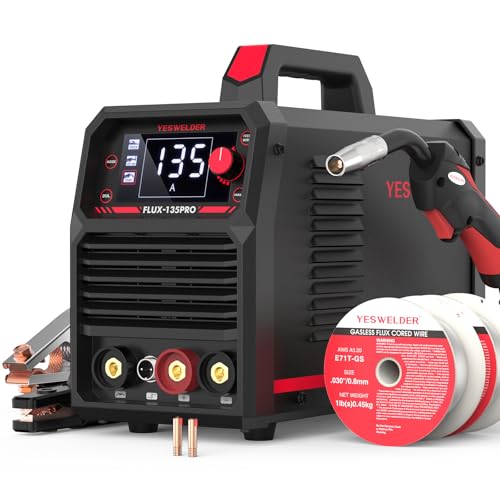
YESWELDER 135A MIG Welder
- Best for: Beginners and light repair work on a standard household outlet.
- Stated maximum output: 135A
- Input: 110V only
- Processes: flux-core MIG, lift TIG, stick
- Synergic MIG controls
Beginners and light repair work on a standard household outlet.
The 110-volt-only input limits output on thick metal, so match the machine to the material thickness you weld most.
The 135A is the lightest and simplest machine here, and the natural pick for a beginner learning on a household outlet. It offers 135 amps, three processes in flux-core MIG, lift TIG, and stick, and synergic MIG controls, all in a package that weighs 11.4 pounds. It runs on 110 volts only, so there is no outlet question to answer, and the flux-core process suits outdoor repairs where shielding gas would blow away. It will not weld thick plate like its larger siblings, but for learning, tacking, and light repair it is the easiest machine to live with.
Watch out for: The 110-volt-only input limits output on thick metal, so match the machine to the material thickness you weld most.
YESWELDER 165A MIG Welder
- Best for: Portable dual-voltage welding where the machine must move between the shop and the job.
- Stated maximum output: 165A
- Input: dual voltage 110V/220V
- Processes: MIG, flux-core MIG, lift TIG, stick
- Synergic MIG controls
Portable dual-voltage welding where the machine must move between the shop and the job.
The top output needs the higher-voltage outlet, so check the workshop supply before expecting full power.
The 165A suits a welder who wants dual-voltage flexibility in a machine that still carries easily. It offers up to 165 amps, three processes, and dual-voltage input, with synergic MIG, lift TIG start, hot start and anti-stick for stick welding, and VRD for added safety. At 18 pounds it is light enough to carry to the job, and the four-in-one design covers MIG, flux-core MIG, lift TIG, and stick without changing machines. It is the balanced choice when the 185A is more machine than the work needs and the 135A is too little.
Watch out for: The top output needs the higher-voltage outlet, so check the workshop supply before expecting full power.
YESWELDER 185A MIG Welder
- Best for: A home workshop that welds thin sheet and thicker plate with one machine.
- Stated maximum output: 185A
- Input: dual voltage 110V/220V
- Processes: MIG, lift TIG, stick
- Synergic MIG controls
A home workshop that welds thin sheet and thicker plate with one machine.
The 185-amp figure is a 240-volt figure, so confirm the workshop outlet before expecting full output.
The 185A is the strongest machine in this guide and the pick for a workshop that welds varied thicknesses. It offers 185 amps of stated output, dual-voltage input, and three processes: MIG, lift TIG, and stick. Synergic MIG controls give a starting point for wire speed, and the listing includes gas MIG for cleaner beads, flux-core MIG for outdoor work, and spool gun support for aluminium wire. On a household outlet the output is lower than the headline figure, so the full 185 amps needs the 220-volt connection, and that is the first thing to check before ordering.
Watch out for: The 185-amp figure is a 240-volt figure, so confirm the workshop outlet before expecting full output.
Which One Fits Your Situation
You weld thin sheet and small brackets indoors
Choose the Lincoln Electric Easy MIG 140. Gas MIG keeps the beads clean on sheet metal and light brackets, and the 50 to 500 inch-per-minute wire feed range makes it easy to dial in a gentle arc that will not burn through. The machine stays on a cart in the shop, which suits a fixed indoor bench far better than a portable unit.
You are learning on a standard household outlet
Choose the YESWELDER 135A. Its 110-volt-only input removes the outlet question entirely, the 11.4-pound weight makes it easy to set up and put away, and flux-core wire forgives the breezy conditions of a driveway repair. Synergic controls give a beginner a sensible starting point for wire speed instead of a blank guess.
You move the welder between the shop and the job
Choose the YESWELDER 165A. At 18 pounds it carries with one hand, and the dual-voltage input means it runs on the household outlet today and a 220-volt outlet when the work grows. Four processes in one case cover a fence repair in the morning and a shop bracket in the afternoon without swapping machines.
You want one machine for steel, thicker plate, and aluminium wire
Choose the YESWELDER 185A. It is the only pick here with spool gun support for aluminium wire, and its 185-amp ceiling gives the most headroom for thicker plate once a 220-volt outlet is available. Gas MIG handles the tidy indoor work while flux-core covers the jobs that happen outside the shop doors.
Common Mistakes
- Plugging a 20-amp welder into a shared 15-amp circuit and blaming the machine when the breaker trips.
- Judging a welder by its maximum amperage while ignoring the duty cycle at the output you actually use.
- Ordering a gas MIG welder without arranging a cylinder, regulator, and hose first.
- Choosing a dual-voltage machine for its headline output while the shop has no 240-volt outlet.
- Welding galvanized or coated steel without removing the coating and ventilating the area.
Frequently Asked Questions
Can a 110V welder weld 1/4-inch steel?
It can, with the right setup and expectations. The Lincoln Easy MIG 140 lists a quarter inch in a single pass with gas on mild steel, yet a single pass at the top of the range leaves little margin. Bevel the joint, clean the metal, and use multiple passes for a stronger result. Structural, vehicle-safety, lifting, or pressure work calls for the right process, equipment, and inspection rather than a hobby machine pushed to its limit.
Do I need shielding gas for a home shop welder?
Gas gives cleaner beads with less spatter and slag on mild steel indoors, which is why the Easy MIG 140 and the larger YESWELDER machines support it. Flux-core wire needs no cylinder and handles wind better, so it suits outdoor repairs and occasional use. Machines that support both let the shop switch by the job, but the cylinder, regulator, and hose are usually separate purchases.
Will a 110V welder run on any household outlet?
It plugs into a standard 120-volt outlet, but the circuit behind it matters. A dedicated 20-amp circuit is preferable, because a shared 15-amp circuit can trip at higher settings, especially when lights or other tools share the line. Keep extension cords short and heavy-gauge, since a long, thin cord causes voltage drop and an unstable arc.
Can one machine really handle MIG, TIG, and stick?
Yes, within the limits of a 110-volt supply. The YESWELDER machines in this guide list MIG, lift TIG, and stick in one case, and the lift TIG start avoids scratching the tungsten to strike the arc. No single compact machine matches a dedicated TIG welder for fine control, and the full output still depends on the outlet, so read the output table for each process before planning a demanding job.
Related guides
More from Amazon
Programs that pair well with the guide above. Offers and eligibility are set by Amazon and may change.
A free business account with business pricing and bulk-buying tools for work, shop or home office.
Create a business accountFree shipping on eligible items, Prime Video and more. Eligible new members can start with a free trial.
Start a Prime free trialAudiobooks and podcasts to listen to on the go. Eligible new members can start with a free trial.
Try Audible freeAd-free music streaming. Eligible new subscribers can start with a free trial.
Try Music Unlimited freeAs an Amazon Associate we earn from qualifying purchases.







Write Your Review
No reviews yet. Be the first to share your experience!