
Key takeaways
- Find the best RV vent fan for your rig with 14-inch roof picks covering reversible airflow, rain protection, low power draw, and simple manual controls.
What's inside
As an Amazon Associate I earn from qualifying purchases. This post may contain affiliate links at no extra cost to you.
As an Amazon Associate we earn from qualifying purchases.
A parked RV heats up fast. Sun on the roof, cooking steam, shower humidity, and gear stored inside after a day in the workshop all push hot, stale air into a small space. A good roof vent fan pulls that heat and moisture out through the ceiling, draws fresh air in through a cracked window, and keeps the cabin comfortable without running air conditioning.
Most RVs already have the hard part done: a standard 14 by 14 inch roof opening, with 12-volt power nearby. Every fan here fits that cutout. The differences are airflow, rain handling, speeds, power draw, and controls. We compare five proven options, from a fully automatic flagship to a simple single-speed fan.
Disclosure: This post contains affiliate links. If you buy through links on this page, we may earn a commission at no extra cost to you.
What we cover
Quick picks
- Best overall: MAXXAIR MaxxFan Deluxe 00-07500K — 10 speeds, reversible, thermostat, remote, built-in rain cover.
- Best simplicity: Fan-Tastic Vent 1200 Create-A-Breeze — 3 speeds, manual crank lid.
- Best with a light: Hike Crew 14-inch with LED Light — 3 speeds, complete install kit.
- Best low draw: Leisure Coachworks 14-inch — 1 speed in and out, very low wattage.
- Best airflow: Starvent 14-inch — 6 speeds, reversible, built-in rain shield.
MAXXAIR MaxxFan Deluxe Vent Fan (00-07500K)

The MaxxFan Deluxe is the fan most full-timers recommend, and our take is that the reason is the lid. Instead of a plain dome that must close in rain, it builds the rain cover into the vent itself, so it can run through a shower and even while driving. You also get 10 speeds in both directions, a thermostat, a remote for lid, speed, and direction, and a ceiling fan mode that circulates air with the lid closed. The insect screen pops out without tools for cleaning. Practical notes from owners stress strong airflow and quiet low speeds for sleeping.
Specs
- Fits: 14 x 14 inch roof opening
- Speeds: 10, reversible intake and exhaust
- Controls: Remote, thermostat, on-unit controls
- Lid: Smoke, built-in rain cover
- Power: 12 volts DC
- ASIN: B002OW5JG2
Pros:
– Runs in rain and while moving
– Quiet low speeds for overnight use
– Remote and thermostat add convenience
Cons:
– Larger housing than basic vents
– More electronics than a crank fan
Fan-Tastic Vent 1200 Create-A-Breeze RV Roof Vent

Fan-Tastic Vent helped define this category, and the 1200 is its straightforward model: a 3-speed fan with a manual crank lid, no remote, and no rain sensor. That simplicity is the point for smaller trailers and workshop-hauler conversions — fewer electronic parts, and controls anyone can understand. It is light for a powered vent, seals tightly when closed, runs on standard 12-volt wiring, and has served as original equipment for decades, so parts are easy to source. Choose it for dependable air over a bathroom or galley if you will add a separate cover for rain use.
Specs
- Fits: Standard roof opening, 14-inch class
- Speeds: 3, manual control
- Lid: Manual crank, smoke dome
- Power: 12 volts DC, 5 watts listed
- Weight: 9.99 pounds
- OEM part number: 801200
- ASIN: B0027XAN78
Pros:
– Proven design, widely available parts
– Light weight for one-person roof work
– No remote to lose
Cons:
– No rain sensor or powered lid
– Only 3 speeds
Hike Crew 14-inch RV Roof Vent Fan with LED Light
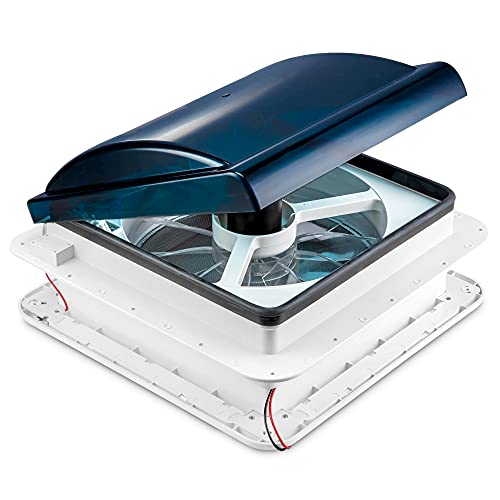
Hike Crew adds a feature campers want in bathrooms and small trailers: light. This model combines a 3-speed intake and exhaust fan with an LED light, a smoked lid, and manual open and close. Screws and an interior garnish are included, making it a tidy one-box replacement for a brittle old vent or a plain vent needing a powered upgrade. Airflow is listed at 706 cubic feet per minute, plenty for shower steam or cooking odors in a compact cabin. Our take: a practical middle path, more capable than a bare vent and less complex than a fully automatic fan.
Specs
- Fits: 14 x 14 inch roof opening
- Speeds: 3, intake and exhaust
- Airflow: 706 cubic feet per minute
- Power: 12 volts DC, 40 watts
- Blades: 10
- Extras: LED light, screws and garnish included
- ASIN: B0949VJFXV
Pros:
– Light helps over a bath or galley
– Complete kit in the box
– Solid airflow for small cabins
Cons:
– Manual lid, no rain sensor
– Higher wattage than low-draw models
Leisure Coachworks 14-inch RV Roof Vent Fan

This fan is built around restraint: one speed for air in, one for air out, a manual riser for the smoked lid, and a simple 2-wire hookup. Listed power use is about 5 watts, which matters if you boondock on a modest battery bank, run small solar, or leave a fan turning for hours to keep a stored trailer fresh. With 10 blades and a listed 530 cubic feet per minute, it still moves meaningful air for a bathroom, bunk area, or small camper. Practical notes praise how quiet and undemanding it is. Pick it when battery life and simplicity matter more than speed choices.
Specs
- Fits: 14 x 14 inch roof opening
- Speeds: 1 in, 1 out, reversible
- Airflow: 530 cubic feet per minute
- Power: 12 volts DC, about 5 watts
- Blades: 10
- Lid: Smoked, manual riser
- ASIN: B08SG67FX3
Pros:
– Very low draw for solar setups
– Simple wiring and controls
– Quiet for long run times
Cons:
– Single speed, no fine control
– Lid must be closed by hand in rain
Starvent RV Roof Vent Fan, 14-inch, 6-Speed Reversible

Starvent aims at buyers who want strong airflow and rain protection without a fully automatic flagship. Its 14-inch model lists 1,100 cubic feet per minute, the highest figure here, from a 6-speed reversible fan. Push-button controls handle speed and direction, the fan ramps gradually rather than jolting on, and clear blades let daylight through under the smoked dome. A built-in rain shield protects the opening, and ceiling fan mode circulates air with the vent closed. It suits larger trailers and motorhomes where one vent must clear a bigger volume.
Specs
- Fits: 14 x 14 inch roof opening
- Speeds: 6, reversible
- Airflow: 1,100 cubic feet per minute
- Power: 12 volts DC, 22.2 watts
- Blades: 10
- Noise: 56 decibels listed
- Model: Starfan Basic A031C
- ASIN: B0CYSWV1VK
Pros:
– Highest listed airflow here
– Rain shield and closed-lid circulation
– Six speeds without needing a remote
Cons:
– Louder on high than low-draw fans
– No automatic rain sensor
How to choose
Start with the opening and wiring. Measure before ordering. Almost every fan here fits a 14 by 14 inch opening, but roof thickness, garnish depth, and whether 12-volt power reaches the vent vary. A powered bathroom vent may already be wired; a passive vent may need a short run from a nearby light circuit. Plan on fresh butyl tape and self-leveling sealant for the flange.
Next, decide on rain handling. A built-in cover or shield, as on the MaxxFan Deluxe and Starvent, lets the fan work in wet weather. A sensor on some automatic models closes the lid when wet, but ventilation stops while closed. A plain manual dome works if someone is present to close it. For stored RVs or changeable weather, built-in protection is worth prioritizing.
Then match airflow and power to cabin and battery. A small camper or bathroom does well with 500 to 700 cubic feet per minute; a large living area benefits from 900 or more. More airflow usually means more wattage and noise on high. If you boondock, check low-speed draw, not just the maximum. Finally, weigh controls: a remote helps over a bed or in a tall motorhome, while crank or push-button controls suit a low ceiling and never get lost.
FAQs
Can I replace a plain roof vent with a powered fan myself?
Usually, yes, if the opening is standard and 12-volt power is nearby. Remove the old garnish and sealant, set the new flange in butyl tape, drive the screws, seal the flange, and connect two wires. Test the fan before the seal cures. If wiring must run far or the roof is damaged, call a mobile technician.
Should the fan blow in or out most of the time?
Use exhaust as the default. Run the fan outward to remove heat and humidity, and open a shaded window to supply replacement air. Switch to intake on cool evenings to pull air down over a bed, or use closed-lid circulation, where fitted, to even out temperature.
How do I stop a new vent fan from leaking?
Leaks come from the flange, not the fan. Remove all old sealant, clean the roof, bed the flange in butyl tape, tighten screws evenly, and cover screw heads and the flange edge with sealant suited to your roof material. Recheck after the first trips and each season.
Do I need a separate vent cover over these fans?
Not always. Models with a built-in cover or shield ventilate in rain without one. With a plain manual dome, an add-on cover lets you leave the vent open in wet weather and protects the lid from hail and sun. Check added height against garage limits first.
Conclusion
For most owners, the MAXXAIR MaxxFan Deluxe is the easiest pick: strong reversible airflow, rain handling without closing, and remote thermostat control. For proven simplicity, choose the Fan-Tastic Vent 1200; for a light and complete kit, the Hike Crew. Pick the Leisure Coachworks for low draw and long run times, and the Starvent for the strongest listed airflow with a rain shield. Measure, confirm wiring, seal carefully, and any of these five will keep your RV cooler and drier.
Related guides
More from Amazon
Programs that pair well with the guide above. Offers and eligibility are set by Amazon and may change.
A free business account with business pricing and bulk-buying tools for work, shop or home office.
Create a business accountFree shipping on eligible items, Prime Video and more. Eligible new members can start with a free trial.
Start a Prime free trialAudiobooks and podcasts to listen to on the go. Eligible new members can start with a free trial.
Try Audible freeAd-free music streaming. Eligible new subscribers can start with a free trial.
Try Music Unlimited freeAs an Amazon Associate we earn from qualifying purchases.


Write Your Review
No reviews yet. Be the first to share your experience!