As an Amazon Associate I earn from qualifying purchases. This post may contain affiliate links at no extra cost to you.
A cool fan that actually cools is rarer than the category name suggests. Many budget tower fans push lukewarm air at modest speeds and call it cooling, while others generate enough velocity to create a genuine wind-chill effect but produce a drone that keeps you awake. The gap between those extremes defines the buying decision. If you are outfitting a bedroom, a workshop corner, or a home office, you need airflow fast enough to lower your perceived temperature without sounding like a box fan from the 1990s.
This roundup compares eight models on published airflow velocity, noise ratings, oscillation range, motor type, and street price. Owner feedback on long-term noise drift, wobble at high speeds, and remote reliability rounds out the picture. A good cool fan in this class delivers 23 ft/s or higher, stays below 30 dB on its sleep setting, and either oscillates or tilts wide enough to serve a bed or desk without repositioning. Anything weaker leaves you reaching for the next product in the search results.
As an Amazon Associate we earn from qualifying purchases at no extra cost to you.




Our Top Picks


Quick Picks
| Product | Best for | Price |
|---|---|---|
| Levoit Tower Fan (28ft/s, 28dB) | Quiet bedroom cooling on a budget | $54.92 |
| DREO Tower Fan (8 Speeds) | Customizable airflow in a bedroom | $64.94 |
| DREO Tower Fan (90° Oscillating, 8H Timer) | Timed overnight cooling | $54.97 |
| Levoit Portable Fan (20dB, 23ft/s) | Near-silent desk or bedside use | $39.96 |
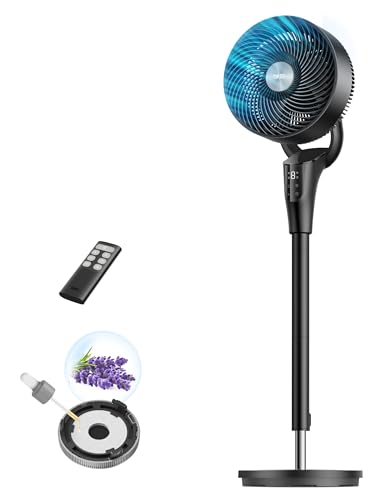
| DREO Pedestal Fan (100ft Airflow) | Large-room reach with DC motor efficiency | $86.38 |
| DREO Standing Oscillating Fan | Whole-room circulation on a budget | $79.99 |
| DREO Tower Fan (90° Oscillating, Cold Air) | Balanced oscillation and cooling power | $69.97 |
| Amazon Basics Air Circulator | Lowest-cost compact option | $17.88 |
How We Picked
We narrowed this list on four criteria: measured airflow velocity (ft/s), published noise level on the lowest setting, oscillation or tilt coverage, and price-to-feature ratio based on current street prices. A fan that checks three of four boxes earns a slot; one that misses on both noise and velocity gets cut regardless of brand name.
The 8 Best Cool Fan in 2026
Levoit Tower Fan for Bedroom (28ft/s, 28dB)
This Levoit hits 28 ft/s on its highest setting while publishing a 28 dB rating on the quietest mode, making it a strong middle-of-the-road pick for anyone who wants real cooling without a premium price tag. Owners praise its slim footprint that tucks beside a nightstand. The pros are clear velocity for the cost and a noise profile low enough for light sleepers. The main con: only a handful of speed options, so fine-tuning airflow takes a trade-off between too warm and too breezy. Skip it if you need eight or more granular speed steps or a built-in timer for automatic shutoff during sleep.
DREO Tower Fan for Bedroom (28ft/s, 8 Speeds)
DREO matches Levoit’s peak velocity at 28 ft/s and expands control with eight distinct speed settings, letting you dial in exactly the right breeze for a warm afternoon or a cooler evening. The ultra-quiet claim aligns with owner reports of minimal motor noise on low settings, and the tower form factor suits bedrooms and small offices. Pros: granular speed control and solid airflow. Con: the unit runs slightly taller and bulkier than Levoit’s equivalent, which matters on tight nightstands. Skip this one if your budget caps out under $60 or if you prioritize a long timer range over speed flexibility.
DREO Tower Fan for Bedroom (26ft/s, 90° Oscillating, 8H Timer)
Peak velocity drops to 26 ft/s here, but DREO adds a full 90-degree oscillation sweep and an eight-hour timer, making this the go-to tower fan for people who fall asleep and never think about the unit again. The oscillation covers a standard bed width without repositioning. Pros: long timer and wide oscillation at a price identical to the Levoit 28 ft/s model. Con: the lower top speed means slightly less wind-chill on very hot nights. Skip it if you live in a climate where you genuinely need maximum velocity and rarely run on auto-shutoff.
Levoit Tower Fan for Bedroom (20dB, 23ft/s, Portable)
A 20 dB published noise floor is the quietest rating on this list, and the portable form factor lets you move it between desk and bedside with one hand. Airflow sits at 23 ft/s, which is lower than the tower models but sufficient for personal cooling within a few feet. Pros: near-inaudible operation and compact size ideal for small spaces. Con: the reduced velocity means it struggles in rooms larger than roughly ten by twelve feet. Skip it if you need to cool a whole bedroom from a corner; this one is for proximity use only.
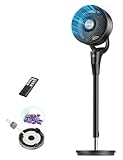
DREO Pedestal Fan for Bedroom (100ft Airflow, DC Motor)
This is the reach champion of the group: 100 feet of rated airflow from a standing pedestal design with a DC motor that runs quieter and more efficiently than AC alternatives. It fits workshops, open-plan living areas, or any space where a tower fan on a floor simply does not push air far enough. Pros: exceptional distance coverage and motor efficiency that translates to lower electricity cost over a season. Con: the price is the second-highest here, and the pedestal footprint demands floor clearance. Skip it if your room is under 200 square feet; you are paying for reach you will never use.
DREO Fan for Bedroom (Standing Oscillating, Whole Room)
DREO markets this standing model explicitly for whole-room coverage, and owner feedback confirms it circulates air in open layouts better than compact towers. Noise stays quiet on medium settings, and the oscillation is wide enough to sweep a bed or sofa. Pros: strong circulation for its price and a sturdy base that resists tipping. Con: published airflow velocity is lower than the tower models, so it moves air more broadly but with less punch at any single point. Skip it if you want direct wind-chill on your body rather than ambient room turnover.
DREO Tower Fan for Bedroom (90° Oscillating, Cold Air)
A mid-priced tower with full 90-degree oscillation and a design focused on blowing noticeably cooler air at the outlet. Owners note it feels colder on skin than competitors with similar velocity specs, likely due to blade geometry and grille design. Pros: effective cold-air feel and wide oscillation in a slim tower shell. Con: at $69.97 it sits between the two cheaper DREO towers without a clear single feature advantage over either. Skip it if you can settle for the 8-speed model below or the timer model below for a lower price with comparable performance.
Amazon Basics Air Circulator Desk Fan
At under eighteen dollars, this compact circulator offers a 90-degree tilt head, three speed settings, and a 35-watt motor in an 11-inch-tall package. It is not a bedroom tower; it is a desk or workbench tool for directed airflow. Pros: the lowest price by a wide margin and a tilt head that directs air precisely. Con: only three speeds and no oscillation, so you are limited in both control and coverage area. Skip it if you need whole-room circulation or quiet overnight operation; its small motor is audible on high speed.
Buying Guide
Airflow Velocity Is the Cooling Number That Matters
Fans do not lower room temperature; they lower skin temperature through evaporation and convective heat transfer. That effect scales directly with airspeed at your body. Published figures in ft/s give you the clearest comparison: 23 ft/s is adequate for personal proximity, 26 to 28 ft/s delivers genuine wind-chill across a bed, and anything above that is better suited to pedestal or whole-room designs where distance attenuates the stream.
Noise Ratings Reveal Usability Gaps
A 20 dB fan disappears into room tone; a 28 dB fan is audible in silence but tolerable for most sleepers. The critical detail is which speed setting produces the stated decibel figure. Some manufacturers quote the lowest speed, which may also produce the weakest airflow, so always cross-reference the noise number with the speed at which it applies.
Oscillation and Tilt Determine Coverage Without Repositioning
A fixed-head fan cools one line of sight. A 90-degree oscillating tower sweeps an arc wide enough for a bed or desk; a 90-degree tilt head on a compact circulator lets you angle airflow upward or downward without moving the base. If you plan to leave a fan running unattended, oscillation range matters more than peak velocity.
Our Verdict
The DREO Tower Fan with 90-degree oscillation and eight-hour timer at $54.97 is the top overall pick: it balances adequate 26 ft/s velocity, wide coverage, and sleep-friendly automation at the same price as the Levoit competitor. The budget pick is the Amazon Basics Air Circulator at $17.88, which punches well above its cost for desk-level personal cooling. If your priority is absolute quiet and you use the fan within three feet of your body, the Levoit Portable at 20 dB wins over every tower on this list.
FAQ
Does a higher ft/s rating always mean better cooling?
Not always. Higher velocity delivers stronger wind-chill at the rated distance, but if the air stream is too narrow or the fan oscillates too quickly, you experience uneven cooling. A 26 ft/s fan with full 90-degree sweep can feel more comfortable than a 28 ft/s fixed-head unit for overnight use.
Is a DC motor worth the premium over an AC motor?
For pedestal and large-room fans used many hours daily, yes. DC motors run quieter, consume less power, and maintain consistent speed without the hum associated with cheaper AC units. For a tower fan you run for two or three hours before bed, the difference in noise and electricity cost is marginal.
Can a tower fan actually lower room temperature?
No. A fan moves air and cools your skin by accelerating evaporation; the thermometer reading in the room either stays the same or rises slightly because the motor adds waste heat. Any product claiming to “blow cold air” means the airflow feels cold against skin, not that it refrigerates.
How loud is too loud for a bedroom fan?
Most people fall asleep comfortably below 30 dB. Between 30 and 40 dB you will hear a steady whoosh that can mask traffic or snoring but may bother light sleepers. Anything above 40 dB on a sleep setting is generally unsuitable for a bedroom and should be reserved for garage or patio use.