What's inside
- Best low-cost welders by situation
- Head-to-head comparison of budget-friendly options
- Flux-core versus MIG: where the low-cost MIG welder wins
- Why voltage flexibility matters more than peak amperage
- When a low cost TIG welder makes sense
- Controls and accessories that help beginners
- A simple ownership-cost calculation
- Durability and repairability: what wears first
- Final buying decision
- Best low-cost welders by situation
- Head-to-head comparison of budget-friendly options
- Flux-core versus MIG: where the low-cost MIG welder wins
- Why voltage flexibility matters more than peak amperage
- When a low cost TIG welder makes sense
- Controls and accessories that help beginners
- A simple ownership-cost calculation
- Durability and repairability: what wears first
- Final buying decision
As an Amazon Associate I earn from qualifying purchases. This post may contain affiliate links at no extra cost to you.
The best low cost welder for most home users is a 120-volt flux-core or MIG machine with a published duty cycle, replaceable torch and ground leads, and enough output for the material you actually plan to weld—not simply the machine with the highest advertised amperage.
For occasional repairs, a basic flux-core unit costing roughly $150–$300 is usually the lowest-cost sensible choice. A 120/240-volt MIG machine in the $400–$800 range is a better long-term purchase if you weld regularly, want cleaner beads, or need to work on material thicker than about 1/4 inch. TIG capability is useful for thin stainless steel and aluminum, but an inexpensive TIG machine is rarely the cheapest way to begin welding.
As an Amazon Associate we earn from qualifying purchases at no extra cost to you.

What we cover
- Best low-cost welders by situation
- Head-to-head comparison of budget-friendly options
- Flux-core versus MIG: where the low-cost MIG welder wins
- Why voltage flexibility matters more than peak amperage
- When a low cost TIG welder makes sense
- Controls and accessories that help beginners
- A simple ownership-cost calculation
- Durability and repairability: what wears first
- Final buying decision
Best low-cost welders by situation
| Situation | Best machine type | Practical choice | Typical market range |
|---|---|---|---|
| Small repairs and occasional mild steel | 120-volt flux-core | Forney Easy Weld 140 FC-i or a comparable 125–140 amp unit | $150–$300 |
| Cleaner indoor welding with room for gas | 120-volt MIG | Hobart Handler 140 or Lincoln Electric POWER MIG 140 MP | $450–$700 |
| One machine for several processes | 120/240-volt multiprocess | Lincoln Electric POWER MIG 180 MP or a comparable 180–200 amp inverter | $700–$1,100 |
| Thin stainless, delicate fabrication, or weld appearance | DC TIG with high-frequency start | A budget 160–200 amp TIG inverter with a usable pedal option | $350–$800 |
Prices are broad market ranges rather than fixed prices. Included accessories and regional electrical requirements can change the real cost substantially.
Head-to-head comparison of budget-friendly options
| Welder or category | Input | Advertised output class | Published duty-cycle example | Included process and useful accessories | Ownership concern |
|---|---|---|---|---|---|
| Forney Easy Weld 140 FC-i | 120 V | 140 A | About 25% at 90 A, depending on version and rating standard | Flux-core torch, work lead, clamp, and starter consumables | Flux-core wire and spatter cleanup add recurring cost |
| Hobart Handler 140 | 120 V | 140 A | 20% at 90 A | MIG/flux-core capability, regulator and hose commonly included | Needs a gas cylinder, regulator care, and suitable wire for best results |
| Lincoln Electric POWER MIG 140 MP | 120 V | 140 A | 20% at 90 A | MIG, flux-core, stick, and spool-gun-ready multiprocess design | More controls and accessories cost more than a flux-core-only unit |
| Lincoln Electric POWER MIG 180 MP | 120/230 V | 180 A | About 30% at 130 A, depending on rating and configuration | MIG, flux-core, stick, and TIG functions with better voltage flexibility | Higher purchase price and a 230-volt circuit may be needed |
| Budget DC TIG inverter | 120/240 V on many models | 160–200 A | Typically 20–60% at rated or midrange output | Torch and ground lead; gas regulator and pedal vary widely | Tungsten, cups, collets, gas, and filler rod are additional costs |
Duty cycle is the percentage of a 10-minute period a machine can weld at a stated amperage before requiring a cooling period. A machine rated at 20% at 90 amps can weld for two minutes and then needs eight minutes of cooling at that output. Ratings at lower amperage can be much more useful for home projects than a maximum-amp figure.
Flux-core versus MIG: where the low-cost MIG welder wins
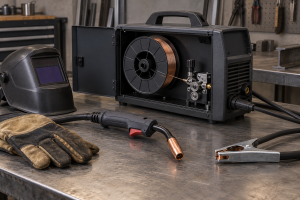
A flux-core welder is usually the cheapest entry point because it does not require a shielding-gas cylinder, regulator, or gas hose. It is suitable for outdoor repairs, brackets, gates, lawn equipment, and ordinary mild steel. The trade-offs are more smoke, slag, spatter, and sensitivity to wire polarity and wind.
A gas-shielded MIG machine is the better choice for thin sheet, indoor fabrication, and cleaner-looking work. Solid ER70S-6 wire in 0.023-inch or 0.030-inch diameter generally gives easier control than large flux-core wire. However, the initial setup may add $150–$300 for a cylinder, regulator, gas, and fittings. Gas also blows away outdoors, so MIG is not automatically superior for field repairs.
For many buyers searching for the best low cost MIG welder, a 120-volt model such as the Hobart Handler 140 or POWER MIG 140 MP is a safer purchase than an anonymous machine claiming extreme amperage. They have clearer setup information, conventional consumables, and better prospects for finding replacement leads or service information.
Why voltage flexibility matters more than peak amperage
A 120-volt machine is convenient because it can run from a normal household outlet, but its input current limits sustained output. A 120/240-volt machine can deliver more stable power at higher amperage when connected to a suitable 240-volt circuit. That matters when welding 1/4-inch plate, using larger wire, or making long structural welds.
Voltage flexibility also helps prevent a common buying mistake: paying for a 200-amp label while using a machine that can only produce that output briefly, or only on 240 volts. Check the manual for required breaker size, input current, minimum generator capacity, and output at each voltage.
When a low cost TIG welder makes sense
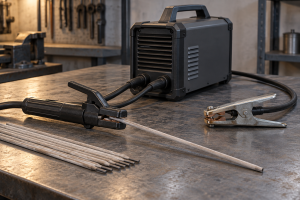
A low cost TIG welder is worthwhile when control and appearance matter more than speed. DC TIG works well on mild steel and stainless steel, especially thin material, but it does not weld aluminum unless the machine provides AC output. A machine advertised as “TIG capable” may only offer lift-start TIG, a torch without a gas valve, or no foot pedal. Those limitations can make it unsuitable for learning precise TIG technique.
Before choosing a budget TIG inverter, confirm that it includes or supports a standard torch, flow-controlled regulator, foot pedal or amperage control, high-frequency start, post-flow adjustment, and replacement collets. A $400 machine that requires another $150 in missing equipment may cost more than a better-equipped $500 machine.
Controls and accessories that help beginners
- Inductance or arc-control adjustment: helps tune bead wetting and arc smoothness, although simple voltage and wire-speed controls are easier to learn first.
- Polarity diagrams: essential when changing between solid wire and self-shielded flux-core wire.
- Euro-style or replaceable torch connections: make future torch replacement less expensive than a permanently wired lead.
- Standard contact tips: 0.023, 0.030, and 0.035-inch tips are inexpensive and widely available.
- A proper regulator and hose: more important than a decorative accessory kit if the machine will run MIG.
- Thermal protection: prevents damage when a beginner exceeds the duty cycle, but it does not eliminate the need to let the machine cool.
Be cautious with packages that advertise a helmet, brush, gloves, and a tiny spool of wire as major value. Those items may be useful, but a reliable ground clamp, flexible torch, clear manual, and accessible consumables have greater long-term value.
A simple ownership-cost calculation
Suppose a flux-core machine costs $220 and uses a $15 spool of 0.035-inch wire. If one 2-pound spool produces approximately 60 minutes of actual arc time, the wire costs about $0.25 per arc minute. Add roughly $0.05–$0.15 per minute for contact tips, nozzles, and occasional liner replacement, depending on technique.
A MIG setup costing $550 may add $220 for a regulator, cylinder deposit or purchase, and initial gas and wire. If gas-shielded wire reduces cleanup and makes each project 20 minutes faster, the extra cost can become worthwhile for frequent indoor work. For five small repairs a year, flux-core is usually cheaper; for weekly fabrication, the cleaner MIG process can be the better value.
Durability and repairability: what wears first
On inexpensive welders, the first replaceable parts to wear are usually contact tips, nozzles, drive rollers, liners, torch triggers, and ground-clamp jaws. Keep the wire path clean, use the correct drive-roll groove, and do not drag the torch through spatter. A blocked nozzle can disrupt gas coverage and imitate a machine fault.
Inspect the liner when wire feeding becomes erratic, especially after using a long or sharply bent torch lead. Replace a liner rather than increasing drive-roll pressure until the wire is crushed. Clean the fan intake regularly and keep the machine off dusty floors. Never bypass thermal protection or use an undersized extension cord; voltage drop can produce poor arc performance and overheated wiring.
Final buying decision
Choose a basic 120-volt flux-core unit if your budget is below $300, your work is occasional, and outdoor repairs are common. Choose a conventional 120-volt MIG welder if you value clean indoor welds and can budget for gas. Choose a 120/240-volt multiprocess machine if you expect to weld regularly, want a longer service life, or may move into thicker material. Choose a TIG inverter only when its controls, torch equipment, and AC/DC specification match the metals you intend to weld.
The best low cost welder is therefore the one with honest duty-cycle ratings, standard consumables, usable accessories, and enough electrical capacity for your projects. A modest machine from an established manufacturer can deliver more reliable results—and lower ownership costs—than a higher-amperage bargain with unclear ratings and unavailable replacement parts.