What's inside
As an Amazon Associate I earn from qualifying purchases. This post may contain affiliate links at no extra cost to you.
What we cover
Best Fiber Laser Engraver for Guns: Buyers Guide and Reviews
For most lawful firearm marking, a 30–50 W enclosed fiber laser with a 110 × 110 mm lens, a compatible rotary, and clear interlock and exhaust provisions is the best starting point; choose an open-frame machine only if you have a controlled workspace and can provide equivalent guarding.
The right fiber laser engraver for guns depends less on headline wattage than on the parts you need to mark, how they fit under the lens, and whether the machine can repeat a clean result on steel or aluminum. Treat the recommendations below as equipment-selection guidance, not instructions for altering a firearm. Before work, confirm that the marking is lawful, that you are authorized to perform it, and that the firearm is unloaded and handled according to applicable safety rules. For regulated identification marks, check the exact requirements with the relevant authority or a qualified professional.
As an Amazon Associate we earn from qualifying purchases at no extra cost to you.


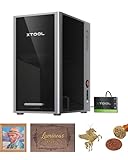
Quick comparison: enclosed versus open-frame
Specifications vary by configuration, lens, and seller. The figures below are common planning ranges, not guarantees; verify the actual work area, machine dimensions, and safety features on the model being offered.
| Configuration | Typical marking field | Typical source power | Rotary fit | Best suited to |
|---|---|---|---|---|
| Enclosed galvo fiber, compact lens | 70 × 70 to 110 × 110 mm | 20–50 W | Often, if the enclosure has sufficient clearance | Small parts, frequent use, and a dedicated indoor workspace |
| Enclosed galvo fiber, larger lens | 150 × 150 to 200 × 200 mm | 30–60 W | Possible, but check door and height clearance | Larger flat components and fewer repositioning steps |
| Open-frame galvo fiber | Typically 70 × 70 to 200 × 200 mm, by lens | 20–60 W | Usually easier to arrange, but not automatically safer | Experienced operators with a properly guarded work cell |
| Enclosed MOPA fiber configuration | Often 110 × 110 to 200 × 200 mm | Typically 20–60 W | Depends on enclosure and fixture | Operators who need more pulse control across varied finishes |
Power alone does not tell you whether a machine will produce the desired appearance. Lens choice affects field size and detail; the material’s alloy, coating, and finish affect the result. A fiber laser is generally a more appropriate starting point for bare metals than a typical CO₂ engraver, but test samples made from the same material and finish are still essential.
Shortlist by situation
- New operator or shared workshop: Favor an enclosed unit with a documented laser classification, functioning door interlock, emergency stop, and a clear operating manual. A smaller field is usually a reasonable trade for straightforward guarding.
- Small parts and limited bench space: Look at a compact 20–30 W enclosed galvo system with a 70 or 110 mm lens. Confirm the usable internal height before purchasing fixtures.
- Regular mixed-metal work: A 30–50 W enclosed fiber system is a practical middle ground. A MOPA source may offer additional control over pulse parameters, but it adds cost and does not remove the need for material-specific qualification.
- Long or cylindrical components: Consider a rotary-compatible system, but check whether the rotary can be installed while the enclosure remains closed and interlocks remain active. If it cannot, the setup may not meet your safety requirements.
- High-volume production: Prioritize service support, replacement-part availability, repeatable fixtures, and documented process control over a small increase in rated power.
What matters for firearm-related work
Field size, focus, and precision
The advertised field is the maximum area under a particular lens—not necessarily the area available once a fixture or rotary is installed. A 110 × 110 mm field suits many small, flat components, while a larger lens can reduce repositioning for broader work. Larger fields may trade some detail or energy density for coverage, so compare the manufacturer’s stated spot size and resolution at the actual lens you plan to use.
For precision on steel and aluminum, ask the supplier for sample results on comparable alloys and finishes. Bare steel, anodized aluminum, coated parts, and polished surfaces can respond differently. A visible mark is not automatically a durable or compliant mark; where a marking must meet a legal specification, verify legibility, dimensions, location, and permanence with the responsible authority or a qualified marking provider.
Rotary compatibility and workholding
A rotary attachment helps present cylindrical surfaces consistently, but “rotary compatible” can mean only that the controller has a rotary setting. Ask whether the machine includes the correct cable and software support, what diameter and weight the rotary accepts, and how much vertical clearance remains. For small components, a rigid fixture can be more useful than a rotary: it controls position and makes repeat jobs easier to inspect.
Software and controls
Confirm which controller and software are included, what file formats they accept, and whether the license is perpetual or subscription-based. Common systems in this category include EZCAD-based controls and LightBurn for supported configurations, but compatibility depends on the controller and machine—not just the laser source. Request a written compatibility confirmation before buying. Useful controls include a visible job boundary or preview, parameter presets, and a way to save and identify approved job files.
Enclosure, exhaust, and compliance
An enclosure should be more than a cover: look for appropriate laser-rated viewing protection, interlocks that stop emission when opened, an emergency stop, and manufacturer documentation identifying the machine’s laser classification. Ask about local exhaust requirements and filtration; marking coatings can produce hazardous fumes, and indoor recirculation should not be assumed safe. Open-frame machines need a properly engineered guarded area, access controls, and suitable eyewear matched to the source wavelength and optical density. Follow the machine manual and local workplace rules.
For lawful firearm work, do not assume that a machine seller’s phrase such as “firearm ready” establishes legal compliance. Rules differ by jurisdiction and by the kind of marking or service involved. Verify licensing, recordkeeping, marking specifications, and who may perform the work before buying equipment or accepting a job.
Budget and ownership: what the listing may not show
As broad market ranges, entry-level enclosed systems commonly run from roughly $2,000 to $5,000, while better-supported or higher-spec enclosed configurations can range from about $5,000 to $12,000 or more. Open-frame systems may cost less, but guarding, extraction, fixtures, and training can erase that apparent saving. These are planning ranges, not current quotations; configurations and service packages vary substantially.
Budget for a rotary if needed, extraction equipment, suitable fixtures, sample material, and installation. The source itself is not the only ownership cost: protective windows can become contaminated, lens surfaces can be damaged by careless cleaning, and fans or filters require maintenance according to their manuals. Keep optics covered when idle, use only the specified cleaning method, and inspect the enclosure and interlocks routinely. A dirty protective window, loose fixture, or incorrect focus can cause inconsistent results or damage—do not compensate by changing settings blindly.
Bottom line
For most buyers seeking a fiber laser engraving machine for guns, an enclosed 30–50 W galvo fiber system with a 110 × 110 mm lens is the balanced choice, provided its rotary arrangement, software, documentation, and safety controls match the intended work. Choose a compact 20–30 W unit for occasional small-part marking; consider a larger field or MOPA configuration when a documented production need justifies it. An open-frame fiber laser gun engraving setup is best reserved for a controlled, professionally guarded workspace. Get written answers on usable field, rotary clearance, material samples, software compatibility, and compliance documentation before placing an order.